In a huge effort to tackle the country’s waste problem, 42 million discarded tyres will be recycled, making space for the creation of an eco-friendly residential city.
When anything unnatural can easily be spotted from space, that’s when you know it’s become a real problem.
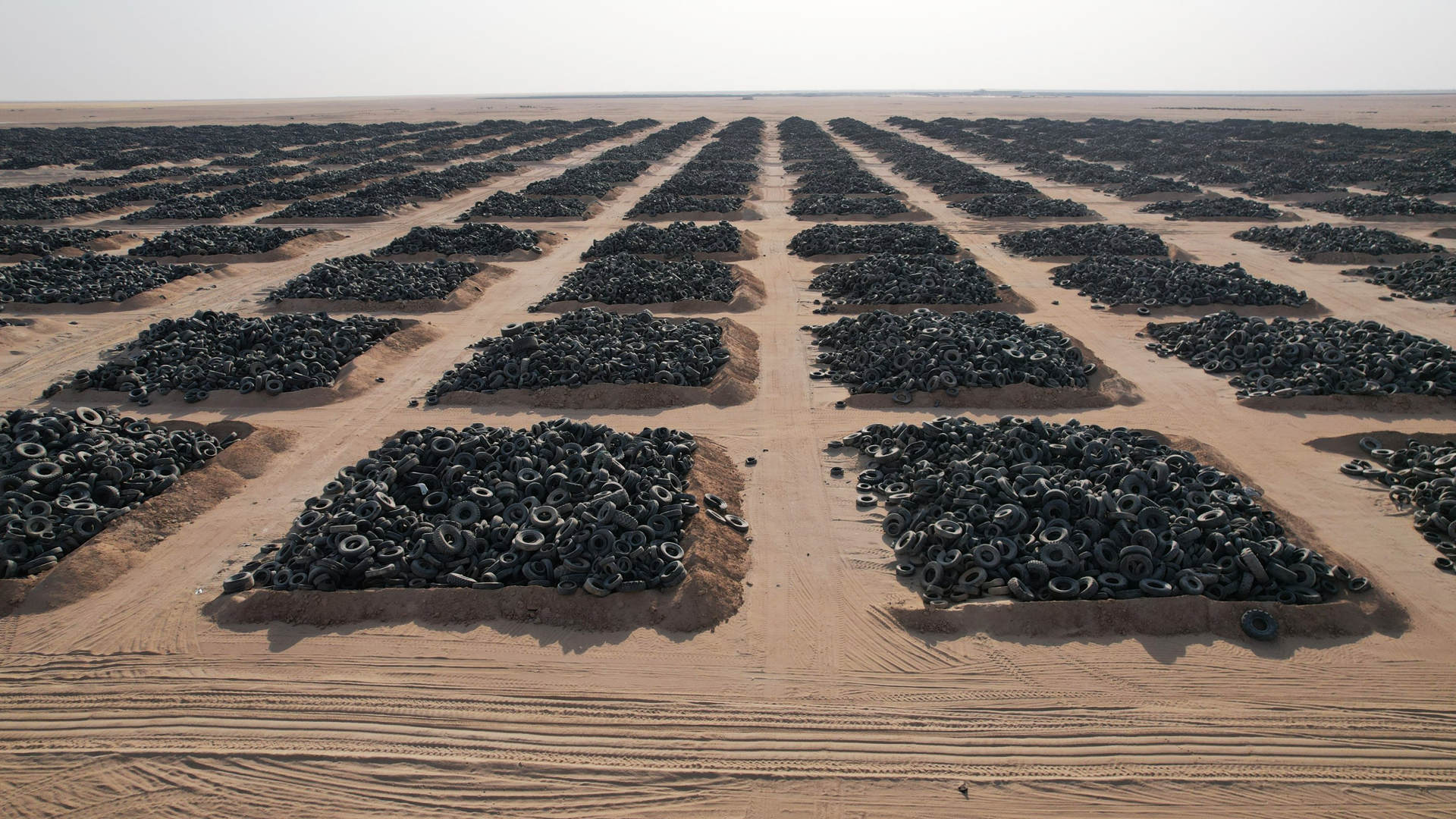
This became the case when over the course of seventeen years, an area spanning 2 square kilometres became a primary dumping ground for old automobile tyres in Kuwait – a site so big, it could be captured by satellites.
Described as a ‘tyre graveyard’ neighbouring closely to a residential suburb, the site would often catch fire, emitting noxious black smoke that wafted into surrounding areas – causing concerns about potential health and environmental risks.
After months of brainstorming for a solution, Kuwait has taken action to rid the space of tyres for good. It recently completed a massive clean-up of the dumpsite and has since announced plans to use the land to build a completely new city.
I thought you might ask! In a mammoth-like relocation project, 500 trucks were used to make 44,000 trips from the landfill, carrying tyres to a facility near the Saudi border called al-Salmi.
Not long ago, in January 2021, a recycling facility was opened in al-Salmi by EPSCO Global General Trading. This facility alone has the capacity to recycle an estimated three million tyres annually.
Here, Kuwait’s old tyres will be shredded by employees and the remaining rubbery particles will be pressed into soft tiles. These tiles can be used as indoor gym flooring or outdoor playgrounds, both locally or as exports.
Being sure to use as much of the discarded rubber as possible, other raw materials from the tyres will be extracted and utilised for paving roads and sidewalks.
With plans to open more recycling factories already in the works, the government hopes that al-Salmi will become a hub for speeding up sustainability, in particular for the safe repurposing of old, otherwise pollutant tyres.
With the dumpsite finally cleared, Kuwait’s government has announced exciting plans to build the Middle East’s first ‘smart city’ in line with international environmental standards.
Called Saad Al-Abdullah city, it will be comprised of 30,000 new housing units and has sustainable technology at the core of its creation.
The project bases itself on incorporating new technologies as much possible and makes the assumption that all residents will be in possession of a smartphone or smart device.
The project outline reads: ‘The idea of this environment-friendly smart city is based on the city’s dependence on modern technology through connecting its services and roads by an Internet network, which will make it easy for them to use all services of the city more efficiently and with less effort.’
The development of Saad Al-Abdullah city is estimated to cost £2.8 billion over the course of its 30-year completion.
Kuwait’s Oil Minister Mohammed al-Fares has recognised the need for a stronger efforts towards environmentalism in the Middle East. In regard to future plans, he said: ‘we have moved from a difficult stage that was characterised by great environmental risk.’
His vision for the future is to create a ‘greener’ region that reduces its dependency on the oil industry, and instead become an international hub for tourism and trade.
These changes won’t happen overnight, but it’s still amazing to see one of the world’s most oil-rich regions making efforts to become more sustainable and environmentally conscious.
Deputy Editor & Content Partnership ManagerLondon, UK
I’m Jessica (She/Her). I’m the Deputy Editor & Content Partnership Manager at Thred. Originally from the island of Bermuda, I specialise in writing about ocean health and marine conservation, but you can also find me delving into pop culture, health and wellness, plus sustainability in the beauty and fashion industries. Follow me on Twitter, LinkedIn and drop me some ideas/feedback via email.
Actor Jason Bateman recently caught heat for telling Charli XCX she might change her opinion on not wanting kids. Why are we still inferring that happily coupled, child-free women are unfulfilled?
I’d like to think we’ve made some strides in the motherhood conversation – and to some extent we have. But I still feel the tail winds of disappointment when I tell my elders there’ll be no children on the...
The ongoing Winter Olympic Games have seen many acts of defiance against the Trump administration. How will the situation play out when the US hosts in 2028?
When Baron Pierre de Coubertin revived the Olympics in 1896, one of his main aims was to promote mutual understanding among athletes. He believed that competing on the track instead of the battlefield could encourage peace and help prevent war.
However, countless...
Anxiety, depression, and emotional problems are on the rise across the globe, cutting across boundaries of culture, geography, and socio-economic status. The World Health Organisation says ‘one in seven’ have a mental health disorder in 2026.
According to the World Health Organisation, ‘one in seven adolescents worldwide has a mental health disorder.’ Such statistics obviously cannot be ignored.
This generation of teens is the first to be raised in an...
Why has the precedent that ‘British culture is dying’ invaded every aspect of our lives recently? From TikTok commentary to culture-war politics, who is really influencing the supposed shift in British culture?
Claims that Muslims and BAME communities are erasing British culture have become a popular rhetoric in recent political spheres in the UK, but also around the Global North as a whole. Popular, but not new.
Here's my take...
We use cookies to ensure that we give you the best experience on our website. If you continue to use this site we will assume that you are happy with it.
































 0 comments