Though watching our favourite celebrities venture into motherhood is both exciting and weirdly humanising, can sensationalising their pregnancies be damaging?
Society has had a fascination with Hollywood couples for as long as celebrities have existed, but where our adoration really takes hold is when they’re expecting a child together.
In recent months many beloved icons have coupled up, gotten engaged, or made the decision to become parents. Kravis (Kourtney & Travis), MegGK (Megan Fox & MGK), and Rihanna and A$AP Rocky immediately come to mind.
Gracing our social media feeds with public displays of affection and revelations of their unique (and outright weird) relationship dynamics, many have anticipated that these love-crazed couples would be popping out kids in no time.
The resurgence of post-pandemic award shows and red-carpet events has only added to this craze, providing the couples with a healthy number of photo opportunities and other candid content for our Instagram explore pages.
So when a female celebrity stands beside her man looking a little more voluptuous than normal, you can bet the internet will cause their name to trend beside ‘PREGNANT?’ in about 3.5 seconds. But can this behaviour be damaging? And is it even our business at all?
People ask if kourtney kardashian is pregnant every few months bc she posts pics where her belly looks like a normal persons belly and people wonder why eating disorders exist. Mind ya business bitch
Despite having never been pregnant myself, I can say with all confidence that pregnancy – for most women – is a highly personal experience.
Though partners facilitate the process of creation, it’s the woman who first feels a fluctuation in hormones, day-to-day changes to their body, and eventually, the first kick or wiggle of a soon-to-be-born child.
And while pregnancy has historically been perceived as a beautiful miracle of a journey, it is one that we’ve become more comfortable with acknowledging as a time potentially ruled by anxiety over physical and mental health concerns.
According to health professionals, miscarriage is a lot more common than most people realise. It’s estimated that 1 in 8 known pregnancies will end in miscarriage, 80 percent of which occur in the first trimester where crucial development occurs.
So while a positive pregnancy test may be tough to keep secret, new parents are advised to make the announcement only after the 12-week mark. This is, of course, assuming that getting pregnant was an uncomplicated process to begin with.
In America, 7.3 million women between the ages of 15-44 have already undergone fertility treatments. In 2019, it was reported that 55,000 women gave birth to babies conceived through reproductive technologies – a figure that is expected to climb as Gen-Z and Millennials start families later.
The public’s fascination with celebrity pregnancies
The media’s obsession with women’s bodies doesn’t stop at sexualising them for clicks or financial gain. It also includes scrutinising noticeable changes to their weight or pointing out a possible baby bump.
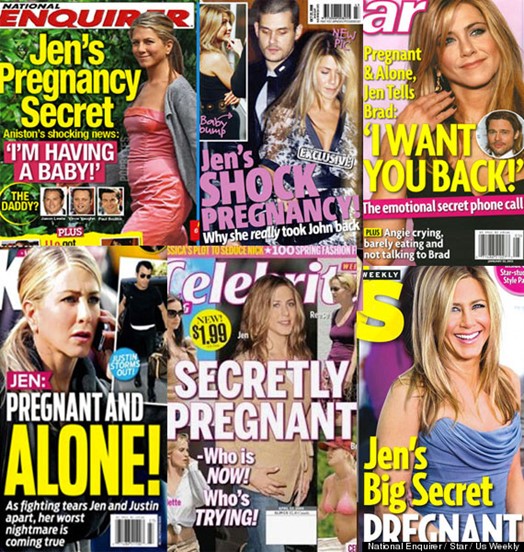
These tactics are as old as media frenzies themselves – and they’ve persisted today, regardless of never having made any real impact. As you can see above, Jennifer Aniston has been deemed pregnant by tabloids endlessly, even though she’s said she ‘is not in pursuit of motherhood’ by choice.
In 2008, Mariah Carey appeared on The Ellen Show just days after tabloids began claiming the ‘We Belong Together’ singer was expecting. Ellen asked whether the rumours were true and proceeded to pop a bottle of champagne to see if Mariah would drink or not.
After playing coy and denying the rumours, Ellen asked her to ‘prove it’ by handing a full glass to an apprehensive Mariah, whose obvious fake sip caused the audience to roar with laughter.
Weeks later, Mariah revealed that she had miscarried, saying ‘it took [her] to a dark place’ and that she found it weird that she was forced to discuss her pregnancy publicly in the first place.
A ploy to create media hype resulted in an all-around awful situation where Ellen had robbed Mariah of the choice to announce her pregnancy on her own terms – had it have been successful.
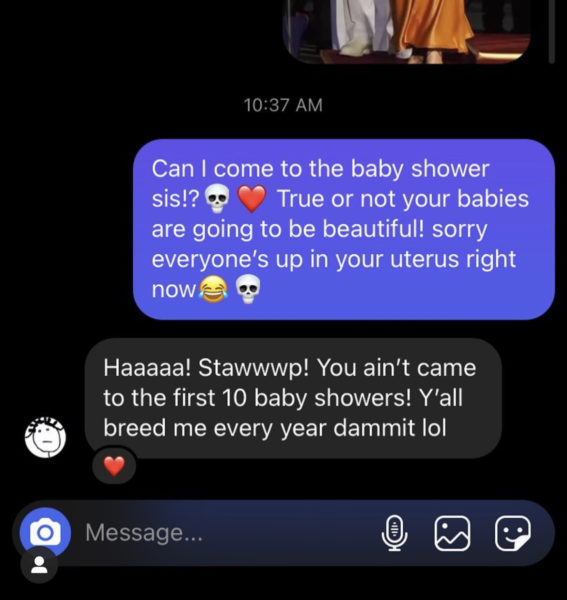
Back in December, Rihanna shut down pregnancy rumours after a fan slid into the Instagram DMs to ask if a baby-BadgalRiri was on the way, to which she replied ‘Stawwwp!!! Ya’ll breed me every year dammit lol’.
Though fan speculations turned out to be correct, Rihanna – according to my totally precise calculations – must’ve been somewhere within the first trimester of her pregnancy where it’s still too early to tell anyone.
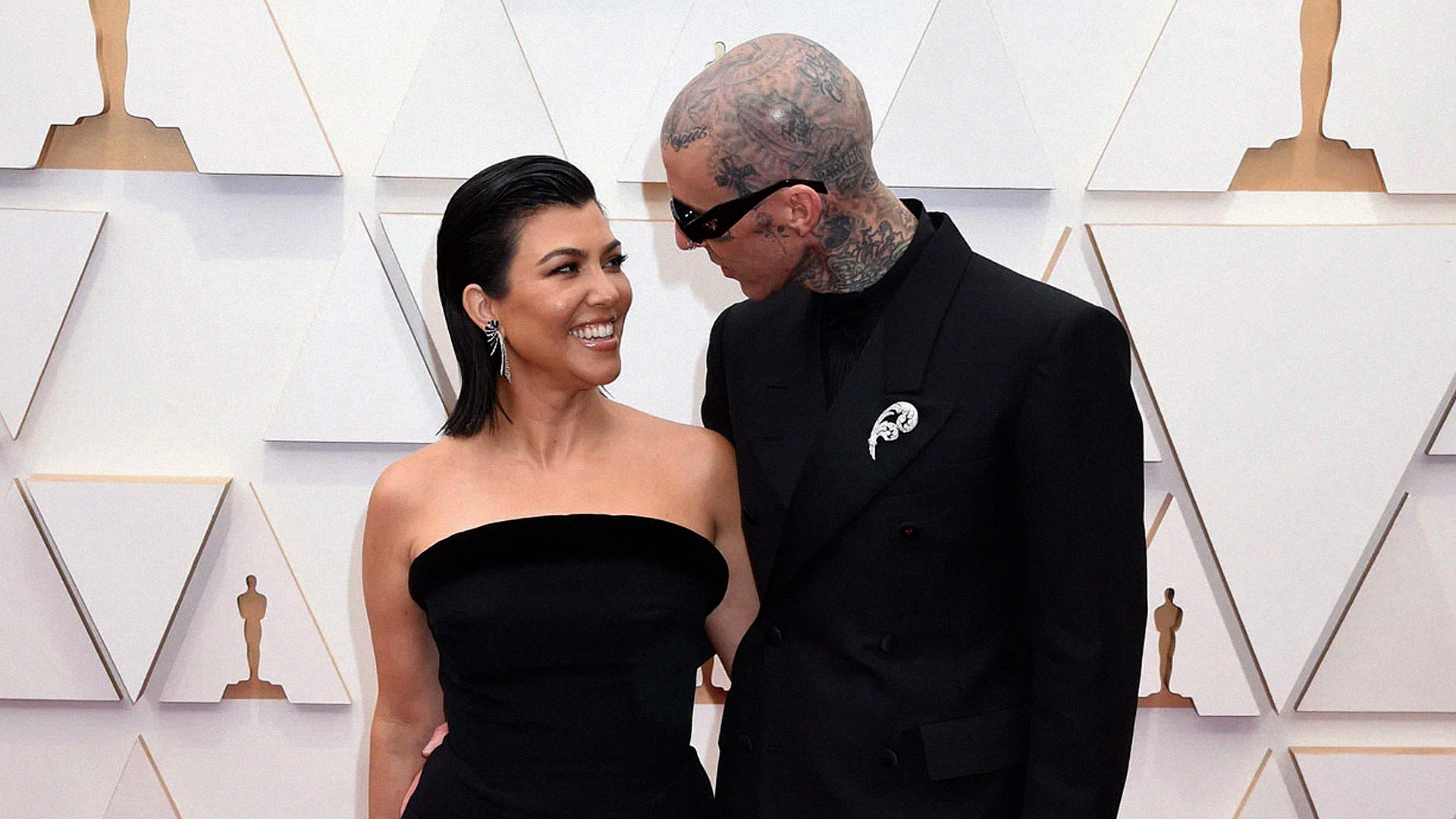
Making more recent headlines has been Kourtney Kardashian, who was captured in public and at the Oscar’s event looking different than normal.
Kourtney has admitted to utilising IVF to try for another baby with her new beau, stating that ‘it hasn’t been the most amazing experience.’ Yet her curvier figure has brought on a cocktail of body-shaming and pregnancy speculations online.
When IVF is a tricky process known to cause weight gain, emotional changes, and increased appetite (amongst loads of other side effects), perhaps we shouldn’t automatically assume what is an already stressful process has been completed.
On another note, when a normal sized belly is visible in Hollywood, why is our first thought ‘she’s pregnant!’ and not ‘good for her, she’s enjoying life a bit more’?
Insecure star Issa Rae encapsulated this perfectly, when she was seen looking thiccer on a friend’s Instagram story. Fans instantly questioned whether she was pregnant, but the star was quick to shut them down on Twitter with a rather admirable use of 280 characters.
With all of these examples to hand, it’s understandable that many celebrities have started keeping their pregnancies hidden for as long as possible.
It’s bad enough to be bloated from a couple heavy lunches and have people criticising your weight on the red carpet, let alone being pregnant and have every decision and fashion choice monitored by audiences across the globe.
Awareness that having a baby can be a personal (and sometimes difficult) process for anyone, perhaps we should learn to back off with these kinds of narratives pertaining to changes to any woman’s body.
Celebrities share pretty much every part of their lives with the public, don’t they at least deserve this one thing?
Deputy Editor & Content Partnership ManagerLondon, UK
I’m Jessica (She/Her). I’m the Deputy Editor & Content Partnership Manager at Thred. Originally from the island of Bermuda, I specialise in writing about ocean health and marine conservation, but you can also find me delving into pop culture, health and wellness, plus sustainability in the beauty and fashion industries. Follow me on Twitter, LinkedIn and drop me some ideas/feedback via email.
The new judge is dismantling diet culture with big bites and no nonsense. We need more of this on TV, now more than ever.
I’ve always loved Nigella Lawson. I’m a fellow foodie, I’m a writer – which means I’ve devoured her written recipes as fervently as the dishes themselves – and I’m also a woman. Nigella has always represented the essence of womanhood in my eyes. She’s confident and unapologetic...
Gen Z subscribes to everything from music and films to software and storage, paying endlessly for things we never actually own. As ownership is increasingly replaced by access, are subscriptions making life more convenient - or creating a generation that pays forever and owns nothing?
There was once a revolutionary economic model called buying something.
You handed over money, gold, or whatever the currency was. Someone gave you the purchased item....
Recruiters are debating on TikTok whether it’s okay to bring iced coffee into a job interview, highlighting discrepancies in professional standards between different generations and industries.
Would you bring iced coffee into a job interview?
A debate has been underway on social media this week as Gen Zers and older professionals consider whether it’s ‘inappropriate’ or an unnecessary restriction that makes new, potential employees uneasy.
It began when TikToker @caitlinrecruiter uploaded...
From Substack to explainer TikToks, everyone’s craving thought-provoking content. But is our hankering for brain food a reaction to AI or evidence of a deeper desire for fulfillment in the modern age?
What is a ‘thinkfluencer’? Consider them the talking head in your pocket: a bastion of knowledge on often niche topics, sharing facts and figures with the help of a teeny tiny handheld mic. These types of influencers have...
We use cookies to ensure that we give you the best experience on our website. If you continue to use this site we will assume that you are happy with it.






























 0 comments