Pakistan is one of the very few countries in the world to offer the death penalty for blasphemy. Being a highly controversial issue, will the state be able to curb the misuse or amend the provisions of the law?
You’d be forgiven for thinking blasphemy laws are archaic, forgotten technicalities of the past, but the reality is rather different in Pakistan.
But what is more astonishing is the mob culture that these legislations have given rise to.
In November 2021, a mob torched a police station in Charsadda for refusing to hand over a man accused of desecrating the Holy Quran. Later, in December that year, Priyanka Kumara, a Sri Lankan national living in Pakistan, was lynched to death and his body was burned for allegedly committing blasphemy.
In Pakistan, mobs can kill anyone and torch any building or entire neighborhood merely on allegations or rumors of blasphemy. Today, it is in Chrasadda. https://t.co/R0heAj1AAQ
In light of this violence, let’s look at how these laws came to be and why they have had such a profound impact on the population.
How did the blasphemy laws originate?
In 1927, the British introduced Section 295(a) on blasphemy to British India’s Penal Code in an effort to prevent tensions between Hindus and Muslims.
When Pakistan and India were partitioned in 1947, the former’s Penal Code was still rooted in the Indian Penal Code, which means that this blasphemy law was carried on.
Between 1927 and 1986, there were fewer than 10 blasphemy cases. But there was a sudden shift in these numbers; the National Commission for Justice and Peace (NCJP) states that a total of 776 Muslims, 505 Ahmadis, 229 Christians, and 30 Hindus have been charged between 1987 and 2018.
At the time, Zia ul-Haq- known for his hard-line Islamist ideology- was the dictatorial President of Pakistan. And during his reign, Section 295(b) and 295(c) was added to the Penal Code.
Section 295(b) prescribes imprisonment or fine for anyone from the minority Ahmadiyya community who acts like a Muslim (for example, if they refer to their place of worship as ‘masjid’ or ‘mosque’)
In 1990, the Federal Shariat Court included the option of punishment by death and stated that the National Assembly could take action against this by 30th April 1991 if they wished to remove this penalty.
Even so, the National Assembly failed to take action, automatically making the death penalty a legal punishment in this case.
‘Whoever by words, either spoken or written, or by visible representation or by any imputation, innuendo, or insinuation, directly or indirectly, defiles the sacred name of the Holy Prophet Muhammad (peace be upon him) shall be punished with death, or imprisonment for life, and shall also be liable to fine.’
The controversy surrounding blasphemy laws
In 1993, the Masih case grew in popularity; what happened was that Salamat Masih (11), Manzoor Masih (38), and Rehmat Masih (44) were charged for allegedly writing blasphemous comments on the walls of a mosque. This was despite Salamat Masih’s mother arguing that her son was illiterate.
While Manzoor Masih was killed outside a courthouse in 1994, the other two were sentenced to death the following year.
However, in February 1995, the Lahore High Court acquitted the both of them on the grounds that as Christians, they would not be familiar with Arabic. Just two years later, one of the Justices assigned to this case, Justice Arif Iqbal Bhatti was assassinated in his chambers.
Yet, in the past, such extrajudicial killings have also been committed by public officials; for instance, Samuel Mashih, a Christian, was charged for defiling a mosque by spitting on its wall, and was killed in police custody using a hammer.
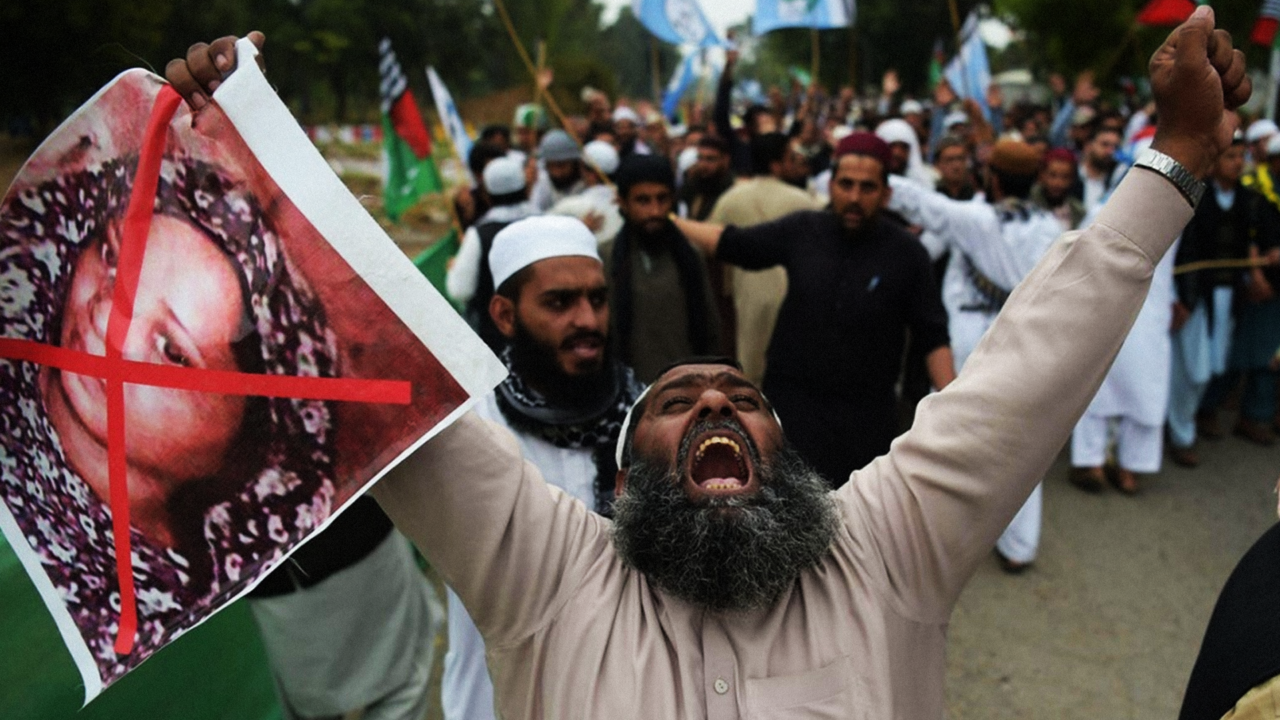
Apart from these landmark cases, one trial that occupied centre stage in Pakistan’s blasphemy debates was that of Asia Bibi. Her story goes something like this; Asia Bibi, as many other women in her village, was a labourer. Once, she was asked to fetch a jug of water from the well for her co-workers, and happened to drink from it on her way back.
When they find out about this, they blamed her for contaminating the water, seeing her as impure due to her faith in Christianity. This was followed by an intense argument between both sides.
After five days the police stormed her house and hauled her outside, claiming that she had insulted Prophet Mohammed (PBUH). Present outside was a mob including the village cleric, who thrashed her in front of the police.
In 2010, she was sentenced to death and spent almost a decade in solitary confinement.
In an interview to the BBC, Asia Bibi’s husband said, ‘If a loved one is dead, the heart heals after some time. But when a mother is alive, and she gets separated from her children, the way Asia was taken away from us, the agony is endless,’
Salman Taseer, then Governor of Punjab, decided to visit her in prison along with the media and openly criticised the law. His fierce campaigning for Asia led to his assassination by his own bodyguard in 2011. Only a month later, Religious Minorities Minister Shahbaz Bhatti was also shot dead for speaking up against the law.
In fact, when Salman Taseer’s bodyguard was executed in 2016, a crowd of about 30,000 people turned out for his funeral.
Regardless, Asia Bibi’s death sentence was overturned by the Supreme Court in 2018 and she is now free, living in Canada.
Evidently, blasphemy laws are not something that cannot be amended easily in Pakistan, given the public sentiments surrounding it. Still, this does leave room for averting the misuse of it.
With judges having been killed for acquitting innocent persons, politicians being assassinated for speaking up against these provisions, and minorities as well as some Muslims being accused to settle personal scores, one could only hope that the government of Pakistan takes a strong stance against mob violence and promote fair judicial proceedings.
Less 20-somethings are getting married today than ever. As Gen Z ditches wedding rings, it begs the question: what has changed?
There’s little I love more than the sweet sound of an orchestra playing a doting love song, as a couple makes it down the aisle, ready to make the ultimate commitment and say: ‘I do’. Yet nowadays, it seems like my generation is more inclined to say ‘I don't’...
Companies in the Global North are increasingly purchasing carbon credits to offset their emissions, while projects across Africa are encouraging farmers to adopt climate friendly practices that can generate those credits.
The process is theoretically simple. Farmers plant trees or adopt other practices that help to sequester carbon dioxide directly from the atmosphere. This is then measured and sold to companies as credits to help them offset their own impact...
Staff and students at the University of Kent were devastated by a fatal outbreak of meningitis last week, which left two people dead and more than 10 hospitalised.
The incident has thrown a community into chaos, as students begin to worry about those they’ve come into contact with and University staff try to manage the outbreak. Hundreds of young people have since begun queuing for antibiotics, while in-person exams...
A recent move by the UK government may alter the educational routes of thousands of young people in the Global South, especially those from areas experiencing conflict.
Recently, the Home Secretary, Shabana Mahmood, announced a plan by the British government to stop issuing study visas to students from various countries in the Global South. These include Cameroon, Sudan, Myanmar, and Afghanistan. If everything goes as planned, the policy...
We use cookies to ensure that we give you the best experience on our website. If you continue to use this site we will assume that you are happy with it.
































 0 comments