A globally accessible database that documents the lives of animals and geographical structures could go live as early as next year. The collection of real-time data will inform experts on species’ behavioural changes and environmental shifts.
Biologists, ecologists, and conservationists alike are concerned with the health of our planet and all life within it. So why doesn’t a comprehensive, living database exist to assist their work?
One might argue that previously published research papers can be pieced together to illustrate notable trends and changes. That’s true, but aside from consulting other researchers’ work, there is a sparse foundation to support independent nature studies and observations which are, not to mention, tediously developed over long periods of time.
This gap is what German ornithologist Martin Wikelski hoped to fill when he got the idea to create an ‘Internet of Animals’ back in 2001. His idea was to create a tracker to satellite-based project called ICARUS (International Cooperation for Animal Research Using Space).
This democratised database would stand as a digital, living hub that delivers data about sensor-wearing wildlife and unique environments. It would reveal the lives and patterns of the planet’s ‘non-human worlds’, including various wildlife, mountains, and glaciers.
While the idea may seem simple (why hasn’t anyone thought of that before?!) making it a reality hasn’t been a smooth journey, despite Wikelski’s best efforts. He thought he’d be able to get it up and running by 2005, but twenty years on, it’s only now becoming a reality.
What will ICARUS – or the Internet of Animals – look like?
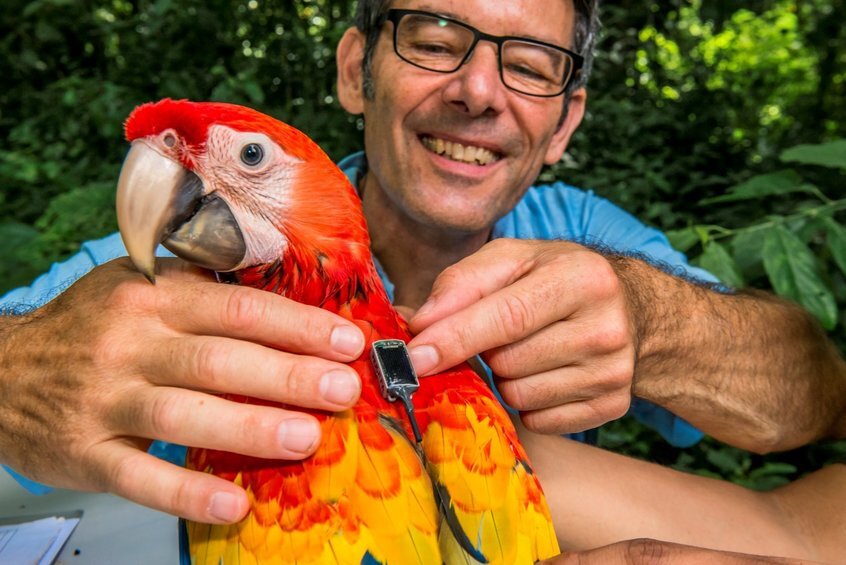
To gather data for the Internet of Animals, tiny solar-powered tracking devices are attached to a breadth of living organisms and natural landscapes including glaciers and ocean plastic. Some of these devices weigh even less than a paper clip.
The tags track thousands of animals to uncover how their experiences link to broader global changes such as environmental shifts, variables that lead to species decline or migration, and much more.
Transmitting the data to space satellites, these inexpensive and easy to deploy trackers will paint a detailed picture of the ongoings of various animals and environments around the world. It will help scientists develop a rich understanding of trends and patterns, as well as what is driving global change.
The benefit of using trackers lies in the real-time updates and timelines they offer. Scientists won’t have to rely solely on observations they make while out in nature doing field research, they’ll be able to consult a database to understand where the animals are or will be.
In fact, the project was already providing this service before facing challenges caused by geopolitical tensions.
ICARUS’ series of starts and stops
If all goes to plan, five low-cost satellites carrying ICARUS receivers will be launched into space via a private rocket next year. This won’t be the first attempt to get the project (literally) off the ground, though.
Back in 2018, the project’s team launched a receiver destined for the International Space Station on a rocket from Kazakhstan. Upon its arrival, Russian space experts attached the receiver to its orbiting lab.
A successful launch meant the Internet of Animals was in action for a short time in the springtime of 2020, but mechanical complications at the Russian space lab caused signals to drop out for almost a full year.
In 2021, the system was back up and running again, tracking 3,500 animals around the globe. Once again, the signal was short-lived. Russia’s invasion of Ukraine caused the West to slash ties with Russia, resulting in all data transmission from ICARUS going dead.
After numerous let-downs, conversations with private launch companies, and lots of innovation, the team at ICARUS have decided to re-launch five different satellites called CubeSats to transmit data to and from their trackers. CubeSats are miniature satellites that look like Rubik’s cubes and weigh just a few kilograms.
This will be no cheap endeavour, costing around $1.57 million USD for the launch alone. Luckily, the funding is coming from the Max Planck Society, an independent non-governmental and non-profit association of German research institutes. Each year, operating expenses for the CubeSats will cost just over $150,000.
Prof. Martin Wikelski showing how a tracker is placed
Using private companies to launch ICARUS’ receivers was a tactical choice.
Involving the International Space Station in operations requires consultation and permission from national governments, opening the door to potential geopolitical hurdles that could cease the operation – for example, when Russia’s war in Ukraine resulted in the satellites turning off in 2021.
Not to mention, the new receivers will present better global coverage. The receivers placed on the ISS weren’t able to transmit data from tags placed in high altitudes on Earth. So I guess it’s a win-win for the team at ICARUS.
What is the value of the ICARUS project?
The Internet of Animals is a cool concept, but most importantly, it will improve accessibility, accuracy, and information detail for scientists researching our planet.
The project has been described as ‘levelling the playing field in studying the earth’ by providing high-quality information that is accessible to everyone. That includes major organizations, smaller teams, or individuals with small budgets or obscure research subjects.
Scientists involved in ICARUS believe the data will also be able to better inform climate models. By gathering intel from areas that have been historically challenging to monitor, such as the sky, ocean, or ice, experts can understand how these areas are being affected by human pressures.
Conservation strategies will also benefit, thanks to the pinpoint technology of trackers. Satellites will pick up the precise coordinates of areas seeing the most change, while providing information about the location’s air pressure, altitude, temperature, and humidity.
Finally, the knowledge provided by the ICARUS project could inspire people everywhere to act. If we understand the direct causes of species decline, sudden migration, or changed behaviours, we’ll be better informed on changes we can make to prevent those things from happening.
Through to 2026, Wikelski and his team plan to tag as many as 9,000 additional animals across Europe. If the 2025 launch is successful, the Internet of Animals could one day be the most important and comprehensive real-time database for the natural world that we have.
Deputy Editor & Content Partnership ManagerLondon, UK
I’m Jessica (She/Her). I’m the Deputy Editor & Content Partnership Manager at Thred. Originally from the island of Bermuda, I specialise in writing about ocean health and marine conservation, but you can also find me delving into pop culture, health and wellness, plus sustainability in the beauty and fashion industries. Follow me on Twitter, LinkedIn and drop me some ideas/feedback via email.
A bizarre event saw thousands of supermarket fridges targeted and mountains of food wasted. But as cyber-attacks like these become more common, their destabilising power proves more insidious than silly.
When supermarket staff arrived early on Sunday morning to stock shelves across France, they found food cooking in the freezers. Some chiller cabinets had risen from as low as -27C to well over 50C, and one shop in Normandy reported...
Gamers have started mashing together different video games using AI tools. So far, we’ve seen Mario in Halo, Minecraft in Skyrim, and much more. Mind-bending results aside, the tech required to pull this off has some people worried about online security and digital infrastructure.
Ever wondered what Super Mario 64 would look like in Halo: Combat Evolved? How about Wii Sports in Silent Hill? Fancy a Minecraft session in the...
With Gen AI now capable of creating functional molecular structures, Google has come up with a new system to tackle imminent biosecurity risks that come with such innovations.
Before modern AI, much of computational biology focused on storing, searching, and comparing biological data. Public databases allowed scientists to check whether a newly identified sequence resembled something already known, but that was it.
However, this changed in 2020, when Google DeepMind unveiled...
With America’s space ambitions only continuing to grow, Trump is turning his focus to the industry’s workforce that could keep the US ahead of adversaries like China.
In both his terms in office, aside from immigration and anti-wokeness, President Donald Trump’s focus has increasingly turned towards the space front. In 2019, he established the US Space Force (USSF), emphasising the growing importance of space to national security.
But this interest...
We use cookies to ensure that we give you the best experience on our website. If you continue to use this site we will assume that you are happy with it.






























 0 comments