Amid South Africa’s power cuts, a group of students built the country’s first fully solar-powered train. The power outages have caused disruptions affecting poor and working-class commuters relying on trains.
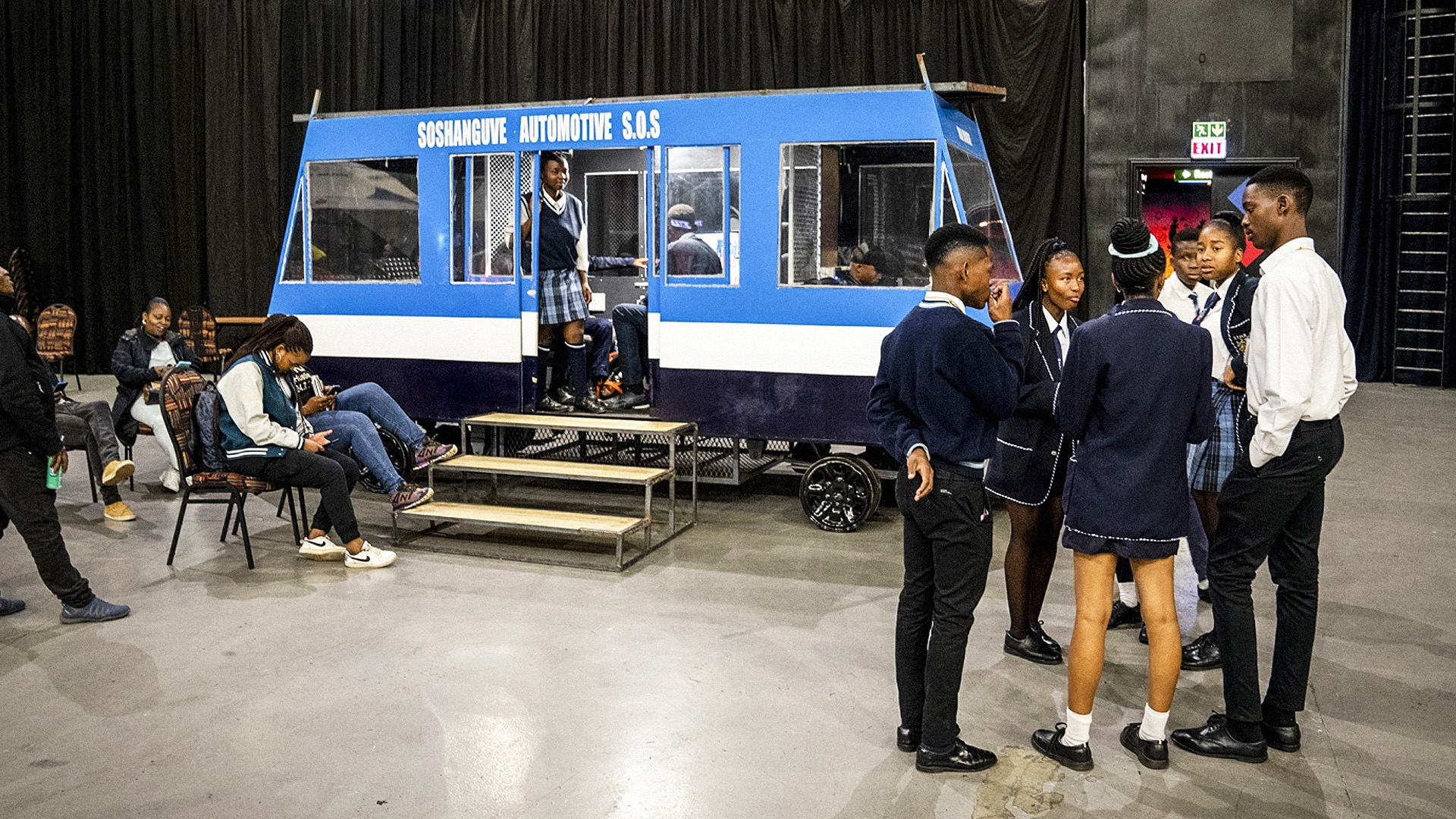
A group of 20 South African students from Soshanguve Technical School recently showcased a fully solar-powered train at a university event.
The prototype, which has taken approximately two years to build, is set to redefine railway travel not only in South Africa but the entire continent, as it is a cheaper alternative long-term.
In 2020, during the Covid-19 economic hurdles in South Africa, there was a rise in cable theft which saw 60% of train users swap to buses and taxis.
For two weeks now, South Africa’s electricity crisis has worsened, affecting the country’s economy and production caused by hours of power outages. Factories and offices have shut down for hours at a time.
Eskom Holdings, the country’s power company, has been accused of poor management and corruption, leading to debt and constant blackouts.
The regular power cuts have disrupted networks in some regions. Mobile operator companies such as Vodacom and MTN are currently facing high fuel costs to keep their towers running.
Similarly, battery theft is on the rise, affecting company relay network in some places. The ongoing cutouts mean batteries are only charging for 5 to 6 hours when they normally require a minimum of 12 hours to fully charge.
According to Eskom, the country could witness higher stages of scheduled blackouts to save energy. This means going up to 9 hours without power.
Last week, the country hit the level 6 record which was implemented during the June winter. This allowed for approximately 6,000 megawatts to be cut to avoid total blackout.
The rotational power outages have affected the majority of the poor population who need to plan ahead on tasks such as cooking and making sure candles are available during darkness. Many small businesses are forced to close early, affecting the most industrialized country in Africa.
Rail traffic has slowed down due to cable theft challenges and the constant power disruptions.
The students from Soshanguve Technical School look forward to showcasing their solar-powered train to the government for further research and adoption as it is environmentally sustainable.
I’m Derrick (He/Him), a Journalism and Mass Communication graduate from the Technical University of Mombasa, Kenya. Currently I write about trending topics and major issues affecting Africa for Thred, specifically concerning SDGs. View my Twitter here if you’d like to send me feedback.
Gamers have started mashing together different video games using AI tools. So far, we’ve seen Mario in Halo, Minecraft in Skyrim, and much more. Mind-bending results aside, the tech required to pull this off has some people worried about online security and digital infrastructure.
Ever wondered what Super Mario 64 would look like in Halo: Combat Evolved? How about Wii Sports in Silent Hill? Fancy a Minecraft session in the...
With Gen AI now capable of creating functional molecular structures, Google has come up with a new system to tackle imminent biosecurity risks that come with such innovations.
Before modern AI, much of computational biology focused on storing, searching, and comparing biological data. Public databases allowed scientists to check whether a newly identified sequence resembled something already known, but that was it.
However, this changed in 2020, when Google DeepMind unveiled...
With America’s space ambitions only continuing to grow, Trump is turning his focus to the industry’s workforce that could keep the US ahead of adversaries like China.
In both his terms in office, aside from immigration and anti-wokeness, President Donald Trump’s focus has increasingly turned towards the space front. In 2019, he established the US Space Force (USSF), emphasising the growing importance of space to national security.
But this interest...
Gen Z subscribes to everything from music and films to software and storage, paying endlessly for things we never actually own. As ownership is increasingly replaced by access, are subscriptions making life more convenient - or creating a generation that pays forever and owns nothing?
There was once a revolutionary economic model called buying something.
You handed over money, gold, or whatever the currency was. Someone gave you the purchased item....
We use cookies to ensure that we give you the best experience on our website. If you continue to use this site we will assume that you are happy with it.






























 0 comments