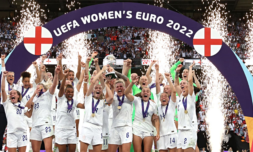
As Qatar hosts the football world cup this year, many people have one issue – where the game is being held. But should we keep political happenings away from the pitch?
In 2010, Sepp Blatter, the then-president of FIFA announced that Qatar would host the 2022 FIFA World Cup.
While FIFA was and still is indicted with accusations of corruption and ethics breaches, Qatar itself is being confronted over its human rights violations.
Last year The Guardian revealed that more than 6,500 migrant workers from South Asia had died while supporting infrastructure and construction for the tournament. At the same time, the country has a history of blatantly discriminating against women and LGBTQ+ people.
Because of this, six out of 10 people in the UK oppose Qatar hosting the World Cup over anti-gay laws, with 39% believing teams should not take part in the event.
Many players and places are also taking action. The US soccer squad, for example, sported a rainbow-themed logo inside their training facility and media workroom to support the LGBTQ+ community.
Denmark is providing a black option for their team jerseys to honour the deaths of the migrant workers, and some major cities in France, including Paris, have decided not to broadcast the World Cup matches in fan zones.
Human rights activists have also started engaging on social media, using hashtags like #boycottqatar2022, with keywords like “exploitation”, “6500 + people”, and “human rights violation”.
While this is a major step in showing solidarity and holding Qatar accountable for their actions, there is a question of whether sports and politics should be integrated.
While western countries are unhappy over Qatar hosting the world cup, FIFA president Gianni Infantino accused western critics of hypocrisy, ignoring their own involvement in systematic oppression.
And what about the many other countries taking part in the event?
Iran participated despite protests over Mahsa Amini’s death. The Unites States’ has issues such as gun control and the criminalisation of abortion. Saudi Arabia’s victory against Argentina was celebrated despite also having their own human rights problems.
Previous hosts were never critiqued, like Japan’s policies against asylum seekers, Brazil actively cutting down the Amazon rainforest, and Germany being the EU’s largest greenhouse gas emitter in 2008.
Sports and politics have always crossed paths, like Tommie Smith and John Carlos raising black-gloved fists at the 1968 Olympic games in Mexico City and Paul Pogba and Amad Diallo raising a Palestinian flag after a Premier League match.
A recent example is football players and staff taking a knee before their game starts as a statement against racism.
The gesture was first used in 2016, when American footballer Colin Kaepernick took a knee during the national anthem, saying he couldn’t show pride in a country that oppressed Black people.
Premiere League players began taking a knee before matches in 2020 after the death of George Floyd, and while football fans across Europe tend to support the gesture, some disagree on whether it’s helping to tackle racism.
Crystal Palace’s Wilfried Zaha was the first Premier League player to stop taking a knee, feeling that it had lost some significance and some players would still receive abuse regardless. The director of the Championship club Queens Park Rangers also thought that the “message has been lost” from the act and equated to it a social media hashtag.
It didn’t help that Rashford, Sancho and Saka received racial abuse after they missed their penalties in the Euro 2020 final. While the Premier League’s captains also decided to no longer take a knee and only do so for “significant moments”.
If the players received abuse regardless, what help does mixing politics and sports give?
After Putin invaded Ukraine, sporting bodies from around the world excluded Russia from sporting events, including football, rugby, tennis, Formula 1 and the Summer and Winter Olympics.
But is it fair that the players have to pay the price for something they have nothing to do with?
While boycotting Russia might be symbolic, a cultural boycott will do something that political and economic sanctions won’t be able to do – isolate the country. Preventing Russia from taking part undermines the macho-nationalist image that Putin has worked hard to make. And if ordinary Russians can no longer enjoy the sports they love to watch, their tolerance for the government will fade away.
There’s also an entirely different issue when politics goes too far.
Pakistan and India have always had the most intense rivalry in cricket. Their matches are known for their intensity and are considered one of the biggest matches across the globe. But this stems from tense relations between the two nations from the Partition of British India in 1947, the Indo-Pakistani Wars and the Kashmir conflict.
What happened over 70 years ago is taken out onto the pitch since both countries share a heritage for cricket, and often, many cricket fans have had what’s been described as a “strong response” when there’s a game.
Most recently, tensions escalated between the Indian and Pakistani communities in Leicester, with violence and a series of protests after the 2022 Asia Cup match between the two in August. Leading to the city’s Muslim and Hindu leaders issuing a joint message calling for the riots to end.
How can an ordinary game be enjoyed if the game’s entire perspective is built on political issues?
But if sports fans don’t expect athletes and other sporting bodies to voice their opinions on political issues, then sports will always be a part of society that “lags behind” in progress. And if fans refuse to acknowledge the political nature of sports, then there won’t be a way to recognise and fix these issues.
Political symbols, like social media, have always been used to create conversations. The racial abuse Black football players received in 2021 shows that we need to do more to put an end to racism, especially relating to the sport. These symbols are here to remind fans about what’s happening in the world, but it shouldn’t transcend to rioting and creating differences that affect an entire match’s viewpoint.
Sports have always been a symbol of unity, while politics have always been associated with division – it’s hard to see what many might view as two drastically different things colliding.
But as Kenan Malik says, sports doesn’t exist in a vacuum; social and political contexts shape the sport and our response to it.
I’m Anam (She/Her), a journalist and Remote Writer at Thred. Born and bred in London, I studied journalism for my Bachelors. I’ve written everything from pieces about veganism to sex education and skincare – my goal at Thred is to write about issues that affect society and what’s happening beyond the borders of London.
Noticed pistachios everywhere recently? It’s no coincidence. Their rise is part of a years-long rivalry between the US and Iran that holds new weight in the face of war.
You’ll have heard of Dubai chocolate. The viral dessert has had TikTok under its kadayif covered thumb for over a year. You may even have tried your hand at making it – a simple recipe comprised of chocolate, tahini, shredded filo dough...
Timothée Chalamet’s dismissal of ballet and opera raises a lot of questions around the survival of the arts.
Has Hollywood’s golden boy tarnished his crown? Timothée Chalemet was a shoo-in to win the coveted Best Actor trophy at this year’s Oscars. It’s his third nomination in the category, and despite having just turned thirty, a win for Chalamet feels like it’s been a long time coming.
Few leading men have established...
Over 10,000 writers have contributed to ‘Don’t Steal This Book,’ an empty publication that only contains a list of their names. Organised by Ed Newton-Rex, the book will be given out for free at the London Book Fair in protest of AI tools stealing the intellectual property of creatives.
Thousands of writers have added their names to ‘Don’t Steal This Book,’ an ‘empty’ publication that has been printed to...
The latest ‘auramaxxing’ TikTok and Instagram trend has Gen Z yelling in public before taking a misleading picture. It is hilarious and has unsurprisingly gone viral.
In need of a confidence boost? Looking to maximise your social aura? Forget the gym, have you tried yelling embarrassing nonsense in public to gain everyone’s attention for an Instagram picture?
This is the latest Gen Z trend currently making waves on TikTok and Instagram,...
We use cookies to ensure that we give you the best experience on our website. If you continue to use this site we will assume that you are happy with it.
































 0 comments