0 comments
Such a move tells us all where the nation’s priorities lie on the environmental front.
Covering 52% of Indonesia’s land is lush rainforests, making it one of the largest tropical rainforest systems in the world after the Amazon and Congo Basin.
Contrary to popular belief, its rainforest isn’t just a dense forest with tall jungle green trees, and constant rain. In countries such as Indonesia, the term is often used more broadly to describe an entire nation’s forest system. In fact, within the Southeast Asian nation lies variations in forests such as coastal swamps, montane forests, and lowland forests among others.
Thanks to these various ecosystems, Indonesia also happens to be the second most biodiverse country in the world, with an estimate that it houses 17% of global wildlife. But that’s not all these rainforests hold. Collectively, Indonesia’s forests store an estimated 13 billion metric tons of carbon, earning it the title as one of the ‘Lungs of Asia’.
It’s not just the trees that act as this major carbon sink, but the ground too; much better at it in fact because of peat. Due to its water content, Peatland can store up to 10 times more carbon than a hectare of regular rainforest. It just happens that Indonesia has one of the largest tropical peat swamp forests. While Indonesia rainforest’s carbon absorption abilities are a subject of intense fascination, the nation’s forest emissions tend to cast a shadow over it.
Annually, this rainforest removes approximately 610 million tonnes of CO2 equivalent. Its forest emissions originate from a combination of the physical destruction, biological decay, and chemical changes in the soil, all of which are obviously caused by man.
This includes peat oxidation from canal digging, biomass loss from deforestation, and peat and forest fires as a cheap way to clear land. Collectively, these actions have led to the release of 970 million tonnes of CO2 – the net carbon absorbed from the forests is only 360 million tonnes.
Yet, the nation has constantly sought to put its industrial needs over its environmental ones as seen through its recent order to involve the military in deforestation efforts.
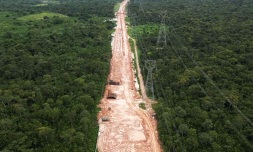
For prior context, Indonesia’s President Prabowo Subianto started an initiative that required the conversion of around 3 million hectares of land in the Papua province into farmland. That’s roughly five times London’s size.
Such a project was supposed to achieve food self-sufficiency within four years to counter declining agricultural land from conversions to housing and other industries, especially with increasing population numbers. Regardless, based on satellite imagery between May 2024 and November 2025, only 40,000 hectares have been cleared.
With progress slow, he decided to involve the military to accelerate deforestation rates. Further rationale for including military personnel was characterized by the project’s importance in guaranteeing food and energy security.
Putting a pause on the deforestation fiasco, what does farmland have to do with energy security? Well, the President wants to conduct large scale sugarcane plantations to produce bioethanol, a renewable fuel to reduce the nation’s reliance on imported fossil fuels.
Military personnel in the project are tasked with providing security, operating heavy machinery, and support deforestation operations.