0 comments
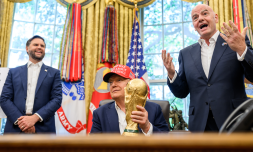
Amongst blocked visas, overseas conflict, and soaring ticket prices, this year’s tournament has been marred by US politics. But Trump’s latest intervention in a FIFA red card ruling signals an ugly future for the beautiful game.
The World Cup has always been political.
By its very nature, a tournament that unites the globe has played out amidst international unrest, dictatorships, corruption scandals, and much more. But those moments have always existed as background noise to football itself. This summer, in which the World Cup has been co-hosted by the US, Canada and Mexico, politics walked directly onto the pitch.
It’s naive to assume politics should never determine sporting outcomes. But FIFA sparked outrage this week when they overturned an automatic one-match ban against US striker Folarin Balogun – following reported lobbying from President Donald Trump.
Balogan had been a star player for the US team throughout the group stages, before Belgium delivered a 4-1 thrashing in the round of 16. Clearly fired up by the perceived injustice, Belgium celebrated on the pitch by performing the instantly recognisable ‘Trump dance’, and the team’s official X account posted ‘overturn this.’
Prior to the tie, UEFA called the decision to suspend Balogun’s suspension ‘unprecedented, incomprehensible and unjustifiable.’ Belgium’s football association also appealed the decision, while former FIFA president Sepp Blatter warned that football should never become ‘a playground for political power.’
Every red card is controversial and involves the subjective interpretation of the matchday ref. Fans immediately question the decision of the governing body, particularly in high-stakes matches.
Some also suggest legendary players like Lionel Messi are granted ‘special treatment’ and rarely penalised – a belief that will have grown exponentially following Argentina’s controversial comeback against Egypt last night, and the scolding of FIFA from the Egypt players and manager since.
Whether you agreed Balogun deserved the ban or not, FIFA’s decision was made. A subsequent U-turn asks whether the laws of a historic game could suddenly be made negotiable once the world’s most powerful politician kicked up a fuss.
That question may prove to be the defining legacy of Trump’s World Cup.
For months, the tournament has felt less like a global celebration than a showcase of American political priorities. The United States’ sweeping visa restrictions meant supporters from countries including Senegal, Iran, Haiti and Côte d’Ivoire struggled – or failed entirely – to attend matches involving their own national teams.
While FIFA markets the World Cup as football’s universal festival, thousands of supporters discovered that entry into the tournament depended on passport politics.
Senegalese supporters who transformed stadiums in Qatar into seas of green were replaced largely by diaspora communities already living in North America. Fans who had spent years saving for a once-in-a-lifetime trip instead watched from thousands of miles away.
Overturn this. 🧏♂️ #USABEL pic.twitter.com/KcBAJp3Z7d
— Belgian Red Devils (@BelRedDevils) July 7, 2026
Even those able to travel encountered another distinctly American export: dynamic pricing. FIFA’s adoption of fluctuating ticket prices pushed costs to unprecedented levels. At England’s recent game against co-hosts Mexico, some of the most expensive seats were selling for upwards of $30,000.
Politics, economics, and football had already become deeply entangled before Balogun’s red card.
But automatic suspensions exist precisely because they remove discretion. Red cards carry consequences regardless of nationality, commercial value, or competitive importance.
They are among football’s clearest rules, because consistency is essential to sporting legitimacy. If governing bodies begin deciding which red cards count – and politicians can apparently influence that process – then every controversial refereeing decision becomes potentially negotiable.
England manager Thomas Tuchel expressed concern it would blur the lines of football’s longstanding rulebook. If Balogun’s suspension can disappear, why not overturn yellow cards? Why not revisit every contentious VAR decision?
FIFA has spent years presenting itself as politically neutral while simultaneously embracing increasingly political hosts. Russia. Qatar. Saudi Arabia’s growing influence. And now, under the first World Cup largely staged in Trump’s America, neutrality appears to have become even harder to defend.
🚨Full interview of Egypt’s Coach Hossam Hassan at full-time:
“I will say what’s on my mind regardless of the consequence, this was clearly a rigged match and the whole world saw it”
“And I want to say one more thing, if they want Argentina to win so bad, why call everyone to…
— Danis (@DanisMCFC) July 7, 2026