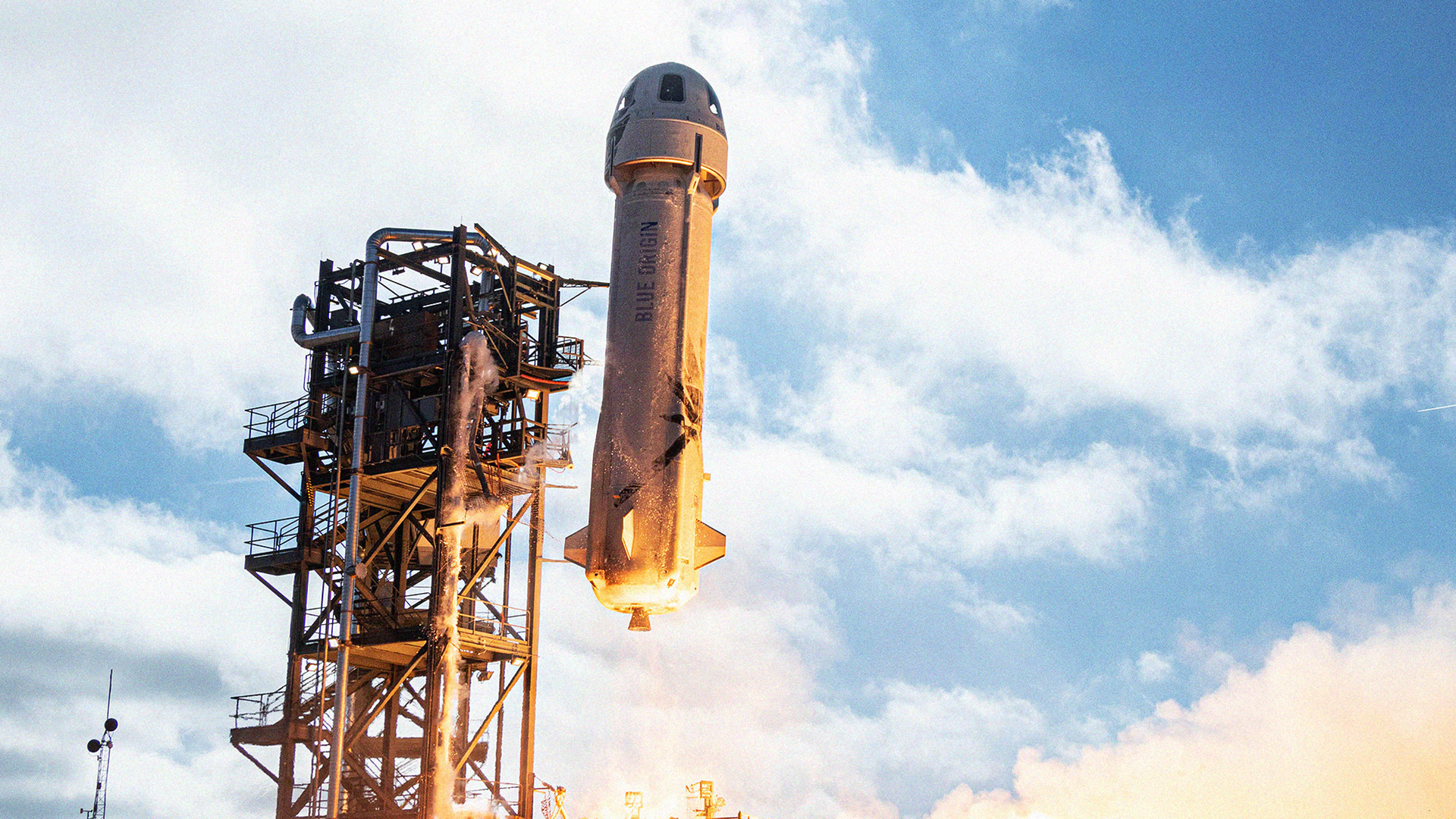
Jeff Bezos was on board the first human flight for his space company Blue Origin today, which reached higher altitudes than Richard Branson’s efforts just last week.
I wonder if CEO entrepreneur Jeff Bezos ever envisioned himself being launched into the heavens via a rocket built by his own private company when he founded Amazon all those years ago.
That’s exactly what happened today, though, as Blue Origin launched its first ever human flight to space successfully – Jeff himself strapped inside a re-usable rocket called New Shepard. It is all part of his efforts to fund space travel and make commercial rocket ships a reality. Once you run out of things to sell on the ground you might as well try your luck at the universe itself, eh?
Jeff was joined by his brother Mark Bezos, veteran space racer Wally Funk, and an 18-year-old student. All four returned to the ground safely.
He joins a growing list of billionaire tech entrepreneurs eager to get ahead in the competition for space tourism. Virgin CEO Richard Branson took to the skies himself just a few days ago, beating Bezos in speed but not altitude.
SpaceX founder Elon Musk is also expected to head into space at some point soon – though nothing specific has been announced yet.
Why are billionaires flinging themselves into the great beyond?
There are a variety of reasons for the growing interest in space travel.
For one, it would give tech and travel companies such as Virgin and SpaceX a significant advantage in a new market for commercial space exploration. Being the first to provide public seats inside rockets would be a big deal, and no self-respecting billionaire wants to be seen missing out.
Elon Musk has also said he wants to eventually colonise nearby planets such as Mars and believes humans shouldn’t be a ‘single planet species’. Whether you view that as an abandonment of Earth – given the looming threat of climate change – or a valiant attempt to broaden our galactic ambitions is up to you.
Billionaires also claim that their work in this industry will help solve current problems down on the surface.
Branson was eager to focus on new jobs within the engineering and tech fields being created as a result of Virgin Galactic, while Bezos said that his work with Blue Origin was part of a necessary step forward for ‘our species and civilisation’.
No word yet if we’re allowed in on that step forward as ordinary plebs, mind.
What has been the response online?
While there has been some fanfare online regarding these recent rocket launches – the views from Branson’s plane were extraordinary – equally there has been criticism.
Both Blue Origin and Virgin Galactic’s billionaire slingshot stunts feel particularly tone deaf given their timing. The world is still on the tail end of a devastating pandemic, a significant portion of Oregon is currently on fire, and the UK is undergoing a sweltering heat wave as a direct consequence of climate change.
Many are understandably wondering what the benefits for ordinary people really are as the wealthy white winners of capitalism head to the stars.
It’s unlikely you or I will ever be able to afford a ticket to space, and some have suggested it’s preparation for the rich to abandon us once everything inevitably falls apart on Earth, like a modern day Titanic with less sinking ships and more jet-fuelled explosives. It’d be some way for us to go out though, I suppose.
There is a strong argument that those at the top of the food chain should be spending more of their time on urgent causes such as the climate crisis, poverty, wealth disparity, and a whole lot more. It’s worth noting that Bezos’ ex-wife is now a more generous donator and philanthropist than he ever has been.
Great for Jeff Bezos to use some of the $86 billion he made leeching off the fallout from the pandemic to send himself to space (taking advantage of his rocket company being given an exemption from lockdown policies), while 150 million back down on earth enter extreme poverty.
At the very least, perhaps these demonstrations provide us with a glimpse into a future that utilises our space innovations to combat more pressing issues. The cheaper, more accessible, and common these types of launches are, the more likely they’ll be used for the greater good.
We’ve yet to see if that’ll be the case though. For now, I’ll say one thing. Congratulations, you did it Jeffrey!
I’m Charlie (He/Him), Deputy Editor and Senior Writer at Thred. I was previously the Editor full time at Thred before moving to Bristol in 2024. As a music and gaming enthusiast, I’m a nerd for pop culture. You can find me curating playlists, designing article headline images, and sipping cider on a Thursday. Follow me on LinkedIn and drop me some ideas/feedback via email.
Why has one of the noughties’ biggest gaming publishers become basically irrelevant in recent years, and is there a way back?
Remember Ubisoft in its pomp?
It seems strange to say now, given the publisher seems intent on lurching from one disaster to another in recent years, but at one point in time, Ubisoft could do no wrong.
Creatively and commercially, it had a firm grip of the industry from 2007 up...
UK ministers are currently voting on an amendment to ban under 16s from social media and the Prime Minister is reportedly open to following in Australia’s footsteps.
Under mounting pressure, the UK government is now weighing up whether to ban children under 16 from using social media.
A consultation is currently taking place, in which dozens of MPs will vote on whether an Australia-style policy should be implemented by next...
Gamers online are taking issue with the casting of Sophie Turner for Amazon Prime’s new screen adaption of Lara Croft. Complaints unsurprisingly range from her not ‘looking’ the part to issues with her previous acting.
In news that probably won’t surprise many, reactions to Lara Croft’s latest look for Amazon’s Primes adaption have been mixed.
Gamers and fans are unhappy with the casting of Sophie Turner, with comments saying that...
The anticipation of having a baby is often clouded with uncertainty for Africa’s women as well as their families and healthcare providers due to an overwhelming number of pregnancy complications.
According to WHO, annually there are over 2 million stillbirths in the world, over half occurring in Sub-Saharan Africa.
These stillborn deaths are often preventable. Poor access to prenatal care, shortages of qualified health care providers, delayed responses to emergencies,...
We use cookies to ensure that we give you the best experience on our website. If you continue to use this site we will assume that you are happy with it.
































 0 comments