0 comments
After pulling foreign assistance to African countries last year, Trump’s government is again offering hundreds of millions in financial aid. But the support comes at a cost, and many nations aren’t willing to pay it.
Ghana is the latest African country to turn down a new funding deal from the Trump administration, after the US president dismantled the governing body that oversaw foreign assistance during his second term.
Despite reinstating financial support to several African nations, a growing number of governments are rejecting the stringent conditions attached to it. Ghana follows Zimbabwe and Zambia in refusing a new ‘America First’ agreement, which Trump has made a condition of any proposed aid package.
The new terms require countries receiving US assistance to disclose sensitive health data, prompting widespread resistance to the latest wave of US-Africa aid agreements.
The first of these new agreements, worth $2.1bn, was signed by Kenya’s President William Ruto in December last year. But despite hopes from the Trump administration to follow up with ‘I don’t know, 30, 40, how many? Fifty?’ more deals, activists have slowed progress in Kenya and halted negotiations altogether elsewhere.
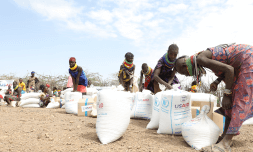
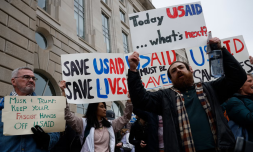
Shortly after taking office for his second presidential term, Trump ordered the closure of the US Agency for International Development (USAID), arguing that it was wasteful. The decision decimated health programmes across parts of Africa that had, until then, relied heavily on American funding.
As is often the case with large-scale structural support systems, USAID’s abrupt closure revealed the extent of the programme’s influence only after it had disappeared. Research suggests that sudden, rather than gradual, aid cuts ‘undermined democratic governance and precipitated civil unrest.’
The administration has argued that overhauling the traditional donor-NGO model, which it says fostered dependency, will reduce waste by partnering directly with national governments rather than international organisations.
‘Our aid to those countries will not just be dollars distributed to an NGO who then will go into the country and impose programmes,’ Secretary of State Marco Rubio said.
‘Not only are we treating the acute situations on the ground of people that are sick, we are helping them build the capacity and the capability to do this for themselves.’
Yet the Trump administration’s attempt to reintroduce aid under a different model is now being firmly resisted by many African governments.
A proposed $1bn deal with Zambia has stalled after Washington reportedly linked the funding to securing mineral rights in the copper-rich nation.
‘America is rolling out billions of pounds of new health aid deals with African governments,’ wrote Ben Farmer, Africa correspondent for The Telegraph. But these ‘trade for aid’ agreements are ultimately a way ‘to back Washington’s commerce and geopolitical goals.’
The approach represents a fundamental departure from the post-war model of global health cooperation centred around the World Health Organization (WHO). Rather than working through multilateral institutions, direct agreements with individual governments allow the Trump administration to align aid more explicitly with American strategic and commercial interests.
Zambian Foreign Minister Mulambo Haimbe has criticised what he views as an attempt to tie ‘health funding to US economic interests’ by linking the aid package to a separate agreement granting Washington access to critical minerals.
‘Our US colleagues looked at it from the perspective that [the two deals] must be taken as a package to be negotiated and concluded at one particular time,’ he told the BBC.
But the US government is not attempting to disguise its motivations.