The idea of ‘supersize’ viruses stored inside Arctic glaciers may sound like the beginning of an apocalyptic novel, but scientists have found that giant viruses are playing a key role in slowing the ice’s melting process caused by climate change.
You’ve likely heard that viruses have been frozen inside Arctic ice for millions of years. It’s speculated that they could become a threat to the planet’s the human population as glaciers melt rapidly due to climate change.
Off the back of a global pandemic, it’s not unreasonable to feel that the existence of these ancient, frozen viruses could be nothing but bad news. Recent studies, however, have offered a more positive angle.
After making a surprising discovery, scientists now believe that viruses burrowed inside ice caps could emerge as crucial players in the battle against climate change.
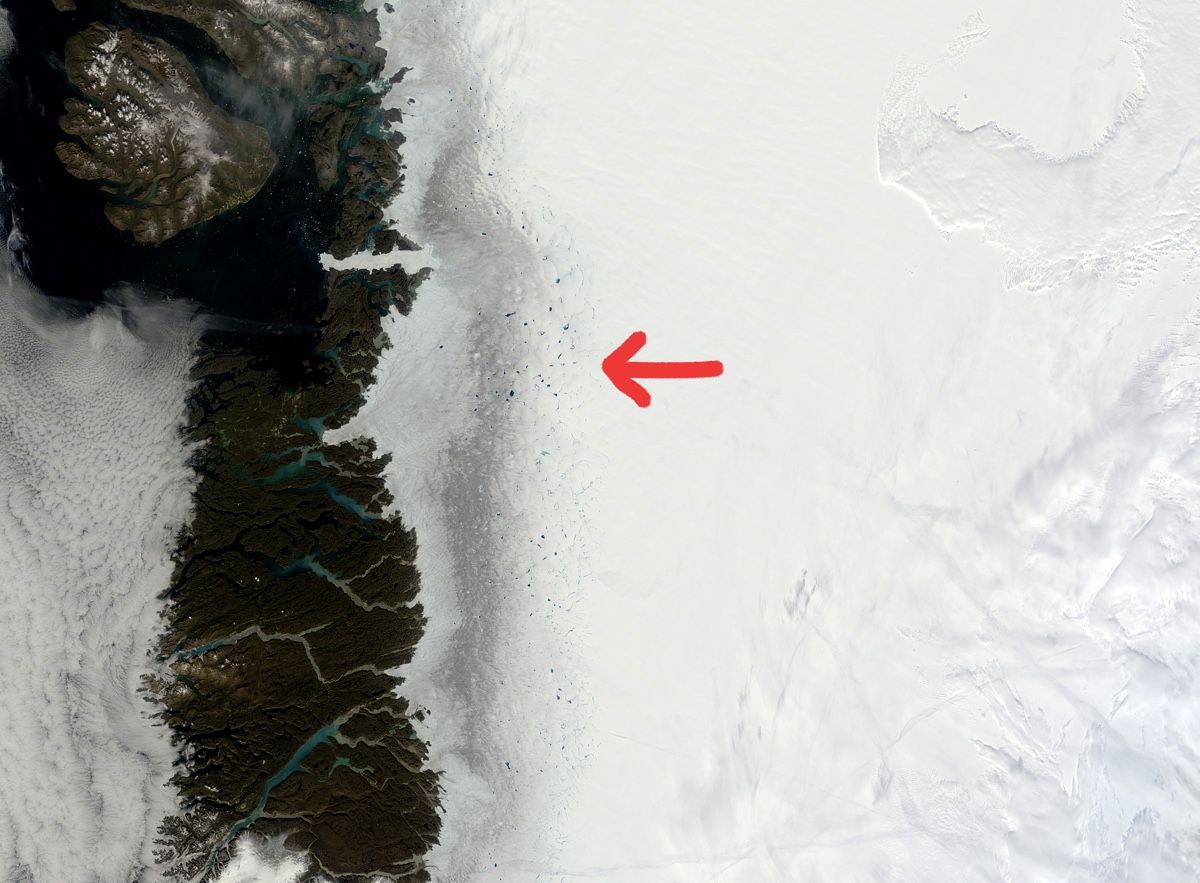
According to research published in the journal Microbiome in May, scientists at Denmark’s Aarhus University have found ‘supersized’ infectious agents in Greenland, where they seem to be slowing the melting of polar ice.
The presence of giant viruses inside ice appears to be inhibiting the growth of black snow algae, which is pictured above. This type of algae is notorious for causing ice melt faster, as it darkens the surface of ice and reduces its ability to reflect sunlight.
While invisible to the naked eye, viruses locked inside the ice are remarkably large, measuring about 2.5 micrometers – roughly 125 times larger than a typical virus. They’re about the same size as fine air particles, which are responsible for air pollution in most developed countries.
The supersize viruses’ genetic complexity is equally impressive, with genomes comprising around 2.5 million base pairs, compared to the 150,000 to 200,000 base pairs found in many bacteria’s DNA. Such size and complexity place them in a unique category.
However, more significant than their size is their impact on their hosts.
These giant viruses tend to infect algae that bloom on the Greenland ice sheet during the summer months. By affecting the growth of this algae, the viruses could hinder their ability to speed up ice melt.
What do the scientists say?
The discovery of supersize viruses in the Arctic is significant, as giant viruses have only been known to the scientific community for about 40 years. The first examples were found in the ocean back in 1981.
Since then, they’ve been found in a number of environments, including the human body, but never before on an ice sheet. Perini’s team discovered them by analysing the DNA from ice samples and detecting sequences that belong to giant viruses.
‘We don’t know a lot about the viruses, but I think they could be useful as a way of alleviating ice melting caused by algal blooms,’ said Laura Perini, a postdoctoral student and co-author of the study, in a press statement.
‘How specific they are and how efficient it would be, we do not know yet. But by exploring them further, we hope to answer some of those questions,’ she added. Perini and her team are now committed to finding out what roles viruses play in the icy ecosystem.
Could viruses be used for climate action?
This knowledge comes at a critical moment. The Arctic is warming four times faster than the rest of the world, and natural solutions to combat this warming could be vital in slowing ice melt.
Arctic ice is so diminishing rapidly that current predictions suggest the region could be ice-free by 2040.
The loss of Arctic ice has widespread implications, including rising global temperatures, weather extremes, endangered coastal communities, food instability, wildlife decline, and methane release from permafrost.
By understanding and potentially harnessing the role of giant viruses in controlling algae species, scientists hope to develop new strategies to mitigate the rapid ice loss and its global repercussions.
The research from Aarhus University does exactly that, presenting a new avenue for combatting climate change.
It’s possible that the continued study of giant viruses and how they interact within the Arctic environment could offer a novel pathway for preserving this important and rapidly deteriorating region.
Deputy Editor & Content Partnership ManagerLondon, UK
I’m Jessica (She/Her). I’m the Deputy Editor & Content Partnership Manager at Thred. Originally from the island of Bermuda, I specialise in writing about ocean health and marine conservation, but you can also find me delving into pop culture, health and wellness, plus sustainability in the beauty and fashion industries. Follow me on Twitter, LinkedIn and drop me some ideas/feedback via email.
Alleged victims will be granted new measures including private entrances and waiting rooms, along with specialist ‘trauma-enforced training’ for court staff.
Andy Burnham has announced the rollout of new specialist rape courts in England and Wales, building on measures that are currently only available in limited locations.
At least one courtroom in every Crown Court will be dedicated to handling rape and cases involving serious sexual offences over the next...
From cutting student loans to stopping small boats, Reform UK used its 2026 conference to tell Britain what its first 100 days in government could look like. But behind the pledges, protests and political drama, what did the conference actually mean for Gen Z?
If there was one message Reform UK wanted people to leave Birmingham with, it was this: we are preparing for government.
Its 2026 annual conference at Birmingham’s...
The value of personal attractiveness is established much younger than you might think. But what does this mean for girls growing up in an image-obsessed era?
We check our appearance around 38 times per day. That pastime was once reserved for mirrors, and now extends to every reflective surface in our vicinity. Phone screens are the obvious preference – whether via their front-facing cameras or shiny black lock screens.
Social media...
Records that were long withheld by the city now reveal that the officials knew about Ground Zero’s toxic air in the years following 9/11 and chose to mislead the public.
On September 11th, 2001, Americans were initially met with confusion when the North tower was first hit. Minutes later, when the second plane struck the South Tower, that confusion quickly turned into fear.
While the collapse of both towers would reshape...
We use cookies to ensure that we give you the best experience on our website. If you continue to use this site we will assume that you are happy with it.





























 0 comments