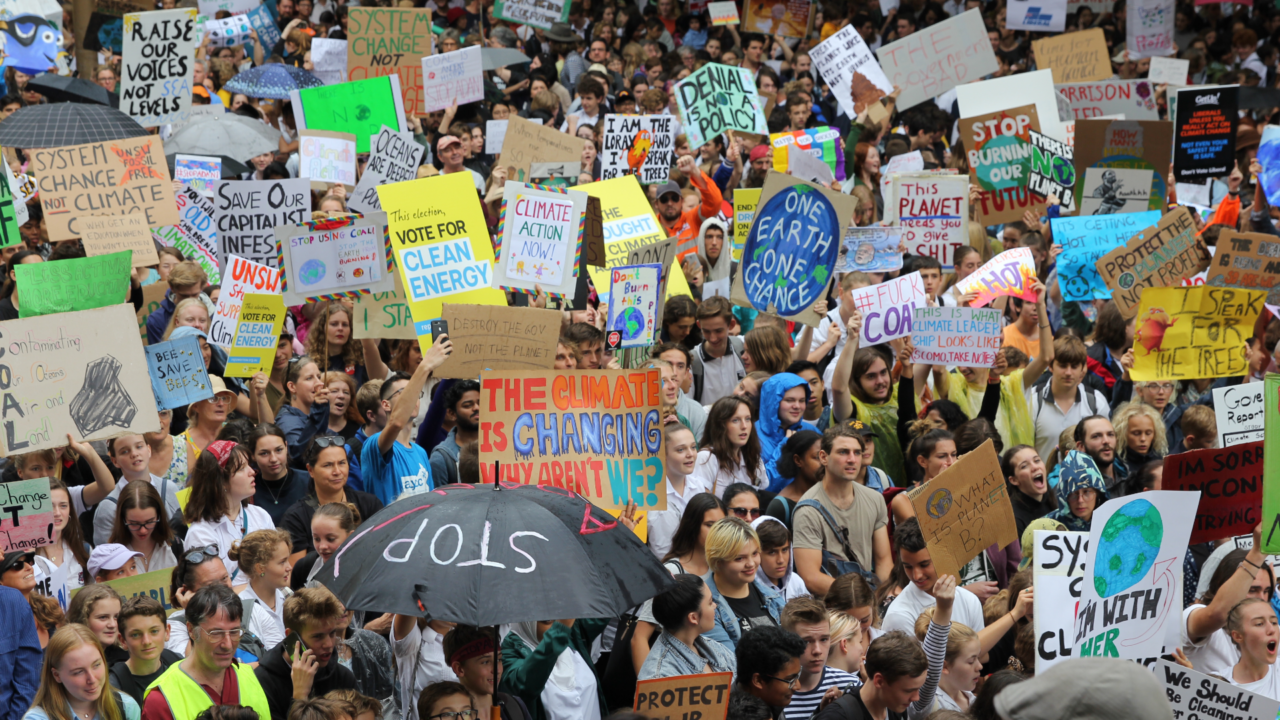
All weekend long, tens of thousands of people will be taking to city streets to protest for an end to the use of fossil fuels.
In dozens of countries and hundreds of cities worldwide, tens of thousands of people are readying to take to the streets to protest for an end to the burning of planet-warming fossil fuels.
Rather timely, if you ask me, as we transition out of a summer marked by dramatic weather extremes and record-breaking heat around the globe.
Branded the Global Fight to End Fossil Fuels, the protests will begin this Friday and continue through to Sunday in various cities in Europe, the US, India, Africa, Australia and South America.
It has been organised by local and global climate groups, with many of them being youth-led, including Greta Thunberg’s Fridays for Future movement.
If your first thought is related to concerns about how closed streets and road detours will inconvenience your weekend plans, allow me to explain why this action is completely necessary.
Fossil fuels – coal, oil and gas – are by far the largest contributor to global climate change. Burning them generates over 75 per cent of global greenhouse gas emissions and nearly 90 per cent of all carbon dioxide emissions annually.
As greenhouse gas emissions linger in the Earth’s atmosphere, they trap the sun’s heat and warm our planet. We have this human-driven process to blame for unpredictable weather patterns, severe natural disasters, unbearable heat, and biodiversity loss happening as of late.
But wait, it gets even more wild.
Despite the signs of climate breakdown – and the role they play in this issue – being more evident than ever, fossil fuel companies are making more than ever before. A 2022 earnings report reveals record-breaking profits last year.
Just five companies – ExxonMobil, Shell, BP, Chevron, and TotalEnergie – reported a total of nearly $200 billion in profits.
The cost of this? Well, human health and safety, biodiversity loss, destruction of natural landscapes, and the decline of the planet itself.
A study published in Science found that we may have already crossed a number of tipping point thresholds with the 1.1 degrees Celsius of global warming that humans have caused so far.
Just last week, the United Nations warned that countries aren’t doing enough to curb warming to 1.5 degrees Celsius, which they agreed to do during the Paris climate summit in 2015. Past this point, more ‘tipping point’ consequences are sure to come.
Experts have warned the world about this for a while, too.
In 2009, a scientific research paper was published in Nature. It outlined the ‘defining preconditions for human development’ and stated that ‘crossing certain biophysical thresholds could have disastrous consequences for humanity’.
At the time of writing, it stated that three of nine interlinked planetary boundaries had already been overstepped. An updated analysis published in recent days says that Earth is now exceeding its ‘safe operating space for humanity’ in six of the nine key measurements of its health.
Lead author of the study Katherine Richardson from the University of Copenhagen says, ‘We can think of Earth as a human body, and the planetary boundaries as blood pressure. High blood pressure doesn’t mean for certain that you are having a heart attack, but it does increase the risk.’
Co-author of the study, Johan Rockstrom of Potsdam Institute for Climate Impact Research in Germany, continued using the medical health analogy. ‘We are in very bad shape,’ he says. ‘We show in this analysis that the planet is losing resilience and the patient is sick.’
So how do we take steps to heal? Turning our backs on the use of fossil fuels would be a great place to start. This is exactly what the Global Fight to End Fossil Fuels protests are hoping to achieve.
An overview of planned events and protests can be found on the Fossil Fuel Treaty map website. Most will be taking place in Europe, more specifically, London, Paris, Rome, Madrid, Brussels, Berlin, Vienna, and Stockholm.
Deputy Editor & Content Partnership ManagerLondon, UK
I’m Jessica (She/Her). I’m the Deputy Editor & Content Partnership Manager at Thred. Originally from the island of Bermuda, I specialise in writing about ocean health and marine conservation, but you can also find me delving into pop culture, health and wellness, plus sustainability in the beauty and fashion industries. Follow me on Twitter, LinkedIn and drop me some ideas/feedback via email.
The alleged incident took place on university grounds in 2024. Cornell has yet to comment publicly.
On Tuesday, the names and faces of seven Cornell University students flooded the internet. They were all young men. And they were all allegedly involved in the gang rape of a woman on campus in 2024.
Jane Doe initially came forward shortly after the incident was said to have happened, telling Cornell University Police on...
Experts suggest the disappearance of London’s iconic red buses will hit the poorest the hardest.
Like most major cities, London is built on a sprawling public transport system. Boasting the tube, black cabs and an iconic route of red bus services, England’s capital is one of the most famous and efficient transport hubs in the world. But experts warn it’s at risk of rapid decline.
Outside of zone 1, red buses...
Alleged victims will be granted new measures including private entrances and waiting rooms, along with specialist ‘trauma-enforced training’ for court staff.
Andy Burnham has announced the rollout of new specialist rape courts in England and Wales, building on measures that are currently only available in limited locations.
At least one courtroom in every Crown Court will be dedicated to handling rape and cases involving serious sexual offences over the next...
From cutting student loans to stopping small boats, Reform UK used its 2026 conference to tell Britain what its first 100 days in government could look like. But behind the pledges, protests and political drama, what did the conference actually mean for Gen Z?
If there was one message Reform UK wanted people to leave Birmingham with, it was this: we are preparing for government.
Its 2026 annual conference at Birmingham’s...
We use cookies to ensure that we give you the best experience on our website. If you continue to use this site we will assume that you are happy with it.






























 0 comments