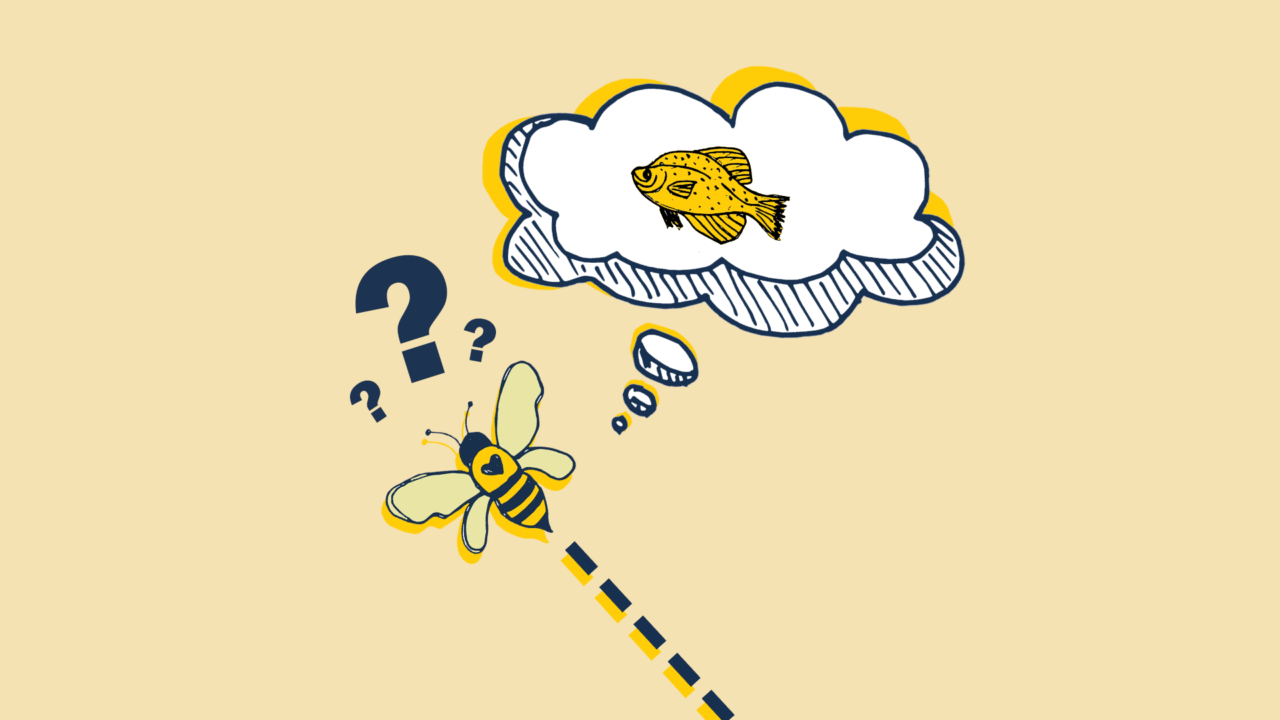
A new court ruling has decided that some species of bee can now legally be considered fish in order to provide extra protection under the California Endangered Species Act.
Consider yourself an expert on bees? Are you an academic on all things honey, hives, and bumbling?
Those clued up on the iconic winged pollinators may want to brush up on their knowledge after this weekend, as a California court ruling now classifies some species of bees legally as fish. Yes, fish.
Although it may sound absurd, the move is intended to help provide bees with extra legal protection and ensure they’re covered by the California Endangered Species Act (CESA).
It had previously been decided by a lower court that CESA only protected ‘birds, mammals, fish, amphibians, reptiles, and plants’ and did not include bees or bugs.
This argument was pushed by agricultural organisations who would be impacted by extra regulations for insects. The Almon Alliance of California, the California Farm Bureau Federation, and five other agricultural groups had successfully confirmed that CESA does not protect insects in November 2020.
Now, the appeals court has allowed the Californian Fish and Game Commission to list four bumblebee species as officially ‘fish’ and therefore legally viable for extra protection – even though they’re not aquatic.
They were able to do this because California’s fish and game code – the outline in which plants and animals are protected – classifies a ‘fish’ as a ‘wild fish, mollusc, crustacean, invertebrate, amphibian, or part, spawn, or ovum of any of those animals’. Quite a mouthful, that.
Crucially, the term ‘invertebrate’ within this definition is ambiguous enough to argue that bees should be included.
The four bumble species in question had already been classified as endangered, but were only regarded as ‘land invertebrates’ and not fish in 2018. This meant they weren’t covered by CESA as they were officially only insects. Still with me?
Judges ruled that ‘although the term fish is colloquially and commonly understood to refer to aquatic species, the legal definition is not so limited.’ The room for interpretation and inclusion of bees as fish grants new protections that will help population numbers – which have been steadily declining in California due to climate change.
This new ruling will also be a setback for agricultural groups, who likely do not want added measures and restrictions on current agricultural practices. It fundamentally means that, in essence, bees are indeed fish in California. Which is hilarious.
Frogs technically fall under the definition of a fish too, as they’re classed as ‘amphibians’- which are listed.
Pamela Flick, Californian program director at Defenders of Wildlife, said that it was a ‘great day for California’s bumble bees’ in a statement. Let’s hope the bees – sorry, fish, I think? – are able to recover and boost numbers with these new protections.
I’m Charlie (He/Him), Deputy Editor and Senior Writer at Thred. I was previously the Editor full-time at Thred before moving to Bristol in 2024. I have since returned to London. As a music and gaming enthusiast, I’m a nerd for pop culture. You can find me curating playlists, designing article headline images, and sipping cider on a Thursday. Follow me on LinkedIn and drop me some ideas/feedback via email.
Hoping The New Stanford Prison Experiment on Netflix would offer real psychological insights? Expect to be disappointed by this flimsy reality show disguised as science.
Ever since it was conducted in the 1970s, the Stanford Prison Experiment (SPE) has become something of a cautionary tale for psychologists. While it was presented as this landmark demonstration of the corrupting influence of power and authority, the study has also gone on...
Popularised by Gen Z and Gen Alpha, the Collins English Dictionary has crowned the term ‘mogging’ as word of the year. But what does it really mean?
In the simplest terms, ‘mogging’ means to outshine someone or something. It’s an odd word, similar to ‘mugging’ and reminiscent of Judith Kerr’s beloved character ‘Mog the forgetful cat’ (if you know you know).
But this unassuming phrase has won the hearts of Gen Z...
Both Miley Cyrus and Charli XCX have defended their shorter concerts and limited dates after backlash. Does this reflect a changing social contract between performers and their audiences?
In the last few years, a pop star’s success has come to be measured in miles. The bigger the album, the bigger the tour; the bigger the tour, the more convincing the evidence that an artist has made it.
A world tour was...
A growing number of tourist spots are tackling content creators in the hopes of preserving the broader guest experience. But who will win?
Taking photos of yourself has become a holiday rite of passage. We all love a pose before a sunset or a historic landmark, but influencer culture has reshaped tourism into something vastly different from what it looked like even ten years ago.
Nowadays, every popular tourist space – be...
We use cookies to ensure that we give you the best experience on our website. If you continue to use this site we will assume that you are happy with it.













 0 comments