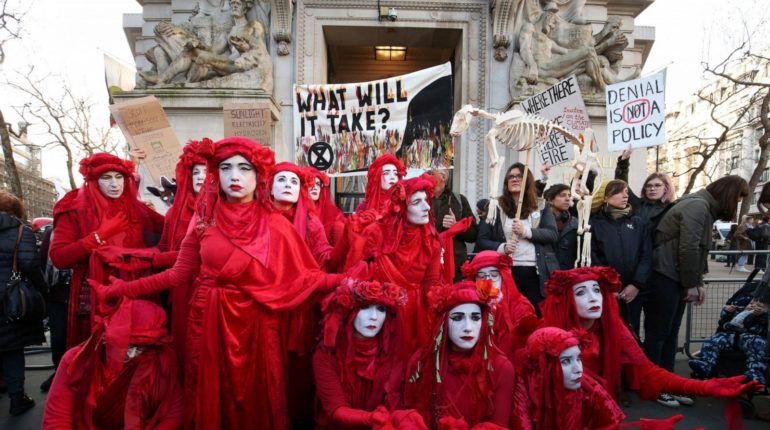
In the last month alone, two deadly climate change demonstrations have taken place in the US and UK. As most governments remain slow to act on environmental matters, is climate extremism inevitable?
British climate scientist James Lovelock once said that climate change should be viewed as a war, and in war ‘democracy can be put on hold’.
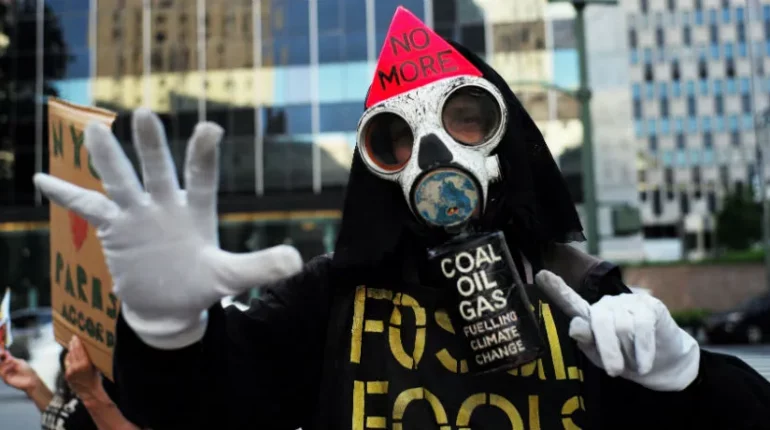
It’s not news to anyone that climate activists have started going great lengths to disturb the status quo, with the sole aim of forcing their governments into environmental action.
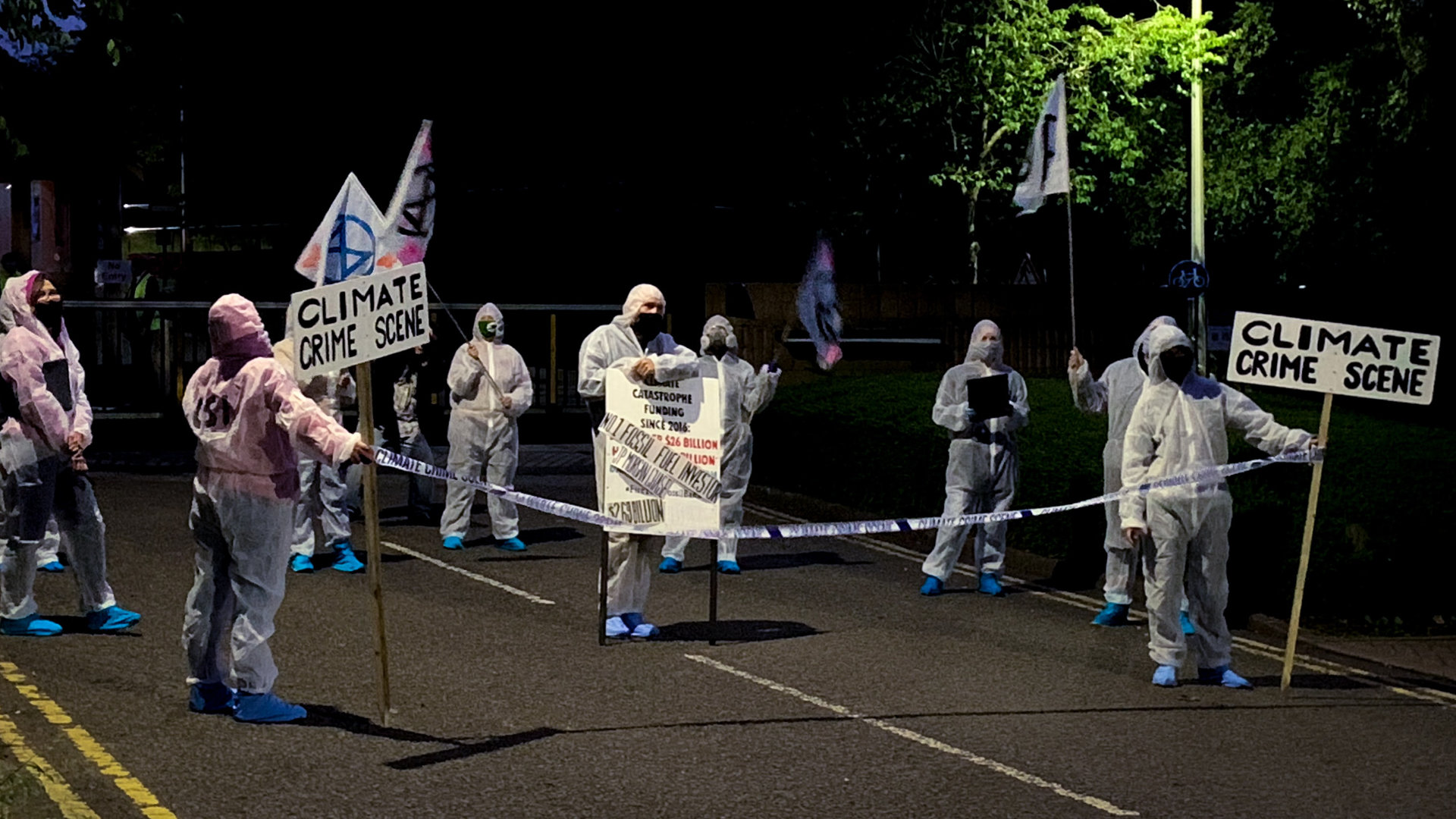
Last year, swathes of protestors blocked key UK roads and motorways, and an international climate lawyer literally glued herself to fossil fuel company Shell’s headquarters to condemn their practices.
We also can’t omit how the British counterterrorism police force began warning communities about the rise of extremist groups such as Nazis, Satanists, and climate change activists in 2020. Yes, really.
Not to mention when UK home secretary Priti Patel publicly called members of Extinction Rebellion ‘criminals’ who ‘threaten the nation’s way of life,’ despite the Home Office saying it is wrong to label them as such.
As the environmental situation worsens globally, are instances of extreme climate activism going to become more frequent?
A story that didn’t make as many headlines as it should have occurred on Earth Day this year.
Wynn Bruce, a 50-year-old climate activist, set himself on fire outside the Supreme Court building in Washington DC. Though he did not explain his actions outright or inform anyone of his plans, the man’s social media profiles point to serious concern over climate change and signs of eco-anxiety.
His lifelong commitment to environmental issues and participation in online environmentalism forums made the date of occurrence – in particular to those who knew him – no coincidence.
This guy was my friend. He meditated with our sangha. This act is not suicide. This is a deeply fearless act of compassion to bring attention to climate crisis. We are piecing together info but he had been planning it for atleast one year. #wynnbruce I am so moved. https://t.co/bHoRaLK6Fr
This isn’t the first time someone self-immolated to draw attention to environmental issues, either.
In 2018, 60-year-old climate activist and civil rights lawyer David Buckel died from injuries caused by self-immolation in a park in Brooklyn, New York.
His mission was clearly explained in an email which he sent to authorities, as well as a backup note left near the site of the fire. Both letters explained how Buckel had set out to protest global inadequate efforts to limit human-caused climate change.
After this happened, The Guardian asked its readers ‘did anyone care?’ and said that judging by a lack of climate action by governments and conglomerates around the world, the sad reality is that not many did.
A five week hunger strike
The latest act of extreme activism took place in Britain over the last week.
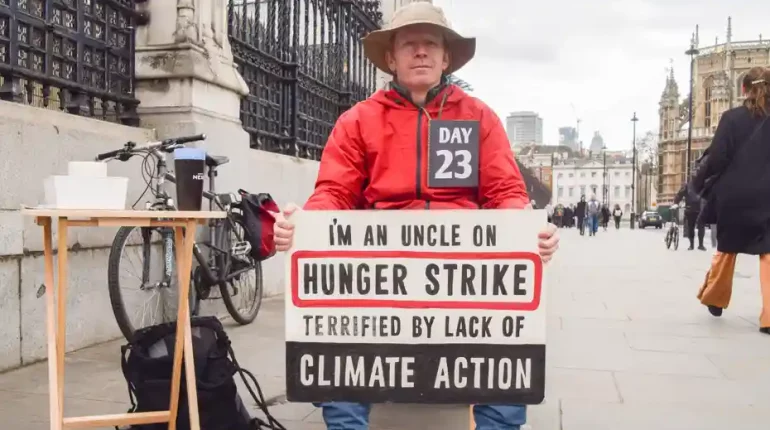
Climate activist Angus Rose starved himself for more than five weeks in a bid to get the UK’s energy minister Greg Hands to publicise the written brief given to Boris Johnson before last year’s climate summit, COP26.
Stationed outside the UK parliament building, Rose said he fully expected ministers to ignore his demands and likely let him die, a fate he told MyLondon he would willingly accept.
By the time Rose finally reached a compromise with ministers, he had lost 17kg (37lbs), leaving many supporters and specialists relieved after fearing he was on the brink of suffering from heart failure or sudden death.
‘It’s an interesting question,’ said Rose in relation to the government’s delayed response. ‘Would they have left me there for another week to see what happened? I don’t know.’
According to Rose, this dangerous form of protest in the name of planetary health is one we should expect to see more of.
‘People will be taking increasingly desperate measures because the government’s actions and its policies aren’t consistent with maintaining a habitable planet on which to live,’ he said.
‘So yeah, these are desperate actions, but they are consistent with the risks.’
The climate crisis increases risk of violence
Over the next decade, the worsening climate crisis will cause environmental issues and resource scarcity across the world.
Already, places like Africa, Asia, and the Middle East have seen how environmental issues like droughts, wildfires, floods, and overpopulation have exacerbated already existing violent conflicts.
But as we edge closer to the limit for global heating, is it possible that in places where regular climate protests are taking place, those with environmental concerns will become more extreme in their actions?
And as people feel more helpless in the face of a changing climate, will the list of climate martyrs grow longer?
Truthfully, I hope not. It looks like the actions of those who have sacrificed their lives and personal safety for the environment don’t go unnoticed, but frankly, fail to incite immediate or significant action from politicians and companies.
And as many climate activists have said before: individual actions matter, but it’s the actions of many that will change the world. In a fight as difficult as the one surrounding climate change, we’ll need as many soldiers as we can get.
Deputy Editor & Content Partnership ManagerLondon, UK
I’m Jessica (She/Her). I’m the Deputy Editor & Content Partnership Manager at Thred. Originally from the island of Bermuda, I specialise in writing about ocean health and marine conservation, but you can also find me delving into pop culture, health and wellness, plus sustainability in the beauty and fashion industries. Follow me on Twitter, LinkedIn and drop me some ideas/feedback via email.
Alleged victims will be granted new measures including private entrances and waiting rooms, along with specialist ‘trauma-enforced training’ for court staff.
Andy Burnham has announced the rollout of new specialist rape courts in England and Wales, building on measures that are currently only available in limited locations.
At least one courtroom in every Crown Court will be dedicated to handling rape and cases involving serious sexual offences over the next...
From cutting student loans to stopping small boats, Reform UK used its 2026 conference to tell Britain what its first 100 days in government could look like. But behind the pledges, protests and political drama, what did the conference actually mean for Gen Z?
If there was one message Reform UK wanted people to leave Birmingham with, it was this: we are preparing for government.
Its 2026 annual conference at Birmingham’s...
The value of personal attractiveness is established much younger than you might think. But what does this mean for girls growing up in an image-obsessed era?
We check our appearance around 38 times per day. That pastime was once reserved for mirrors, and now extends to every reflective surface in our vicinity. Phone screens are the obvious preference – whether via their front-facing cameras or shiny black lock screens.
Social media...
Records that were long withheld by the city now reveal that the officials knew about Ground Zero’s toxic air in the years following 9/11 and chose to mislead the public.
On September 11th, 2001, Americans were initially met with confusion when the North tower was first hit. Minutes later, when the second plane struck the South Tower, that confusion quickly turned into fear.
While the collapse of both towers would reshape...
We use cookies to ensure that we give you the best experience on our website. If you continue to use this site we will assume that you are happy with it.






























 0 comments