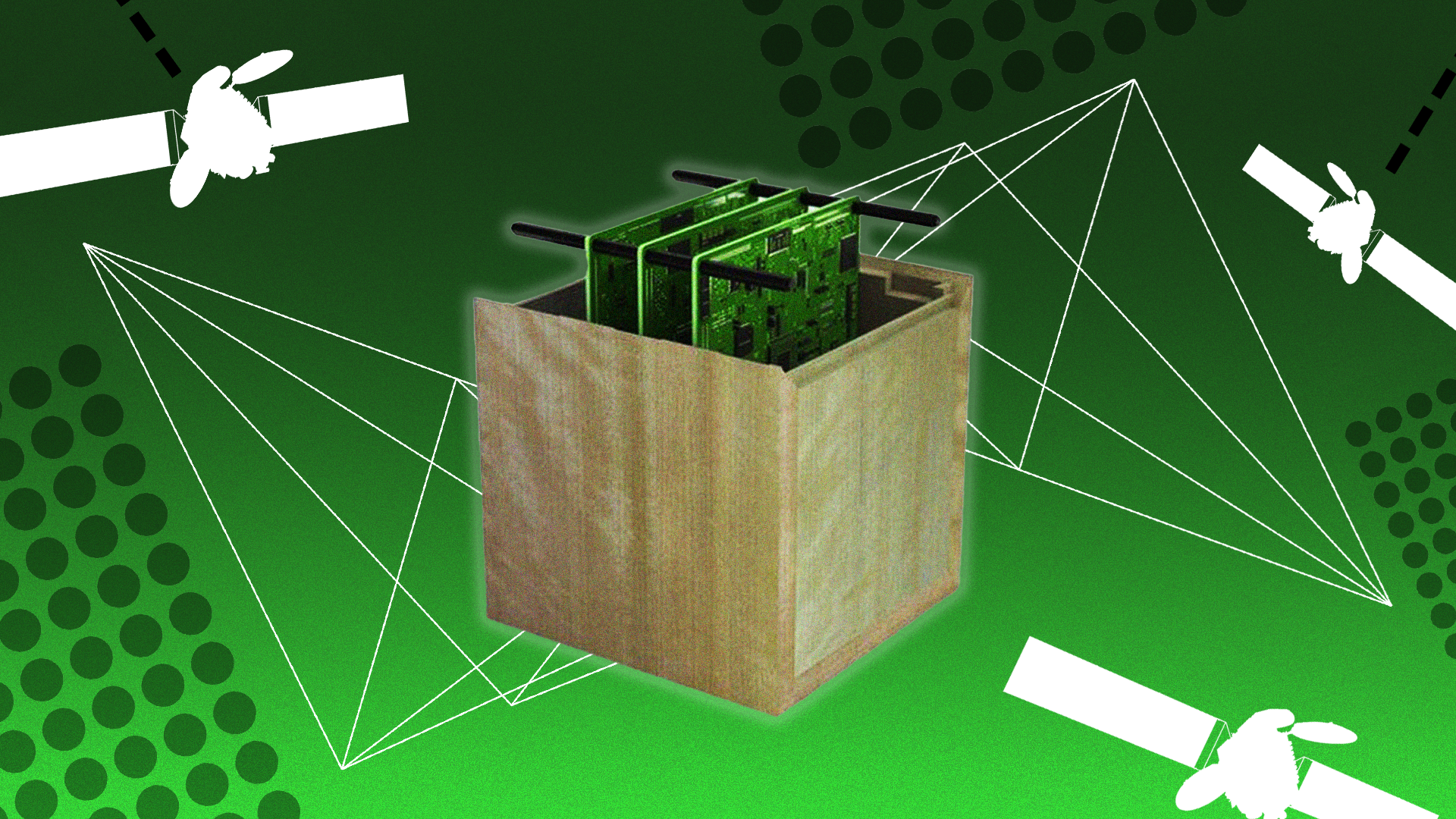
Kyoto University has teamed up with Sumitomo Forestry to create the first satellites made entirely of wood. It’s hoped that they’ll reduce the levels of space junk in our atmosphere.
If you thought human littering and wastage was a problem confined to just our planet, you may want to look into the ever-pressing issue of space junk.
More satellites are being launched into our atmosphere every year. Tiny alumina particles are created as the metals burn upon re-entry and stay within our upper atmosphere for decades. The issue is becoming so urgent that scientists are worried it will eventually begin to affect our environment and weather systems.
To combat this problem, Kyoto University and Sumitomo Forestry are joining forces to develop the world’s first wooden satellite by 2023.
The two parties will be experimenting with different types of wood and extreme planetary heat to see what’s most suitable, with the aim of eliminating space junk residue on future satellites. Switching materials would stop raining debris and harmful substances being released into the atmosphere. Pretty nifty, eh?
Technically they don’t work, at least at present. We’ve yet to see any wooden satellite actually operating or functioning – it’s all in the early research stages.
For now, Sumitomo Forestry is exploring tree growth and the behaviours of wooden materials in space to see what will be most suitable. No doubt the final thing will probably look sleek and modern, though it may have an entirely different interior to the traditional, metal based satellites we currently use.
Professor Doi, a professor at Kyoto University and Japanese astronaut, told the BBC that ‘the next stage will be developing the engineering model of the satellite, then we will manufacture the flight model’.
Meanwhile, Sumitomo Forestry says its current work on wooden material development is a ‘secret’. Is this a spy film? Seems we’ll have to wait a while to get the full picture.
How is space junk causing problems for Earth?
Space debris is becoming a very serious issue, particularly if we ever want to take off and fully commit to space travel. Elon Musk, I’m looking at you.
There are close to 6,000 satellites orbiting Earth right now, according to the World Economic Forum (WEF), and alarmingly over 60% of them are non-operational. That means that the majority of our space tech is outdated and defunct, spinning about the planet with no function except to clog up our atmosphere and emit harmful materials.
This is a phenomena that is only accelerating as we move into this decade. Research firm Euroconsult estimates that roughly 990 satellites will be launched every year throughout the 2020s, which would double our total orbiting satellites by 2030. That’s a lot of junk, people.
It also means that space junk collisions will become more common and present new hazardous challenges.
In 2006, for example, a small piece of space junk hit the International Space Station, which damaged a heavily reinforced window. Events like this will become far more frequent if things continue at their current rate, making rocket launches and space research more dangerous and unpredictable.
Japan’s new research could help in cutting these numbers back and ultimately make space innovation a more sustainable venture.
How is the space junk problem being combatted?
There are a number of things being developed and used right now to try and control the space junk issue.
For one, space-traffic management is an actual field of research, whereby scientists try to understand where all the debris floating about our atmosphere is. In theory, by keeping track of every piece of junk, satellite operators could manually move out of the way to avoid collisions.
It sounds great on paper but it’s a hard task in reality. A vast amount of space junk isn’t properly tracked or is decades old, meaning not everything is properly logged. Pinpointing every item’s location is extremely difficult.
Another proposal is to introduce ‘orbital-use fees’ for every satellite that’s flung into the skies. Having a price tag of over $200,000 USD per satellite would help cover costs for potential collisions and reduce the amount of items being sent into orbit. It would help quadruple the value of the satellite industry by 2040 too.
These ideas have merit, but they’re more coping mechanisms than actual solutions. Japan’s new research could be a game changer that clears up many issues surrounding space junk. We’ll have to wait until 2023 to see, but it’s likely the start of a space tech revolution.
I’m Charlie (He/Him), Deputy Editor and Senior Writer at Thred. I was previously the Editor full time at Thred before moving to Bristol in 2024. As a music and gaming enthusiast, I’m a nerd for pop culture. You can find me curating playlists, designing article headline images, and sipping cider on a Thursday. Follow me on LinkedIn and drop me some ideas/feedback via email.
All Discord users across the world will have to provide proof of age next month, or face being resigned to a ‘teen appropriate’ experience by default. Will this help Discord to finally address safety concerns regarding young users?
Discord has proven notoriously hard to police, but rising pressure in recent years has prompted the platform to roll out stronger safety measures for 2026.
When March rolls around, all Discord users across...
Scientists aim to better understand consciousness to test whether AI is truly sentient. But are humans prepared to handle that reality?
Though Artificial Intelligence has become central to many of our lives, there are those who worry that a Terminator-like reality might be on the horizon. What drives this concern?
The unnerving possibility of AI being a conscious entity.
While the debate over the nature of biological consciousness traces back to
Why are so many cosmetic doctors dishing out unsolicited advice on our appearance?
Cosmetic surgery is not the taboo it once was. These days, aesthetic enhancements are accepted as part and parcel of the modern beauty regimen – and celebrities who forgo them are considered trailblazers.
The normalisation of cosmetic medicine has triggered complex debates. Some believe it’s a blessing that once ‘secretive’ procedures are now out in the open – demystifying unrealistic...
‘Moltbook’ is a new platform made exclusively for AI to discuss any chosen topic. It operates exactly like Reddit, except humans can’t post. The company claims to have over 1.5 million users - are they all real?
For the past few weeks, the tech world has been buzzing over ‘Moltbook,’ a new social media network made exclusively for AI agents.
Modelled after Reddit, an extremely popular human-based forum website, Moltbook...
We use cookies to ensure that we give you the best experience on our website. If you continue to use this site we will assume that you are happy with it.
































 0 comments