0 comments
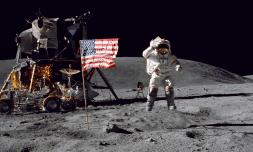
57 years ago, Neil Armstrong set his foot on the Moon’s surface, paving the way for lunar exploration. Now, the Artemis program aims to do the same, but with a twist: to prepare humans for Mars.
Since its launch, NASA’s Artemis II has been making global headlines.
From the obvious making of history, to the release of stunning visuals of the Earth and Moon, Artemis just keeps on giving. Since the program was first announced, it was widely thought that the first few missions would land humans on the Moon right away, just because we had done it over 50 years ago.
But here’s the thing, though both the Artemis and Apollo programs have the same destination in mind, their scientific and political goals are vastly different. In the 1960s, following Yuri Gagarin’s historic feat as the first human in space, President John F. Kennedy stood before Congress to deliver the words that would define NASA’s legacy.
In a bold gamble, he declared the US’s commitment to ‘landing a man on the Moon and returning him safely to the Earth’ before the decade’s end. With that, the Apollo program’s ultimate mission was set in stone.
Recent decades have seen a focal shift towards Mars, however, despite the National Space Council labelling the mission unrealistic during his first term. They had a point, too. How are we to establish a permanent base on Mars, if we can’t even survive for months on the Moon?
Creating another problem, a new foe in China joined the game and rapidly rose through the ranks. The nation’s Chang’e Project was hitting major milestones from landing a spacecraft on the far side of the Moon to returning lunar samples.
In an attempt to re-establish an enduring American presence, the Artemis Program was born.
Building beyond the Moon
For the Artemis program, NASA planned five main missions with the first having been an uncrewed lunar flyby in 2022, followed by the current Artemis II mission. The pinnacle of returning humans to the Moon’s surface is a feat reserved for Artemis IV in 2028.
Though it seems counterproductive from what NASA has already achieved with the Apollo missions, the organisation’s strategy is so much more than just another moon walk. In fact, Artemis I to IV are just the first phase of its plan.
In this phase, NASA aims to test its SLS rocket, Orion capsule, and commercial landers it is using from SpaceX and Blue Origin. In doing so, it hopes to ensure the safety of transporting humans to and from the Moon.
Phase 2 starts with Artemis V and involves heavy cargo such as the Lunar Terrain Vehicle and initial modules for the Artemis Base Camp being sent to the Moon. Then comes phase 3, that extends past the Artemis program, with the Moon acting as a dry run for Mars.