






 0 comments
Tech companies and AI slop have taken over the internet. As social media becomes increasingly homogenised, invasive, and polarising, there is now status in actively choosing to avoid the digital world entirely and rejecting the pursuit of a personal brand.

Zuckerbergs of the world, beware: offline living is on the rise with Gen Z.
Young people are increasingly turning off their phones, keeping their screens dark, and seeking out internet-free spaces to escape the overwhelming presence of social media and algorithmic feeds. Eugene Healey, a writer for Considered Chaos, describes this shift as ‘connected privacy,’ a new form of status symbol that rejects the constant pursuit of engagement and instead prioritises intentional restraint and self-control.
What does this mean, in real terms?
Melissa Fleur Afshar, a journalist for Newsweek, says that Gen Z and young millennials are feeling a ‘growing disillusionment with social media’ and are taking steps to reduce their screen time. This includes deleting accounts on sites like TikTok, using older technology such as flip phones and disposable cameras (which we’ve covered before), and embracing ‘digital minimalism.’
Digital detoxing is on the rise too, with consumer appetite for experiences without internet access growing amongst Gen Z, especially travellers and campers.
Research shows that holidaymakers are yearning for time away from the algorithm, with demand for detox retreats seeing a 47% yearly rise among those aged 18-26. The 2025 Hilton Trends Report also claims that 27% of all travelling adults plan to reduce social media use when on holiday this year. It’s become such a big deal that even the BBC has taken note.
View this post on Instagram
For everyday life, apps that lock your phone after a certain amount of time such as Forest, Off the Grid, and Freedom have found an audience with Gen Z.
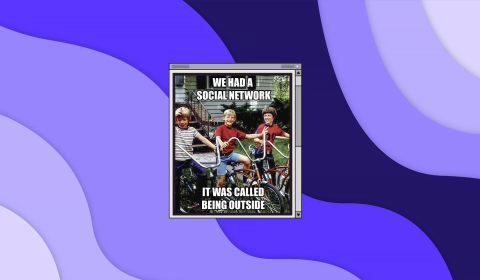
More young people are deliberately choosing to have screen-free days, attending in-person events rather than chatting online, and ultimately being more considered with their phones and laptops. There is a greater, universal understanding today that social media platforms can be harmful, a key shift this decade compared to the early millennial experiences of the noughties. We’re all looking to touch grass.
It’s not hard to see how we got here.
When Facebook and Instagram first launched, they focused solely on our friends and were genuinely social. Our feeds were chronological, not skewed toward influencers and wider creators. Once algorithms were introduced, our real-world connections were replaced by celebrities, corporations, and optimised content designed to maximise watch-time and engagement.
This meant that our screens steadily became hijacked by random, nonsensical videos and posts from accounts we’ve never heard of.
The emergence of AI in the past five years has only compounded the problem, with most feeds now diluted, bloated, and significantly less valuable and interesting. It’s starting to really feel like social media is a waste of time, especially as cheap AI slop seeps into every corner of the internet and billionaires like Elon Musk take over once-beloved platforms like Twitter/X.
For Gen Z, this internet-obsessed climate is normal. They’ve grown up with the pressures of creating a personal brand and accumulating followers all their lives. The expected mindset is that if you don’t post about something, it didn’t happen. Our digital selves are just as important – if not more so – than our real-world lives. By deciding to go ‘offline,’ Gen Zers are intentionally breaking the norm and rejecting modern standards.
As Eugene Healey writes, however, to actually do that requires a substantial amount of tangible capital and personal security.
For most of us, we have to be on the internet to find a job, make connections, stay in the loop and keep up with the demands of education, work, and our social lives. Those who genuinely step away are only able to do so because they have the resources necessary to self-manage without a personal brand. The rest of us are chained to the internet, scrolling LinkedIn for work and finding opportunities wherever we can.
This is why truly living offline is a luxury and a modern flex. The internet and its algorithms have become so ever-present that escaping their clutches is an achievement in and of itself. It’s clear that offline detox experiences are emerging as part of a sizable new market, and things are only set to expand as Gen Z becomes even more sick of AI and endless feeds.
See also:
- Gen Z are turning thirty…do they look it?
- The rise of #RichTok, Gen Z’s latest escape
- How are publishers pushing Gen Z to read?