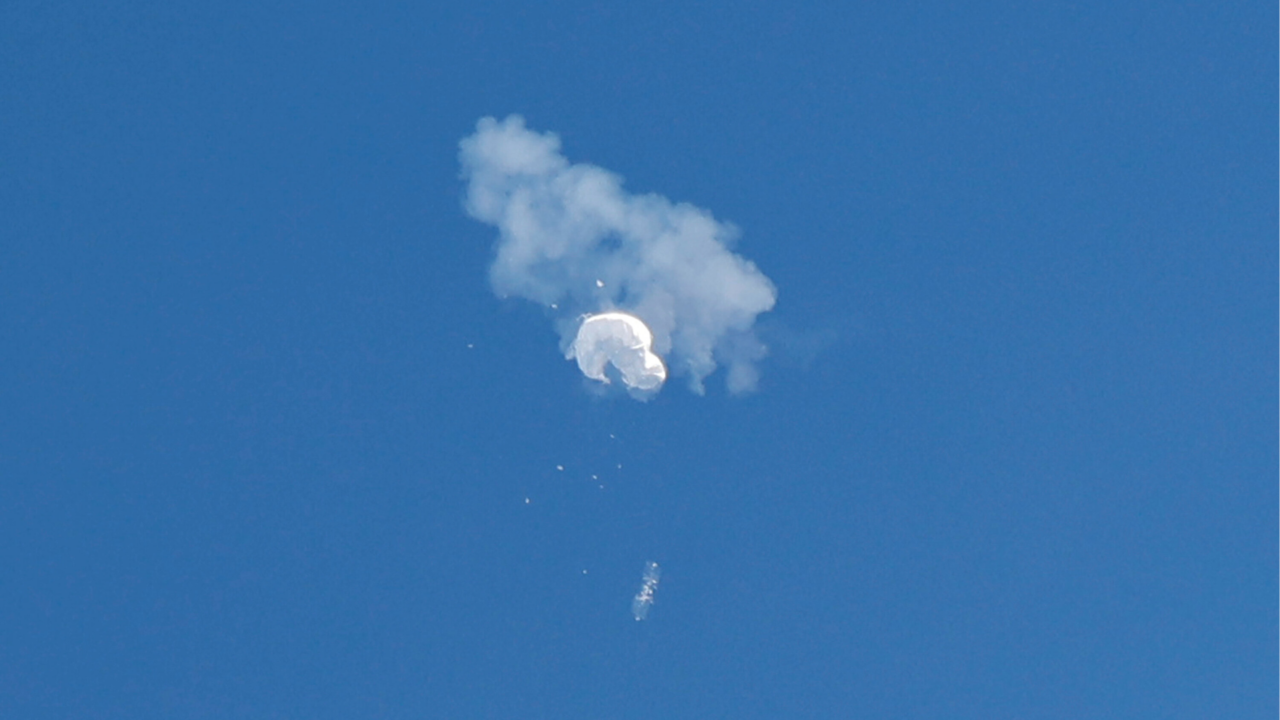
The US Armed Forces have shot down a gigantic flying balloon, now known to be linked to China, that was hovering in its airspace for a number of days. As intelligence services analyse the debris, questions are arising about what it could mean for the two nations’ already complicated relationship.
Over the weekend, reports that a gigantic spy balloon was floating across American soil created the perfect cocktail for news broadcasting sensationalism and comical social media conversation.
But for government officials and national security officers, the balloon is anything but funny. Both have stated that there is no doubt the device was a Chinese spying mechanism.
The gigantic balloon – comparable to the size of three school buses – is known to have been carrying numerous sensors and surveillance equipment. Suspicions of information gathering have been further by the aircraft hovering for long periods above Montana, where American nuclear warheads are stationed.
On the carefully timed orders of President Biden, a US Air Force fighter jet was deployed to successfully shoot down the balloon on Saturday. After just one attempt, debris exploded across seven square metres of shallow ocean off Carolina’s coast.
As pieces of the balloon and its onboard technology are collected, its consequences for the state of US-China relations will become clearer.
Giant balloons have been used for international surveillance since the French Revolution and were later used by both the United States and the Soviet Union during the Cold War.
Nowadays, drones are far more stealthy and efficient for information gathering, but balloons can be favoured for their low cost during production and deployment stages.
The one shot down this weekend was spotted hovering at 60,000 feet. This is lower to the ground than satellites, but higher up than commercial aeroplanes. At least two similar balloons believed to belong to China have been noticed flying over Latin America in the last week.
Not to mention, the inconspicuous design of the balloon has made it easy for China to claim the device was used for reasons unrelated to information gathering. So far, Chinese officials are holding firm to this kind of notion.
They say that the balloon was simply a civilian airship used for meteorological research that drifted off course due to its ‘self-steering’ technology being overridden by high winds. China also expressed its discontent at the aircraft being shot down.
Collection of the debris is underway, but until the pieces can be fully assessed by the US government there will continue to be speculation about the true motivations for the balloon.
What has the fallout been so far?
Many believe it was no coincidence that China sent a balloon across the Pacific at this time. US intelligence services learned of it only days before the Secretary of State Antony Blinken was scheduled to visit Beijing, China for a meeting with top leaders.
During the visit, representatives from each nation were to attempt to iron out issues with their long-fragmented political relationship. However, once the US became aware of the balloon, the trip was scrapped.
Considering that the device was not armed, US officials believe that China performed this stunt to send a message about its growing level of power over the world economy.
China is already on track to become a major financial superpower in the not-so-distant future and it could very well dethrone the US as a leading global nation.
Intelligence experts have stated that the balloon could be China postulating their belief that ‘the United States is a once-great superpower that’s holloed-out, that’s in decline.’
Considering the US deployed balloons during the Cold War, China could be taunting American officials with an ‘anything you can do, we can do too’ attitude.
The coming weeks will be telling, as information about the believed radar and solar-powered mechanics on board the balloon will be revealed.
In regard to how the relationship between the two superpowers is affected in the long term – let’s just say chances of forming a renewed sense of trust is unlikely anytime soon.
Deputy Editor & Content Partnership ManagerLondon, UK
I’m Jessica (She/Her). I’m the Deputy Editor & Content Partnership Manager at Thred. Originally from the island of Bermuda, I specialise in writing about ocean health and marine conservation, but you can also find me delving into pop culture, health and wellness, plus sustainability in the beauty and fashion industries. Follow me on Twitter, LinkedIn and drop me some ideas/feedback via email.
From promises of opportunity for young people to policing playlists on public transport, Andy Burnham's government has had a busy month. But is Labour tackling Britain's biggest problems, or simply the most visible ones?
A month ago, I was in Liverpool, surrounded by politicians, journalists, campaigners, and enough Labour Party lanyards to last a lifetime.
I attended the annual Labour Party Conference with the Patchwork Foundation as a non-party...
At 24, Gen Z workers born in the late 1990s are apparently being paid more than any cohort since those born in the 1950s. The bigger picture isn’t quite so rosy, however.
Gen Z’s early careers are more financially rewarding than those of millennials, according to research from the Resolution Foundation, a British thinktank.
It says that those born between 1997 and 2012 are experiencing a ‘mini rebound’ in pay packets,...
New rules governing hospital wards promise to protect women’s privacy and dignity. But an internal assessment suggests that, for transgender patients, the consequences could be delays in treatment, discrimination and a growing reluctance to seek medical care.
When we think of a hospital, we tend to imagine a place where our differences become secondary to our needs. We go there when we’re our most vulnerable and trust strangers with our...
The return of the annual haze, worsened by the El Nino phenomenon has left Southeast Asia grasping at straws for Indonesian accountability.
It has been months since I have breathed a week’s worth of fresh air here in Malaysia. On some days, low visibility makes it difficult to see what’s right ahead of you, while nights are plagued with the smell of smoke.
This is the stark reality of the transboundary...
We use cookies to ensure that we give you the best experience on our website. If you continue to use this site we will assume that you are happy with it.

















 0 comments