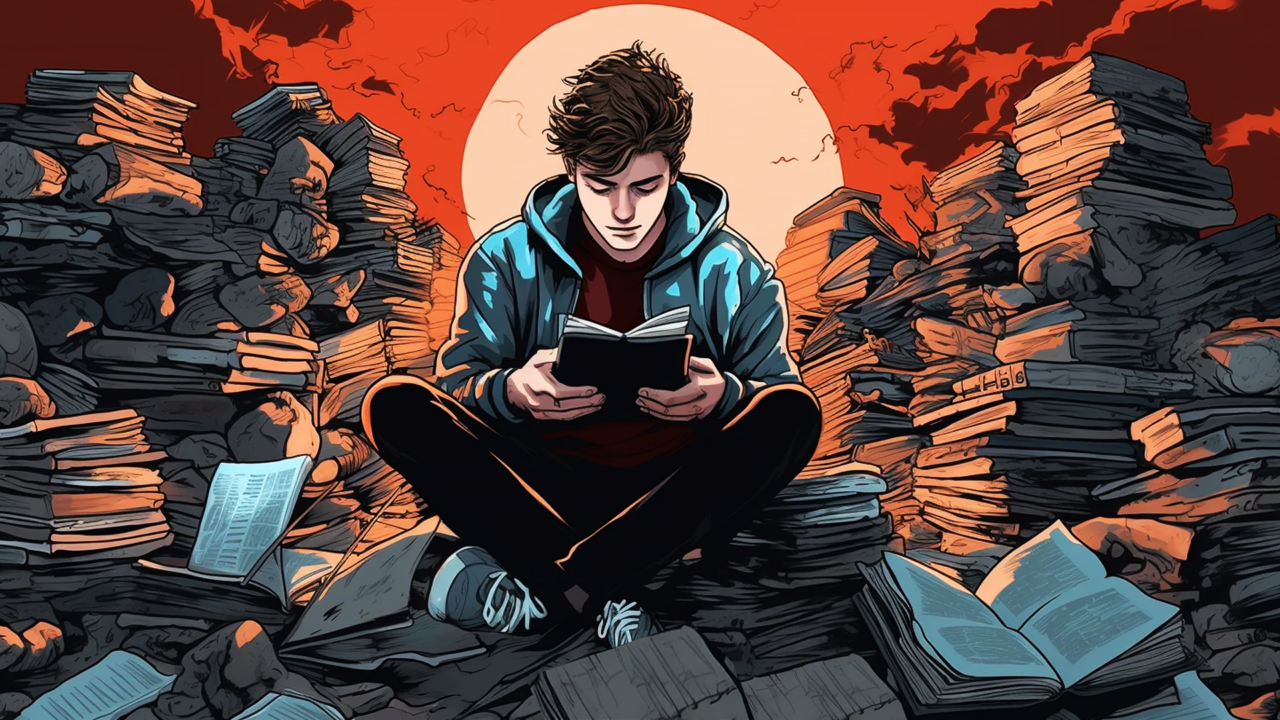
College professors in the United States are noticing a considerable drop in the number of students willing to do reading for their course. Is an uptick in short-form digital content to blame, or is it something else?
In an age where our attention spans are getting shorter and shorter by the day, who has the time or patience to read long-form text anymore?
Apparently, not even students enrolled in higher education.
College professors from Illinois’ North Central College have recently sounded the alarm on the amount of reading their pupils are completing, which is – apparently – not a lot.
‘For most of my career, I assigned around 30 pages of reading per class meeting as a baseline expectation,’ wrote philosophy and humanities professor Adam Kotsko in an editorial for Slate.
‘Now students are intimidated by anything over 10 pages and seem to walk away from readings of as little as 20 pages with no real understanding,’ he continued.
Blaming our almost constant use of technology or addiction to screen time seems like the low-hanging fruit here – and it’s not an entirely bad guess.
Thanks to short-form content on social media, such as TikToks and Instagram Reels, young people have become adapted to consuming information about a wide range of topics in bite-sized portions.
We passively consume information on our smartphones while on the way to class, work, or even before bed. When craving a deeper dive into certain subject matter, we carve out time for movie-length documentaries or long-form YouTube videos.
It’s unsurprising then, that learning through video has become the preferred method for 60 percent of students aged 14 to 23.
Interestingly though, US-based professors do not solely blame technology for students’ disinterest and difficulty with reading long-form coursework.
Professor Adam Kotsko and his colleagues believe multiple years of disrupted education during the Covid-19 pandemic have hindered the progression of their students’ reading comprehension.
Long periods of forced independent learning may have also caused young people to lose confidence in their ability to read, understand, and finish longer pieces of text.
‘Even aside from the impact of smartphones, their experience of reading is constantly interrupted by their intentionally cultivated inability to process unfamiliar words,’ Kotsko writes.
This, he explains, is only exacerbated by the fact that teachers are responding to student’s hesitancy towards reading by providing them with shorter and shorter reading assignments.
It’s worth noting that the potential impacts extended lockdowns would have on education globally were well discussed throughout the pandemic.
As a result, the fact that college students of recent years are struggling to keep up with the demands of advanced-level coursework should really be surprise to no one.
That this trend is becoming obvious only signals that the next generation of college newcomers will require extra support when adapting to the amount of reading required of them in higher education.
That said, I’m sure most young people would agree it is refreshing to hear leaders in education point to something other than modern technology as the primary reason for young people’s inability to focus or commit to studying for once.
Deputy Editor & Content Partnership ManagerLondon, UK
I’m Jessica (She/Her). I’m the Deputy Editor & Content Partnership Manager at Thred. Originally from the island of Bermuda, I specialise in writing about ocean health and marine conservation, but you can also find me delving into pop culture, health and wellness, plus sustainability in the beauty and fashion industries. Follow me on Twitter, LinkedIn and drop me some ideas/feedback via email.
The fight for reproductive rights never ends, especially when lawmakers actively work against their constituents.
It has been over three years since Roe v Wade was overturned. The case that set a precedent for 49 years since its 1973 ruling protected a woman’s right to choose abortion without any excessive government restriction.
In June of 2022, however, a majority of the Supreme Court’s Justices came together to rule that the US...
Experts believe a weakened food security system has left Britain vulnerable to riots and unrest.
Britain has never been self-sufficient when it comes to food. It’s a tiny island that – until immigration and colonisation brought the gift of global cuisine – survived mostly on bread and potatoes.
But thanks to modern trading systems, food security isn’t something we tend to worry about in the UK. We have fancy supermarkets and expansive restaurant...
A new study challenges the years’ worth of negative media portrayal of GLP-1, revealing its potential benefits in treating and preventing substance use disorders.
In these past few years, GLP-1 has become the centerpiece of cultural renaissance.
Discovered in the early ‘80s, the hormone was solely developed to treat Type 2 diabetes, with the first FDA approved variant being approved years later in 2005.
Coincidentally, during the early clinical...
Thousands of flights were cancelled on Monday as air travel faced major disruption following US-Israeli strikes. The Trump administration has indicated that upheaval could last another four weeks.
Global air travel has faced major disruption as a result of the US-Israel war on Iran this week, with thousands of flights cancelled and passengers stranded.
According to The Guardian, airline and travel share prices have fallen sharply after several days of...
We use cookies to ensure that we give you the best experience on our website. If you continue to use this site we will assume that you are happy with it.
































 0 comments