






























 0 comments
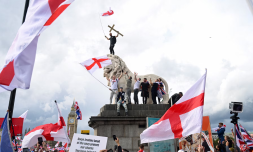
The Unite the Kingdom rally with 110,000 showing up in support of Tommy Robinson’s call for mobilisation is one of the largest political rallies in recent times. Far-right sentiment is undoubtedly growing, and the reality of the foreigner is scarcely considered.
The clashes and the violence against the police all point to how the far right ideology is spreading rapidly and becoming a growing threat to the ‘foreigners’ of London.
And for those who form the lifeblood of London, this change is personal. It affects not only their politics but also their daily life, the way they speak, and the way they act.
People come to London for plenty of reasons: a refugee escapes their war-torn country to find a safe haven, a student arrives to attain world-class education they wouldn’t be able to access back home, and a worker travels to earn a living in order to sustain their family abroad.
Someone flees repression in pursuit of love denied elsewhere. Together, they build the fabric of the city – its universities, hospitals, businesses, and cultural life.
Ironically, the very people who contribute so tangibly to earn the city its reputation as Global Britain are also the most vilified by beliefs such as Robinson’s.
Not all nationalists should be tarred with the same brush, but equally, there is rarely any consideration given to the country’s foreigners and the feeling of marginalisation they’re becoming accustomed to.
‘Belonging can be fragile’
For Shaf, a recent King’s College London graduate of Pakistani origin, the rally was a jarring reminder of the fragility of belonging:
‘Watching a rally that polarises communities that I belong to, made London feel less welcoming in that moment. It reminded me of the fact that belonging can be fragile and it made me emotional since I always felt like home in London.’
For many young people from similar backgrounds, recent far right incidents were a reminder that acceptance can be withdrawn at any moment. The rally also triggered discussions at home.
‘With family we would talk more about reassurance, since I live alone here’, says Shaf. ‘It was almost like a natural response to talk to your family to feel safer, when the place you live in does not feel like home anymore.’
The most intimate of spaces, conversations with family, become consumed with language of safety when the outside world becomes hostile.
The ripple effects of far-right violence are subtle yet pervasive: an extra glance over the shoulder, recovering what to post online, even thinking of ways to look less visible. Fear seeps into the everyday, shared Shaf:
‘Mostly they take the form of microaggressions, extra safety precautions and fearful conversations. These are extra tasks that are invisible in headlines or debates but exhausting in real life.’
‘Perhaps this hatred was always here for me’
While some adjust to the realisation of being unwelcome, there is an awareness among others that there always existed this sentiment of xenophobia to some degree and form. Manahil, who grew up in the UK, says,
‘In hindsight these far right rallies and rise of conservatism just makes me believe that perhaps this hatred was always here for me but now that there is such a great platform (i.e. reform), the need for them to perform and spew out this hatred has become a mouthpiece for how I was always seen as the “other” in this country, never truly accepted.’
In her life, this takes the form of constantly being cautious of what she speaks:
‘As someone who moved out for uni coming from a small town, I have to be extra careful in what I say or if someone approaches me to ask about even basic things, that they don’t have an excuse to justify their verbal/physical attack on me i.e. any sign showing a political stance on something.’
‘I’ve spent over £100,000 and still don’t feel welcome’
In 2023/24, there were 732,285 overseas students studying in the UK, making up 23% of the total student population.
Often, universities charge international students exorbitantly large fees (arguably the income they survive on) as opposed to home students whose fees are capped at £9,535 currently.
Syed, an international student at Cambridge, shares that he has spent over £100,000 in tuition fees and immigration charges in the past three years and does not feel like either him or his wife will ever feel welcomed into the UK. For Syed, this hostility shapes daily routines:
‘My wife is someone who wears the hijab and I always fear for her safety and because of these sort of protests, she always has to be home early during daylight hours in order to protect herself.’
In 2024, the police noted that nearly two in five of all religious hate crimes targeted Muslims, indicating an increase of 13% compared to 2023, creating a sense of fear among the community in London.
There is a sense of betrayal, that despite investing so much money and time into building a life in the UK, only to keep to themselves and care for their family, people such as Syed and his family must face Islamophobia and xenophobia.
When questioned about what advice he would give someone back home about coming to the UK, he replies firmly:
‘I would advise them to not come into this country because of such massive immigration changes because of these far-right protests, it makes it very difficult to stay in this country.’