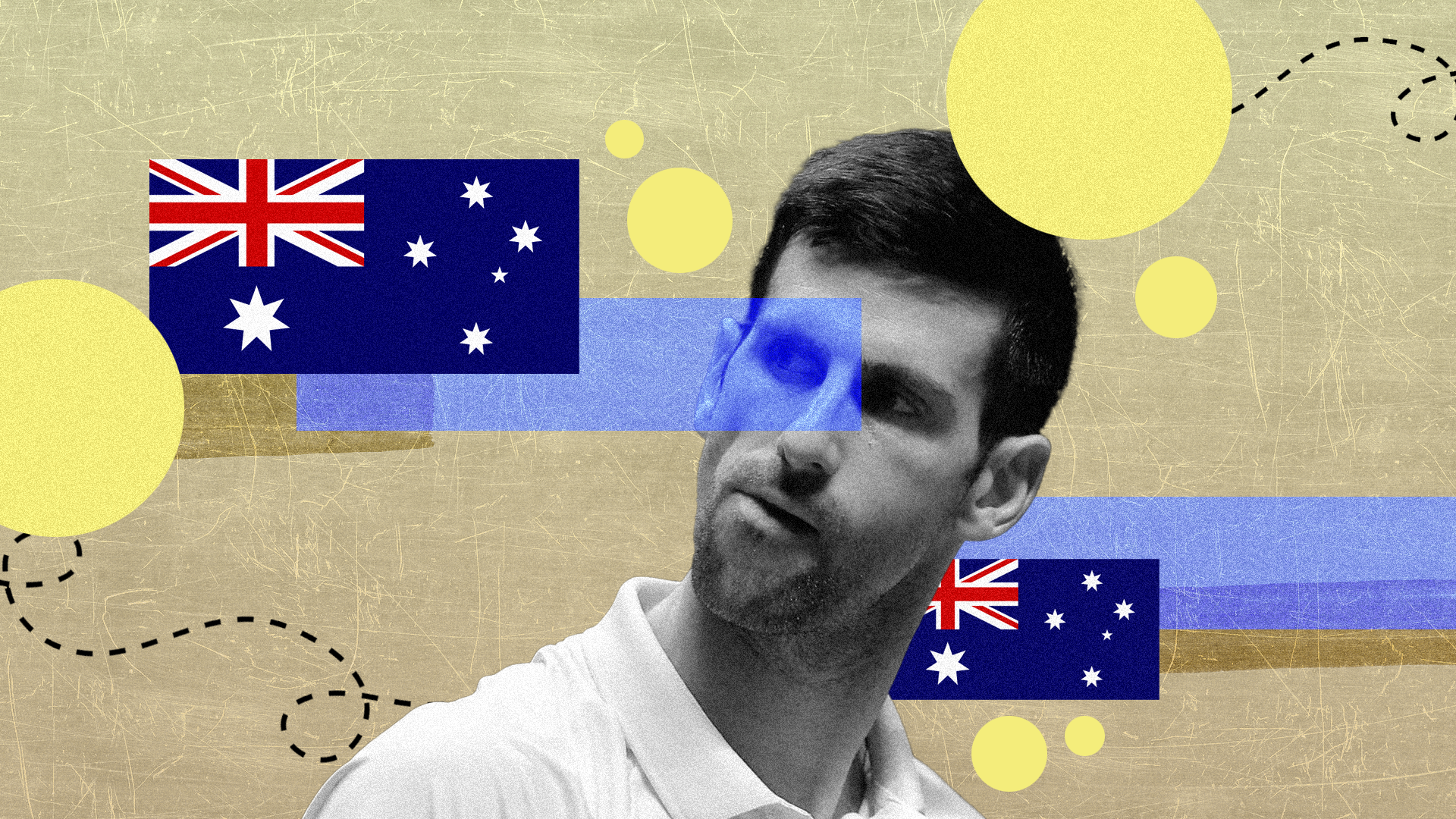
Tennis star Novak Djokovic became the target of public scrutiny and international support after the Australian government decided to cancel his visa. But now that a judge has overturned the decision, the player’s dispensation shines a light on our deeply flawed attitudes toward refugees and displaced people.
Serbian Tennis star Novak Djokovic had dreams of playing the Australian Open this week. But these hopes were prematurely dashed when the Australian government revoked his visa upon his arrival in the country.
Djokovic, who is unvaccinated and has expressed public disdain toward the Covid-19 vaccine (along with other dubious medical beliefs), was placed in temporary detention amid questions over his vaccine exemption.
In wake of the news, Djokovic’s supporters rallied outside a hotel in Melbourne where he was rumoured to be held.
Two disparate social causes have been drawn together through the Djokovic fiasco. Both fighting against the Australian government’s detention policies.
Chants to ‘free Djokovic’ flooded the streets, where – for years – pro-refugee protesters have called to abolish the hotels-turned-detention-centres holding asylum seekers.
On the second day of protesting last Friday, around 50 people gathered with anti-vaccine placards and images of the tennis star. Peppered amongst them were the pro-refugee posters, calling for the freedom of those trapped inside.
But unlike those who have gathered outside these hotels for years, calling out Australia’s archaic approach to the refugee crisis, it was a mere few days before the demands of Djokovic supporters were met by authorities. On Monday, to the surprise of many, a judge overruled the government’s decision and the tennis player’s visa was reinstated.
Djokovic has since admitted to breaking lockdown rules after testing positive for Covid-19, and lying on his travel form prior to entering Australia.
His reasoning for breaking isolation – to attend an interview – was that he ‘didn’t want to let the journalist down’, deciding that a mask would suffice in protecting others. Except, of course, when his photograph was taken – for which he dutifully removed his face covering.
Djokovic’s outrageous behaviour has rightly caused furore amongst global onlookers. It’s the same selfish attitude signposting our government’s lockdown parties, a belief that one’s own interests outweigh the sacrifices of the general population.
But Djokovic’s visa battle has also highlighted the fundamental flaws in our global response to refugees and displaced people.
Mark Kersten argues that the noise surrounding the tennis player’s detainment has distracted from the plight of thousands of asylum seekers who have been denied entry to Australia and remain held in detention camps across the country.
After only four days, Djokovic walked free, smiling at his supporters with a gleeful wave. Playing the role of hero – an oppressed figure who resisted tyrannic governmental powers and won.
Djokovic is no hero. He is rich, white, and adored by the general public. He is a hugely successful sportsperson, with the ability to defend himself in court and garner widespread support from a blindly defensive fanbase.
When he walked out of the Melbourne hotel in which he had been held, Djokovic left hundreds behind. Individuals who have fled war-torn countries in the hopes of a better life.
Australia boasts one of the most repressive policies toward asylum seekers, with a zero-tolerance approach for those who reach its shores.
These displaced people are unprotected by any body of law. Their living conditions are not monitored and are often inhumane – even deadly. Reza Barati, who arrived in Australia in 2013, was killed by two guards at the detention centre where he was being held just six months after his transfer.
Perhaps most alarming is that many international lawyers believe the conditions in Australian detention centres amount to international crime. As a former detention manager stated ‘In Australia, this facility couldn’t even serve as a dog kennel. Its owners would be jailed.’
The reality of these policies is distressing. But Djokovic’s association with asylum seekers by international supports, who have compared his treatment by the government to that of detained refugees, is perhaps most disturbing.
It reveals a gaping chasm in our social outlook: our inability to see – or simply care – about human rights violations when they don’t impact ‘tangible’ figures.
Djokovic has a public face, but thousands of others are reduced to statistics. Their experiences are so unfathomable and far removed from our own that we fail to comprehend our capacity to help.
Thousands have called out the hypocrisy of a government who has pushed stringent Covid-19 laws since the pandemic began, many tearing families apart.
But the public response to Djokovic’s case – both those in support of his plight for a visa, and those denouncing his ‘battle’ as a media farce – has proven that the same public scrutiny isn’t afforded to global refugees.
If only we applied the same energy, media coverage, and inflamed tweets to those who remain inside Australia’s hotels, some who have been held there for years. Perhaps we might someday see them emerge, with a smile and a wave, into the new life they dreamt of when they arrived.
I’m Flo, (She/Her) a Senior Remote Writer at Thred. I recently completed a Masters in Visual Anthropology, and seek to interrogate the ways digital spaces can amplify marginalised voices in the arts and cultural sectors. Follow me on LinkedIn or ping me some feedback via email.
As in many parts of the world, Africa’s Gen Z faces uncertain starting salaries and rising living costs, making moving out of the family home increasingly difficult.
For young Africans, the question of whether their first salary will be enough to live independently often comes down to how much remains after paying rent.
Living alone offers freedom. It means having privacy, managing your own schedule, and inviting friends over without needing...
Students, teachers, and parents have taken to the street to protest France’s crippling education infrastructure. However, as the movement started to gain nationwide traction, so did violence, driven by clashes with the riot police.
These past few weeks have seen intense waves of violence associated with student-led protests in France. What started as a local walkout by teachers at a high school in Créteil quickly turned into a nationwide...
After surviving two doses of a drug intended to kill her, Christa Pike is at the centre of a high-profile legal battle that’s shone fresh light on the absurdity of humane execution.
Last week, Christa Pike survived an attempt on her life. Now doctors at the Tennessee hospital where she’s being held are working tirelessly to save her. Reports state Pike is ‘angry and confused’ about what happened to her,...
When it comes to social change in 2026, Gen Z has lost all the vim of yesteryear. When and where was this energy lost? Let’s break it down.
In the late 2010s Gen Z was synonymous with social change, a broad catch-all term encapsulating the desire for a more equitable and just world.
In 2026, however, the cohort is now more likely to be mentioned in the same breath as subjects...
We use cookies to ensure that we give you the best experience on our website. If you continue to use this site we will assume that you are happy with it.






























 0 comments