






 0 comments
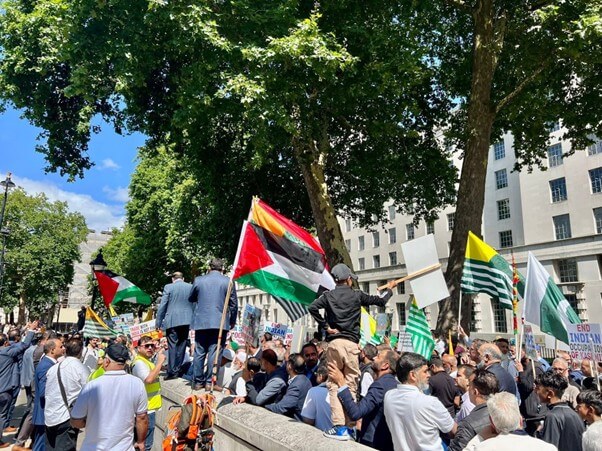
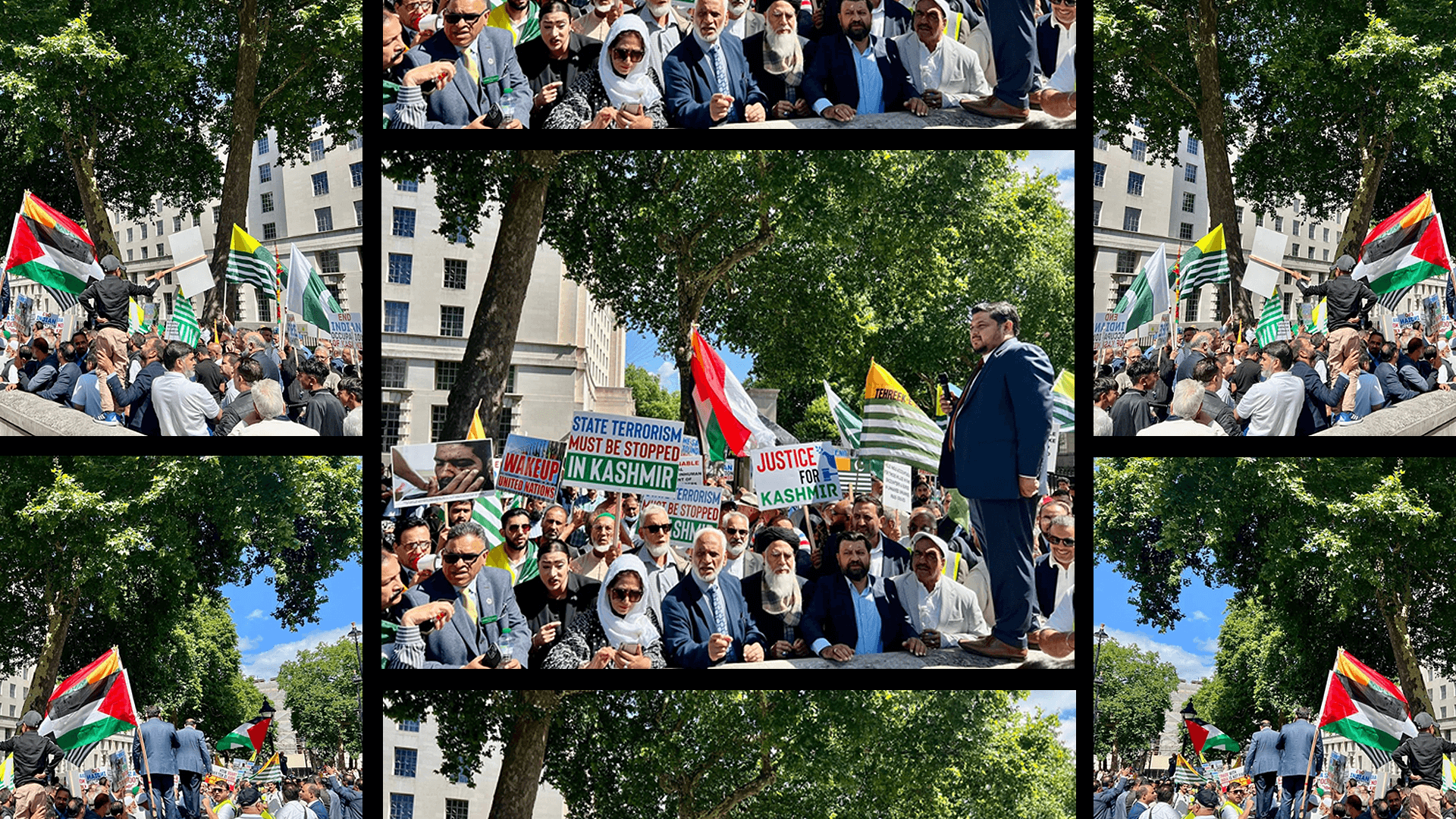
On 5th August, hundreds of protestors marched from 10 Downing Street to the Indian High Commission against India and Israel’s occupation of Kashmir and Palestine respectively. Here’s my experience and thoughts on reflection.
Under the blazing London sun, the crowd moved as a single unit with placards held high, visuals of injured civilians, the flags of Azad Kashmir or Pakistan-administered Kashmir and Palestine waving side by side, and slogans calling for an end to human rights abuses.
Chants of ‘Hum Kya Chahte? Azaadi (What do we want? Freedom) ricocheted off the walls of the Indian High Commission in an expression of dissent.
It had been exactly six years since India revoked Kashmir’s autonomy.
5th August 2019: a date marked by loss
Since the year 1948, Kashmir has been contested between India and Pakistan with a third portion coming under Pakistan and around two-thirds under India (a disputed territory as per the UN, albeit administered by India and Pakistan).
When the Indian President signed an order decades later in 2019 to revoke its autonomy, Kashmir lost many things: its constitution, its police force, its flag- but most of all, its semi-autonomous status.
This meant that Kashmir’s ability to make domestic policies (except in finance, defence, foreign affairs, and communications) and govern itself, came under direct control of the Central Indian government, viewed as problematic by those who feared influence slipping out of the hands of regional authorities.
An added layer of controversy was that prior to signing this order, Kashmiri politicians – including then Chief Minister Mehbooba Mufti – were placed under house arrest and no democratic vote or process was held to determine the will of Kashmiris, who were also put under lockdown.
This meant that not only was this transition devoid of the consent of the very people it would impact, but also that of the representatives that were put in place to voice their interests.
State violence in Kashmir and Palestine
Reflecting on the horrors of everyday life in Kashmir, the Palestinian resistance resonated deeply with the protestors outside the Indian High Commission.
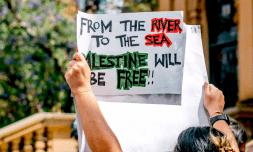
Across the street, a common theme of intersectionality resonated; Gen Z banners read ‘From Kashmir to Palestine, Occupation is a Crime’.
In a crowd of hundreds, an orange cloth-clad Buddhist monk, Ajahn Santanamo, quickly caught my attention; Ajahn’s presence challenged popular assumptions about identity-based activism.
When asked what drew someone from his background to demonstrate for Kashmir and Palestine, especially at a time when people may choose causes for identity-related reasons, he didn’t hesitate:

‘Unfortunately, all mainstream Buddhist institutions have just been silent.
I feel in order to have compassion, surely we must take into consideration the system and structures of oppression that operate in society and then the material conditions which bring about suffering…so I’ve been to maybe three of these Kashmir protests and then ones for Sudan, for Congo.
It’s so important to interconnect all these different struggles because of the same forces of capitalism, imperialism, etc.’
When questioned about the role of state violence in Kashmiri and Palestinian contexts, Ajahn shares:
‘At the moment with the far-right Hindutva fascism, it’s disturbing how they use the rhetoric of Islamophobia and terrorism to justify their policies.’
For many protestors, this cause wasn’t restricted to geography; it was about ideology. The justifications behind apartheid, land grabs, surveillance, and dehumanisation in both Kashmir and Palestine, were seen as universal tools of oppression.
Drawing parallels between the Palestinian and Kashmiri resistance, Aneeq Haider, a Kashmiri activist, pointed out the strategy used by India and Israel to defend their actions.
‘Jo genuine resistance hoti hai uss ko daba ke wou terrorism ka naam de dete hain aur apne self defense ko ek bahana bana ke occupation ko whitewash kar dete hain.’
(The genuine resistance is suppressed and labelled as terrorism, while they use self-defense as an excuse to whitewash occupation.)
Zaffar Ahmad Qureishi from Kashmir Campaign Global (KCG) spoke boldly about the ideological underpinnings of the Indian government’s actions in Kashmir:
‘India’s RSS-inspired Hindutva ideology believes in Hindu supremacy and seeks to create an “Akhand Bharat”, a mythical Hindu empire stretching from India to Saudi Arabia, even including the idea of conquering the Ka’aba and replacing it with idols they believe once existed there.’
Zaffar went on to explain that both Palestine and Kashmir existed as independent political entities originally and that the atrocities therein have been primarily targeted at Muslims. Kashmir being a Muslim-majority region, critics argue that the Modi-led government uses oppressive tactics in the valley to further their majoritarian campaign, fuelling accusations of Islamophobia.
Kashmir is a Muslim-majority region and critics argue that the Modi-led government uses oppressive tactics in the valley to further their majoritarian campaign, fuelling the many accusations of it being an Islamophobic regime.