






 0 comments
Interest rates are accumulating by the second, and young people are leaving university saddled with debt. When did student finance become such a political minefield?
Student debt has always been an unsavoury aspect of adulthood. It’s long been accompanied by hushed tones and avoidant stares. Nobody wants to talk about the fact they’re tens-of-thousands of pounds in debt before the age of 25.
But before I went to university it was always brushed off as something I’d ‘never even notice’ – that Student Finance England would sneak into my paycheck, scoop up a few errant pennies tantamount to a monthly phone bill, and scurry off into the shadows before I could miss them.
The reality has been somewhat different. Since leaving university I must admit I’ve avoided looking at my loan balance, given it’s amassed an eye-watering amount of interest since I graduated.
I don’t regret my degree by any means, but I also don’t consider it to be worth the large sums of money I’ll now likely owe the government for the rest of my life. Not to mention the fact that my final year of undergraduate study landed in the midst of a pandemic.
Two out of three of these terms were spent on zoom, with lacklustre digitised versions of my course dished out by frantic professors who were also navigating this life-changing scenario for the first time. I sympathise with them, of course, but it doesn’t change the fact I certainly didn’t leave university with the degree I’d paid for.
I’m not alone in my gripes. A friend of mine recently got a job in Australia, and in the process of sorting her paperwork was confronted with the question of her student loan. Navigating the bureaucracy associated with this debt is enough to give you a headache before you even tackle the inflated sums of money you actually owe. She was suddenly up close and personal with the very ugly details of something we’re all essentially forced into – if we want to pursue higher education anyway.
As a cost of living crisis continues to dampen our twenties, housing prices send homeownership flying beyond the realm of reality, and international conflicts wage on, my generation are feeling pretty fed up. So it’s no surprise many of us are pursuing pastures new. But this has placed a microscope on the injustices of our country’s student loans system.
Given collective anger has been mounting for some time, it was inevitable that it would explode at some point – and that some poor sod would be caught in the firing line. That someone, it turns out, is Rachel Reeves.
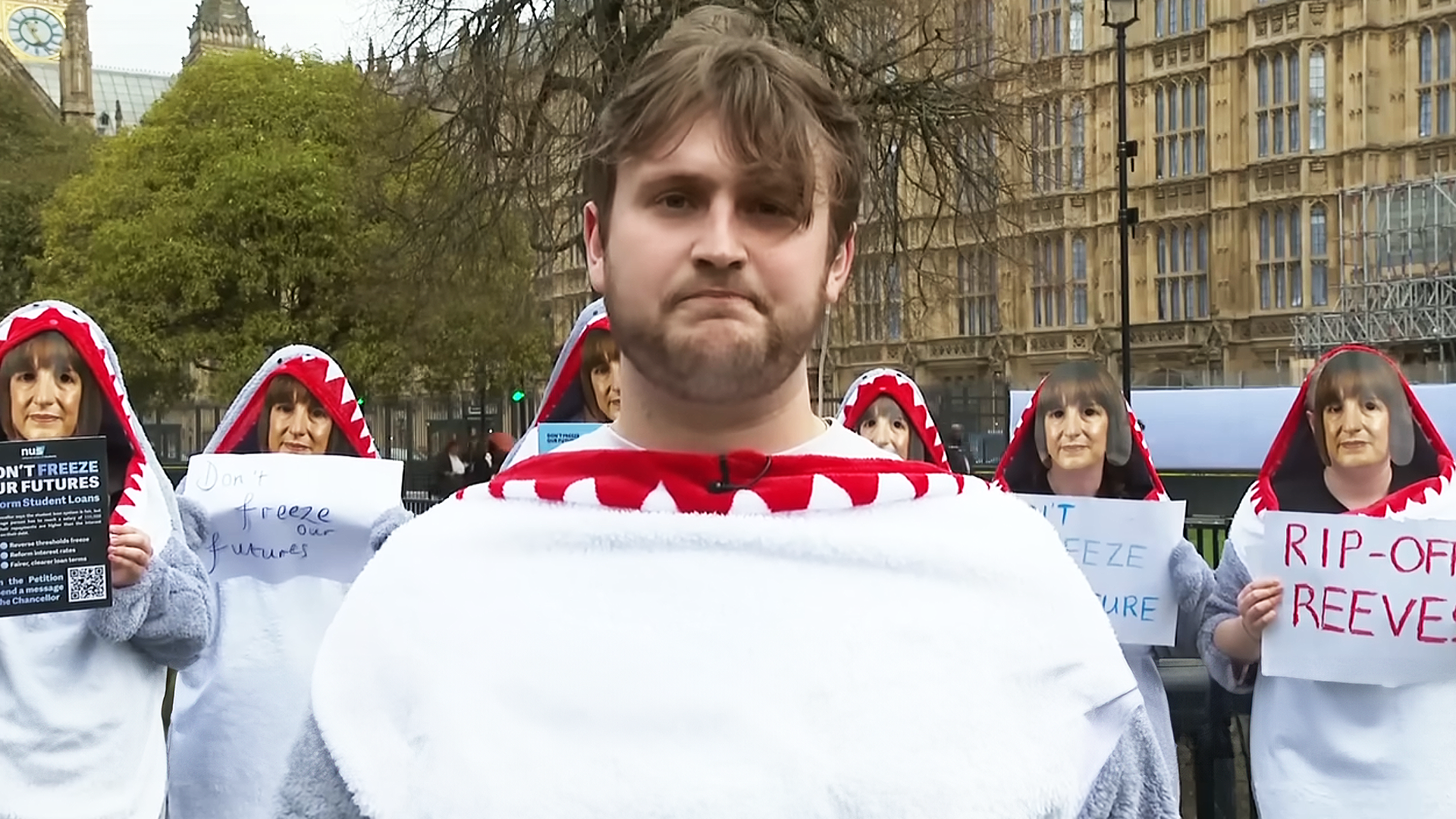
Last Wednesday she was greeted by a group of protesters in shark masks, who had gathered outside the House of Commons to push back on the student loans system. The shark masks represented loan sharks, and in the context of student finance, the comparison between the British government and unregulated money lenders has cropped up repeatedly.
Many of us, myself included, believe we were ‘mis sold’ by a ‘broken system’, which promised one thing at the time of purchase and has now ballooned beyond all recognition.
‘This is a generation who are already struggling to pay the bills, let alone have a conversation about taking out a mortgage or starting a family,’ says Alex Stanley, NUS vice-president for higher education.
My mother’s reassurance that monthly student loans payments would feel ‘much like a phone bill’ have proven rather misguided, given I’m now shelling out over £200 a month to cover my undergraduate and master’s degrees. While I may be earning the same, if not more than a colleague who didn’t go to university, and doing exactly the same job, I’m taking home a significantly smaller pay packet.
It sounds dramatic, but there’s no light at the end of the tunnel, either. Unless I win the lottery I’m unlikely to ever pay mine off, given how quickly it has grown. According to figures from the Student Loan Company, all higher education plans and loans amassed £15.2bn interest in the 2024-25 financial year.
That amounts to a rate of interest growth that exceeds £450 a second.