






 0 comments
The dramatic seizure of Venezuela’s president has raised a lot of questions, but how are people feeling on the ground?
When we witness something unprecedented, like the US capture of Nicolás Maduro (Venezuela’s president since 2013), it’s easy to get swept up in the media whirlwind. Algorithms and headlines shrink years of socio-political unrest into sizeable portions, and social media spotlights the polarised opinions of those with little to no knowledge of the subject.
Within this bloated landscape, the most important voices often get lost. Such has been the case this week, after Donald Trump oversaw a shocking invasion of Venezuela, seized Maduro and his wife, and brought them to the US to be charged in New York on drug offences.
Almost every international law expert, citing the UN Charter and the Security Council, has condemned the US attack as ‘a clear violation of international law’. Despite Trump’s claims that Maduro’s capture was carried out in the interests of the Venezuelan people, and that his motives are solely related to Maduro’s alleged drug offences, many suspect the South American country’s oil reserves have more to do with it.
In the days since, Trump has announced that the US will effectively ‘run’ Venezuela until a suitable transfer of power is achieved. This won’t, the president says, cost the American people a single cent – because Venezuela’s oil reserves (some of the world’s most valuable) will pay for everything.
Despite being one of the most oil-rich countries on earth, Venezuela has been riddled with financial problems and rapid economic downturn – particularly since Maduro took power in 2013. His regime has been condemned by many local people, who’ve suffered the consequences of his erratic leadership.
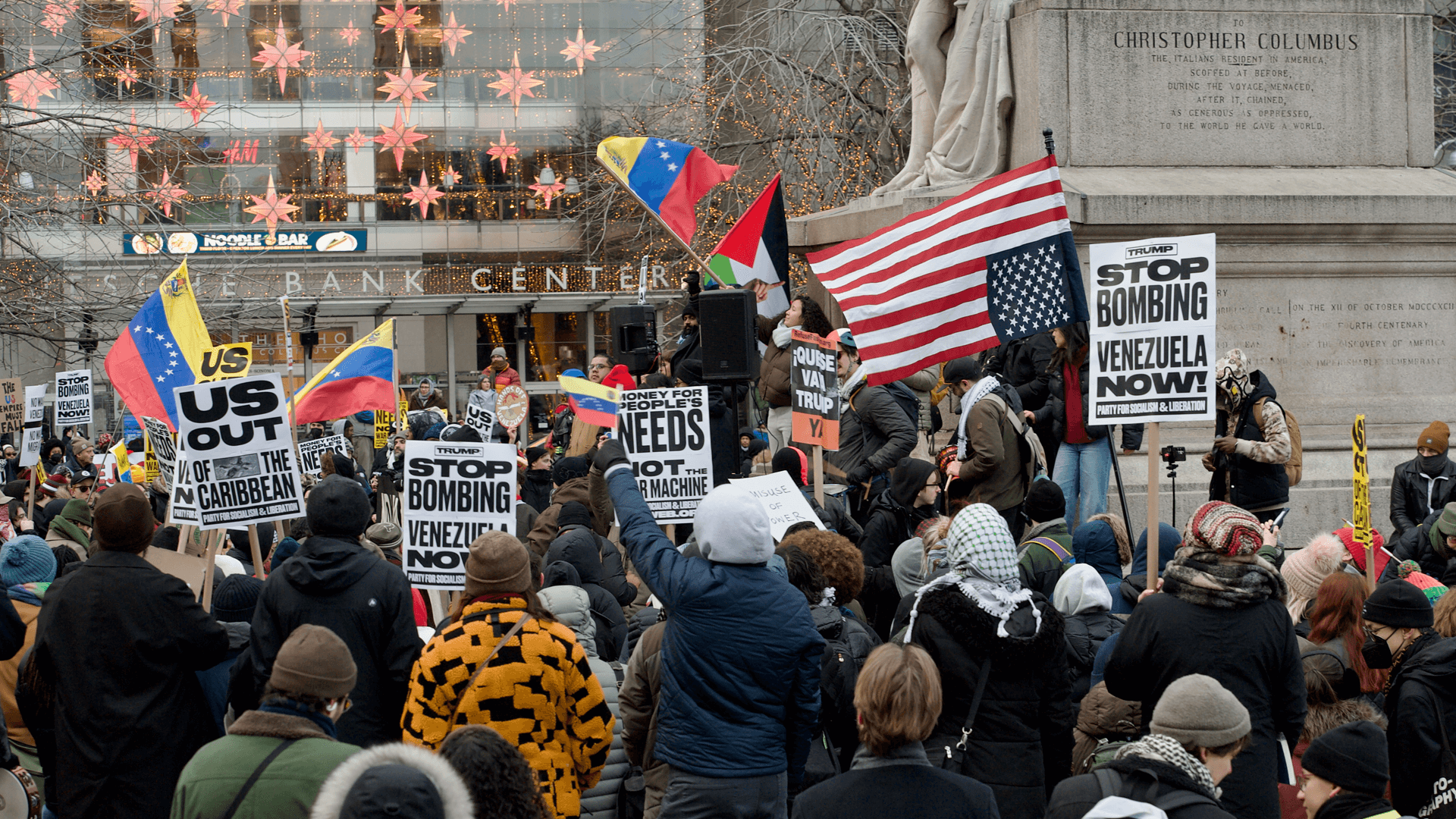
So, despite international concerns over Trump’s intervention – which thus far has no clear end goal and sets a terrifying precedent for other international powers to invade neighbouring nations at whim – many Venezuelans, both within and outside of the country, are celebrating.
Organisations like the International Trade Union Confederation (ITUC) and the Trade Union Confederation of the Americas (TUCA) have issued a joint statement condemning the US’ actions.
‘These acts in no way defend democracy; they are clear acts of aggression as part of a militarised foreign policy agenda motivated by unilateral economic interests,’ said ITUC General Secretary Luc Triangle. ‘Threats of kidnapping and the misuse of the courts to attack a sovereign government undermine the international rule of law and set a precedent of imperial coercion that jeopardises peace everywhere.’