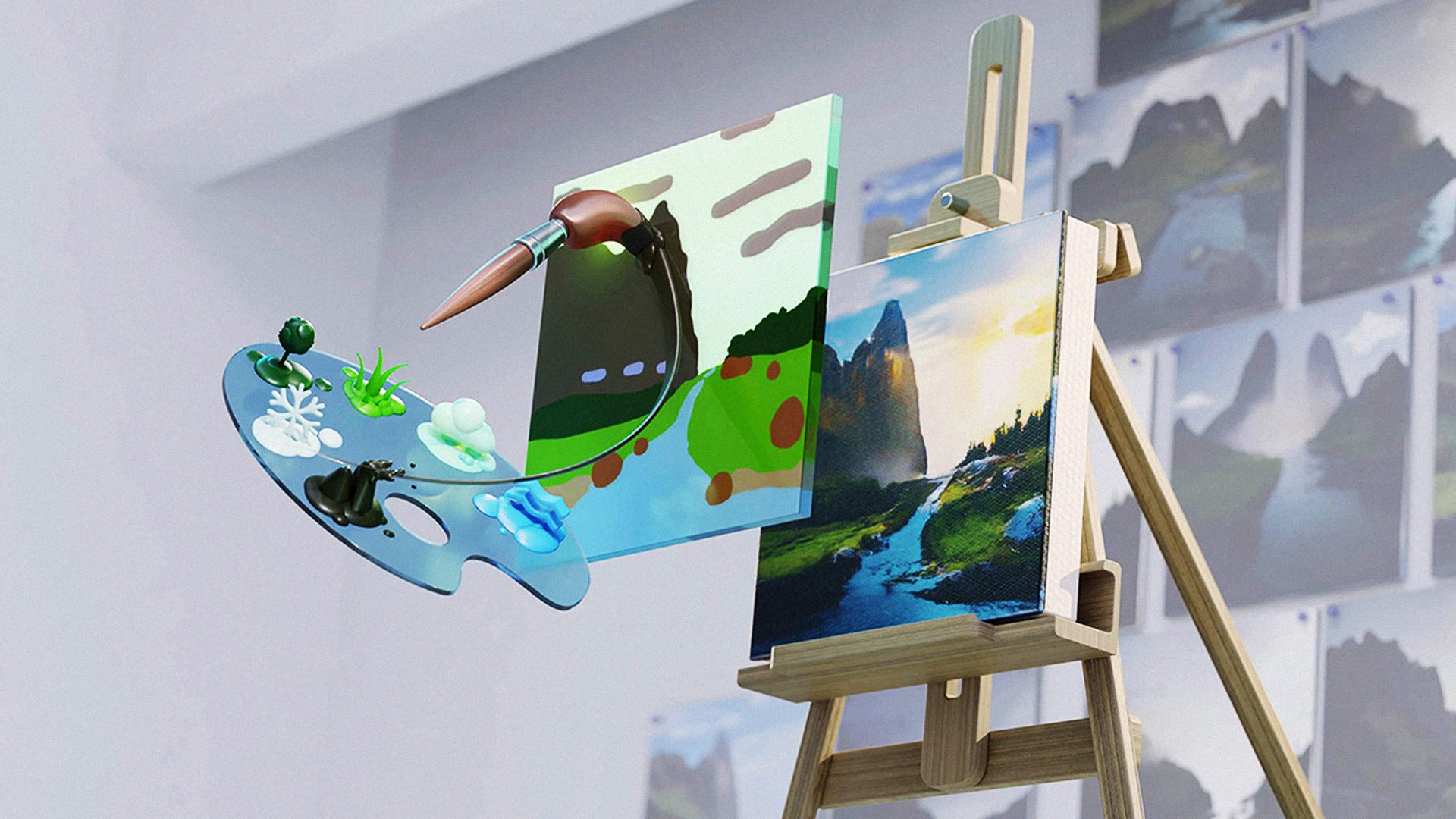
A new Nvidia AI tool called ‘Canvas’ allows users to create complex landscape art using a few doodled brush strokes, potentially changing the creative process for millions of artists.
Remember watching the special feature clips on animated movie DVDs in the noughties and noticing all of the cool concept artwork made by animators and artists?
If you didn’t understand that admittedly niche reference then you missed out on a childhood of artsy film directing ambitions – though Nvidia’s new Canvas app may be able to make anyone a concept artist.
The tech company just announced a new innovative tool for digital artists that can turn any primitive doodle into intricate landscape artwork in real time. The software uses complex AI to generate hillsides, grassland, mountain tops, and even water. Impressive stuff.
The tech is interesting enough on its own, but it may also have widespread ramifications for the industry moving forward, particularly for film and video game concept artists.
Allowing anyone to build original designs immediately and rapidly could open the door for indie studios, providing opportunities for lesser funded projects to gain traction.
First off, its probably worth asking what exactly the Canvas app is.
Using the company’s previously developed ‘GauGAN’ tech, the software is able to freely swap out basic brush strokes, blobs, and colour spots for detailed terrain and assets. Very basic drawings that wouldn’t look out of place on Paint in 2003 can suddenly turn into lifelike artwork.
The idea is to ‘let creators paint by material rather than colour’, according to Nvidia. The app works in real time, which means artists can make decisions quickly as to what works and what doesn’t, without the hassle of restarting or loading up previously saved versions.
You can also swap out materials and textures at whim, turning a snowy scene into a tropical jungle and vice versa. Handy for when you’re not quite sure what the aesthetic and vibe of your project is yet.
Nvidia mentions that it wants to help artists and creatives to find their footing at the beginning of a project. It describes those initial steps as a ‘daunting task when faced with a blank canvas’. AI could help to make creative leaps quicker than ever.
How could it change the industry?
While this may just seem like a quirky tool on the surface, arts and AI becoming ever more intertwined could radically change large industries and their processes in the future.
Making complex tools like this largely available and easy to understand opens the doors for smaller creators, novices, and smaller companies to make complex projects with minimum hassle or investment.
Using Canvas, a teenager could map out tons of concept art for an indie film from the convenience of their bedroom, which could not have been possible even five years ago. Its through these innovations that diversity and originality can thrive.
There are a few barriers to entry though, of course. You’ll need to be using a machine that’s running a Nvidia RTX GPU, which is not exactly dirt cheap – though the company has recently launched a variety of new laptops that are around the same price as a standard Mac.
It’s also helpful to have a basic understanding of graphics tablets and digital drawing, though anyone can now learn with YouTube tutorials and online courses if they have internet access.
Perhaps the bigger question is whether or not we should be concerned for AI’s steady intrusion on the arts – does computer-generated content within movies, games, and music diminish its credibility?
We’ve recently written about how deep fakes and artificial voices can have spooky effects on musicians thar are no longer alive, but it’s ultimately down to personal taste and interpretation.
In this instance it seems Canvas is simply a tool in a larger kit that can help to speed up already established creative processes, rather than fundamentally shift things from the ground up. At least for now.
Either way, it’ll be interesting to see how artists use this technology to their advantage – and where it could go next.
I’m Charlie (He/Him), Deputy Editor and Senior Writer at Thred. I was previously the Editor full time at Thred before moving to Bristol in 2024. As a music and gaming enthusiast, I’m a nerd for pop culture. You can find me curating playlists, designing article headline images, and sipping cider on a Thursday. Follow me on LinkedIn and drop me some ideas/feedback via email.
The NFL chose known Bad Bunny and Greenday to perform at the Superbowl, two artists who are vehemently outspoken against Trump. Facing immense backlash from right-wing conservatives, the NFL remains unbothered. It looks an awful lot like an active stance against the Trump administration.
On February 8th, Bad Bunny and Greenday will be gracing the stage at the NFL’s 60th Superbowl in Santa Clara, California.
Each year, over 100 million viewers...
From Meghan Markle comparisons to scathing ‘boy mum’ memes, why are we always so quick to assume that women are the problem?
I was on my way home from work when Brookyln Peltz-Beckham dropped a 700-word (yes, I checked) bomb of an Instagram story this week. Frantically refreshing my Wi-Fi connection at each tube stop, I was – along with the rest of the nation – caught in a cultural chokehold.
It’s no...
Jennifer Lawrence has consistently pushed back against the pressures of Hollywood and diet culture, yet it hasn’t been enough to stop the speculation and comments surrounding her body. Why are women put into different categories based solely on what they eat?
Jennifer Lawrence first starred in the Hunger Games film franchise back in 2012, playing the role of Katniss Everdeen, a poor, starving teenager living in a dystopian society.
Last...
The show is beloved nationwide, and has since spread overseas. But the experiences of Black contestants consistently mirror everyday life.
Are you affronted by the suggestion that The Traitors – arguably Britain’s most beloved TV show – has an unconscious bias problem? If yes, you’re probably ignorant to the ways in which racial bias constantly shapes society. By which I mean, you’re probably white.
You may think this claim ‘too woke’, or ‘overblown’....
We use cookies to ensure that we give you the best experience on our website. If you continue to use this site we will assume that you are happy with it.































 0 comments