






 0 comments
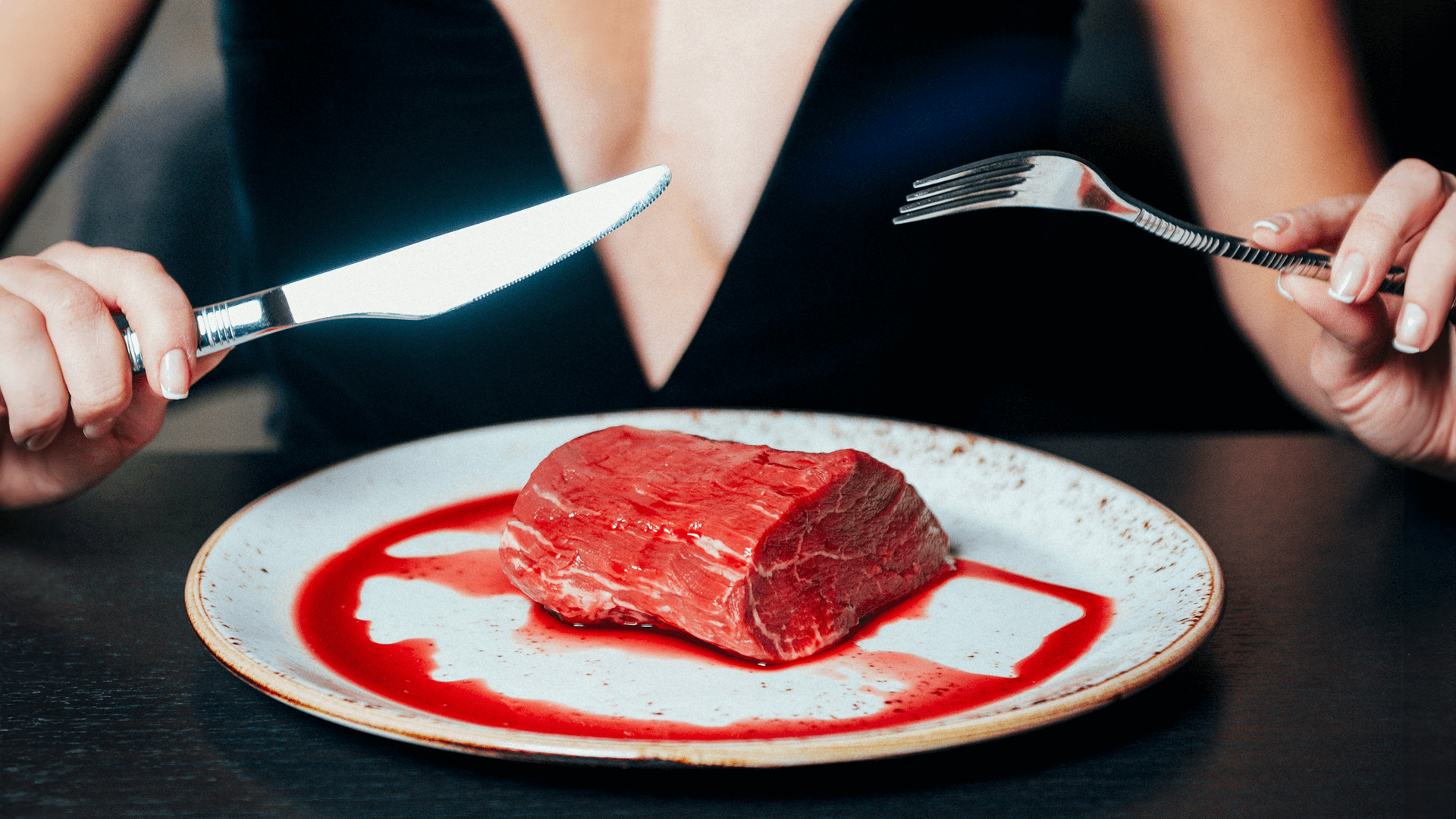
Women joining the carnivore trend might look like a rebellion against diet culture, but the motivations, the messaging, and the results people chase still fall along familiar gender lines.
In his New York Times piece about ‘the Men Who Eat Meat’, Steven Kurutz prefaces his exploration into the carnivorous diet trend by contrasting it with ‘Girl Dinner’.
In case you missed it, the internet trend involves women documenting themselves curating a low-effort, no-fuss dinner of minimal ingredients, rather than going through the domestic labour of preparing an entire meal.
Kurutz’ decision to invoke this trend in an article about men’s carnivorous consumption habits carries obvious gendered implications. Women eat very little, men eat almost entire animals within a week. Beware women, it’s no cook, no slaughter, or nothing.
Adverse to the diet culture that often frames women’s alimentary habits, men are encouraged to be bigger. They spearhead the protein movement. Men not only eat more on average, but they are praised for doing so.
To be a big man is to be more masculine, to take up the space you believe you are owed, even if that space does not extend to the kitchen where the meals you need are prepared.
Internet personalities like Paul Saladino, Brian Johnson (aka ‘Liver King’), and Ray Hicks (aka @carnivoreray) have been incredibly vocal online about what they promote as an ‘animal-based’ diet.
In particular, Saladino and Johnson insist on the health benefits of animals’ organs and meat, whilst also occasionally allowing themselves an accompaniment of honey and raw dairy products.
This is sometimes known as the ‘lion diet’, which is already doing a lot of work rhetorically. It is not just about food, it’s about identity.
The rhetoric around men’s meat consumption compared to women’s plays into disproportionate consumption more broadly. There are more female vegetarians in the world than male, and women on average put fewer products in their bodies and more on their faces than men do. That disparity is mirrored in the digital carnivorous sphere.
@kajsaamolund Girl dinner och myskväll med bästis @alvablomdahl 🍿🫶🏼 #tjejkväll #girldinner ♬ som original – Vbedit.x
Men outnumber women not only among the meat-mad content creators themselves, but also in their following. Perhaps it comes as no surprise that there are overt connections between carnivorous men communities and the manosphere.
Many of those who praise the benefits of the BBBE diet (beef, bacon, butter, and eggs) use the same channels to peddle gender essentialist propaganda.
The irony seems lost on many followers that so many of these men have ended up right back in the kitchen themselves.
In response to this branch of meat-fed masculinity, an alternative digital community of female meat-eaters has formed. They call themselves: The Women Carnivore Tribe.
The Facebook group, which has grown from 27,000 to 38,000 members since Kelly Anne Bonner first reported on it, is self-described as a ‘group for women only […] centered around following a carnivore diet for optimal health’. It is intended as a ‘resource’ for those ‘transitioning from a standard diet, moving from keto to carnivore, or [who] are a veteran carnivore’. The Tribe’s cover photo is, of course, a lioness standing proud.
According to Bonner, the group is inundated each day with memes, despite one policy explicitly prohibiting ‘memes or posts against the vegan community’. One, for instance, compares a withering vegan ‘Carbie’ alongside a pumped ‘Barbie’, flexing with tanned muscles and a plastic hunk of steak.
Other posts are more personal. Women turn to this online community for advice about symptoms such as hair loss or strange rashes, as well as unusual bowel movements, all in the name of “optimal health”.
Of course, even a seemingly monolithic slab of steak can be a multifaceted affair. This group of female carnivores is not the only place for carnivorous women to go. The usual social media apps also host countless women proselytising about how much thinner they are, how great their skin looks and feels, and why, for some reason, it is considered a plus to poop only once a week.