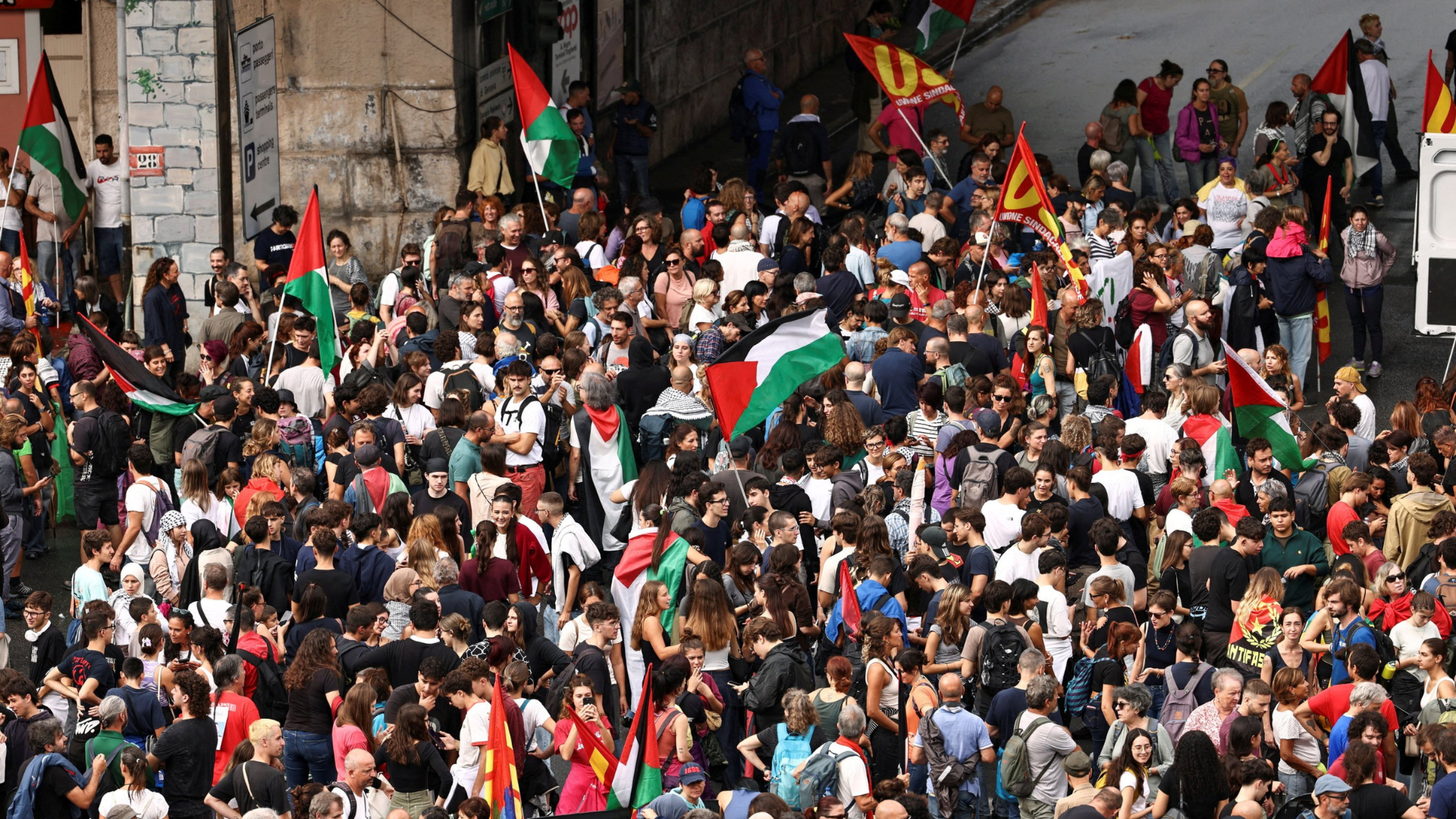
A second day of nationwide strikes has commenced in Italy, following organized walk-outs by the Italian Confederation of Labour on Sunday. The strikes have significantly disrupted travel, trade, and education sectors with the aim of showing solidarity with people in Gaza.
Schools, trains, shipping ports, and roads across Italy are facing major disruptions for a second day due to one of the largest European protests against Israel’s genocide in Gaza yet.
Italian grassroots organisations are responsible for sparking the nationwide movement, calling for a 24-hour general strike in both public and private sectors on Sunday to show solidarity with the people of Gaza.
Though the strike was only meant to last one day, protestors are continuing to build momentum to place pressure on their right-wing government to stop Israel from continuing its almost two year assault on the Gaza Strip.
The groups openly criticised the Italian government’s lack of action to stopping the humanitarian crisis unfolding in Gaza. It labelled the behaviour of Italian and EU governments an ‘inertia’.
In as many as 75 municipalities across the country, stretching from Milan to Palermo, thousands of students and working Italians took to the street waving Palestinian flags and chanting ‘free Palestine’.
Police in riot gear and using tear gas clashed with protesters around the central station in Milan, a Reuters witness reported, while Italian media said that demonstrators were trying to halt traffic on the motorway close to the city of Bologna.
Meanwhile, dockworkers in Livorno and Genoa blocked their ports over concerns that weapons destined for Israel were passing through their shipping posts.
Speaking to Reuters, a protestor from grassroots labour group Autonomous Port Workers’ Collective said, ‘The Palestinian people continue to give us yet another lesson in dignity and resistance. We learn from them and try to do our part.’
Italy’s oldest and largest trade union, the Italian Confederation of Labour (CGIL) staged walk-offs and sit-ins across multiple sectors on Sunday.
The Unione Sindacale di Base (USB), a smaller grassroots union with about 250,000 members, released a statement that said:
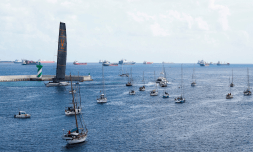
‘The strike is taking place in response to the ongoing genocide in the Gaza Strip, the blockade of humanitarian aid by the Israeli army and the threats against the international Global Sumud Flotilla mission.’
The statement continued, ‘USB also denounces the inertia of the Italian government and the European Union, which refuse to impose sanctions on the State of Israel and continue to maintain economic and institutional relations despite the gravity of the situation.’
The protests came as France and several other countries prepared to recognise Palestinian statehood at the UN general assembly on Monday. The UK, Australia, Portugal, and Canada already did so on Sunday.
But far, Italy has distanced itself from the moves of its European neighbours. The country’s right-wing Italian government of Prime Minister Giorgia Meloni is a long time supporter of Israel and has ruled out recognising a Palestinian state on several occasions.
Speaking to the Italian daily La Repubblica in late July, Meloni stated that she feels it could be counterproductive to recognise the state of Palestine before it was established.
‘If something that doesn’t exist is recognised on paper, the problem could appear to be solved when it isn’t,’ she said.
Though Meloni has repeatedly voiced concerns about Israel’s operations in Gaza, her far-right government has steered clear of taking a stance on the matter.
However, things could change in light of a recently published report from a United Nations commission of inquiry, which concluded that Israel has committed genocide against Palestinians in Gaza since October 2023.
The UN commission has asked for nations to stop supplying Israel with weapons, saying that states have a ‘legal obligation’ to do everything within their power ‘to stop the genocide in Gaza’.
However, since the UN commissions ruling, Israel’s bombardment of Gaza has not halted. In fact, it is escalating.
Over the past days and weeks, Israeli forces have been systematically demolishing major buildings, churches, and homes in Gaza, with 90 percent of infrastructure now damaged or completely destroyed.
Palestinians are being forced to flee from their homes over fears of being bombed where they live, though closed borders and the level of destruction means there is virtually nowhere for them to escape to.
Official numbers say that Israeli forces have killed more than 65,000 people and injured 160,000 more in Gaza since October 2023 – though independent investigations estimate the true death toll to be well past 600,000.
According to data collected by the independent violence-tracking organisation Acled, 15 of every 16 Palestinians killed by the Israeli military since March of this year have been civilians.
The UN commission’s ruling and recent recognition of a Palestinian state from some of the world’s most powerful nations offers only a glimmer of optimism amidst a worsening situation for Palestinians, as it places further pressure on international leaders to stop Israel’s genocidal actions in Gaza.
Deputy Editor & Content Partnership ManagerLondon, UK
I’m Jessica (She/Her). I’m the Deputy Editor & Content Partnership Manager at Thred. Originally from the island of Bermuda, I specialise in writing about ocean health and marine conservation, but you can also find me delving into pop culture, health and wellness, plus sustainability in the beauty and fashion industries. Follow me on Twitter, LinkedIn and drop me some ideas/feedback via email.
Alleged victims will be granted new measures including private entrances and waiting rooms, along with specialist ‘trauma-enforced training’ for court staff.
Andy Burnham has announced the rollout of new specialist rape courts in England and Wales, building on measures that are currently only available in limited locations.
At least one courtroom in every Crown Court will be dedicated to handling rape and cases involving serious sexual offences over the next...
From cutting student loans to stopping small boats, Reform UK used its 2026 conference to tell Britain what its first 100 days in government could look like. But behind the pledges, protests and political drama, what did the conference actually mean for Gen Z?
If there was one message Reform UK wanted people to leave Birmingham with, it was this: we are preparing for government.
Its 2026 annual conference at Birmingham’s...
The value of personal attractiveness is established much younger than you might think. But what does this mean for girls growing up in an image-obsessed era?
We check our appearance around 38 times per day. That pastime was once reserved for mirrors, and now extends to every reflective surface in our vicinity. Phone screens are the obvious preference – whether via their front-facing cameras or shiny black lock screens.
Social media...
Records that were long withheld by the city now reveal that the officials knew about Ground Zero’s toxic air in the years following 9/11 and chose to mislead the public.
On September 11th, 2001, Americans were initially met with confusion when the North tower was first hit. Minutes later, when the second plane struck the South Tower, that confusion quickly turned into fear.
While the collapse of both towers would reshape...
We use cookies to ensure that we give you the best experience on our website. If you continue to use this site we will assume that you are happy with it.






























 0 comments