Humans may have only made their first visit to the moon a little over fifty years ago, but by 2040 some of us could be living there. If building homes on the moon is successful, NASA says homes on Mars could be next.
Living on the moon might sound far-fetched, but the big brains at NASA aren’t being shy about their desire to give it a shot.
Discussions about long-term stays on the moon have been spilling out of the space company for years now, but this idea could soon become a reality thanks to novel technology and fresh partnerships with universities and other private companies.
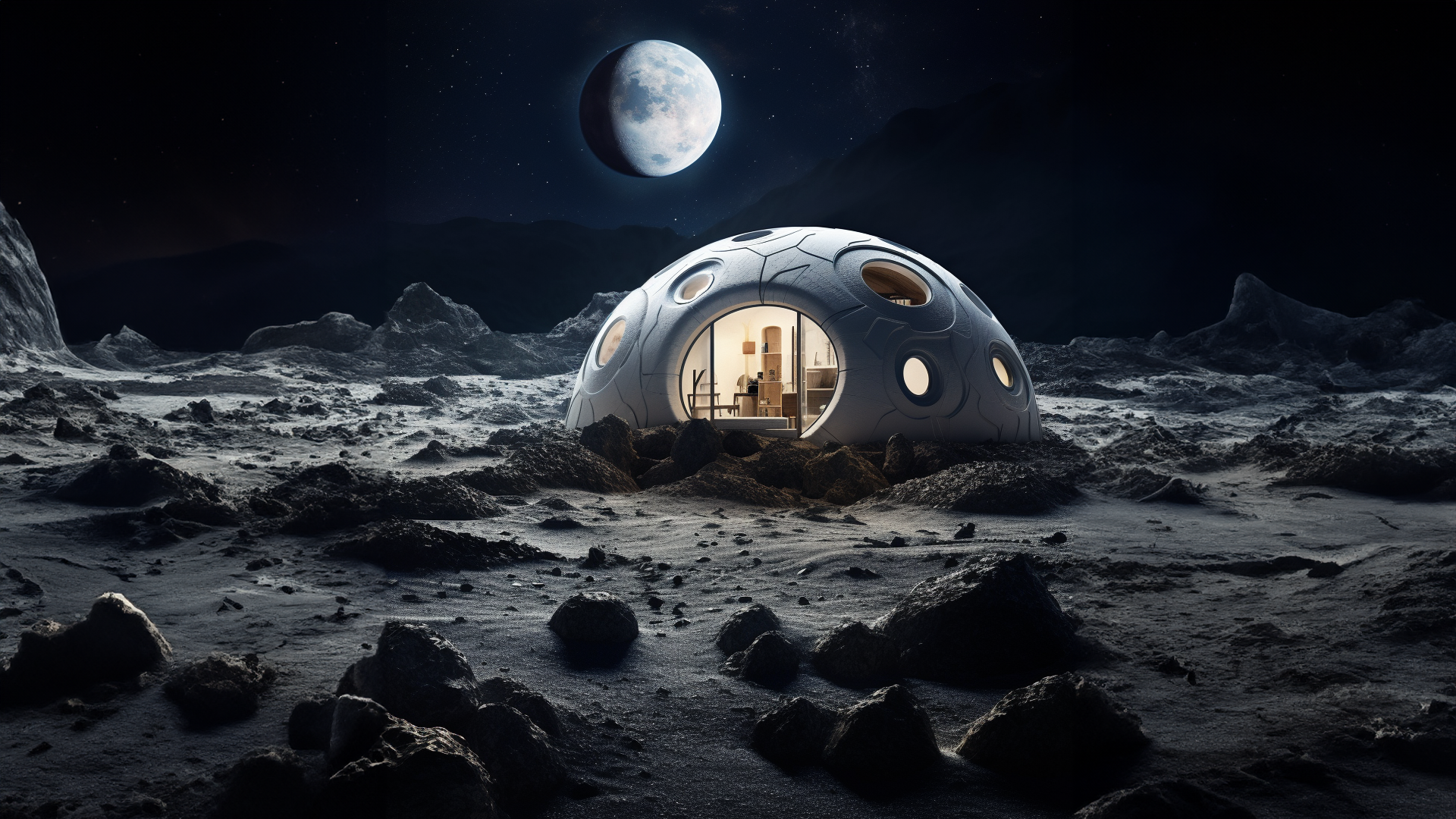
With the help of additional experts, NASA is planning on using 3D printers to build houses on our moon. If all goes to plan, their doors will not only be open to astronauts but to everyday people as well.
Though many scientists have called the timeline extremely ambitious, NASA says these homes could be built as early as 2040. If successful, the opportunity to live on Mars may not be far behind either.
Rather than pre-building homes on Earth and sending them into space, a 3D printer will be sent up to the moon via a rocket to complete the job there. The printer will be tasked with building housing structures in layers, using a specialised lunar concrete made with components of the moon’s surface.
The moon’s cratered surface is made up of mineral fragments, known as ‘rock chips’. Comprising of various-sized chunks, these rock chips are what make the surface of the moon extremely dusty and rugged.
The only problem is that when this dust is disturbed, it billows up into noxious clouds that are poisonous to humans when inhaled. The dust is also extremely abrasive and can cut like glass.
It sounds scary, but many scientists say that if it is used correctly, they believe that collecting the moon’s mineral dust and transforming it into concrete could be a key solution to living there.
That said, 3D printing in space will have its challenges.
Though the laws of chemistry are the same, there will be challenges related to physics. As a result, any equipment destined for the moon must undergo rigorous testing on Earth to ensure its ability to endure the harsh lunar environment.
This is where the Marshall Space Flight Centre comes in.
The centre boasts over a dozen testing chambers where various building components are subjected to radiation and thermal vacuum conditions mirroring those encountered in space.
In February 2024, its 3-D printer will undergo its first inaugural test within the largest of these chambers. NASA scientists are also working on developing a synthetic lunar concrete that can substitute for moon-made materials during the tests conducted on Earth.
In a laboratory at Marshall, researchers are experimenting with artificial moon dust that has been moulded into cylindrical shapes. These cylinders resemble concrete chunks that can fit in the palm of your hand and exhibit remarkable resilience when exposed to a plasma torch, withstanding temperatures of up to 3,400 degrees Fahrenheit.
This promising outcome gives scientists confidence that when they eventually work with actual lunar materials, the structures will perform well even in the face of searing temperatures caused by rocket landings.
Finally, we all know there’s no IKEA on the moon – and houses are far more than just walls and doors.
People living on the moon will require furnishings for seating and sleeping, and various other essentials to support their daily activities.
Jennifer Edmunson, the lead geologist at Marshall Space Flight Center is collaborating with universities and private enterprises to develop prototypes for space-friendly furniture and interior design.
Notably, NASA’s Ames Research Center has joined forces with Stanford University researchers to extract specific minerals from synthetic lunar soil. These minerals are then employed to create a range of coloured tiles, such as green, grey, and white, with potential applications extending to kitchens and bathrooms within space habitats.
It’s likely that all of this will require a lot of trial and error. But if all is successful, this could lay the foundation for eventually having entire neighbourhoods on the moon – or at the very least, a couple of Airbnb’s.
Eventually, a similar project could be extended and carried out on Mars – something NASA’s team says will be a goal to strive for in the near future.
Deputy Editor & Content Partnership ManagerLondon, UK
I’m Jessica (She/Her). I’m the Deputy Editor & Content Partnership Manager at Thred. Originally from the island of Bermuda, I specialise in writing about ocean health and marine conservation, but you can also find me delving into pop culture, health and wellness, plus sustainability in the beauty and fashion industries. Follow me on Twitter, LinkedIn and drop me some ideas/feedback via email.
With America’s space ambitions only continuing to grow, Trump is turning his focus to the industry’s workforce that could keep the US ahead of adversaries like China.
In both his terms in office, aside from immigration and anti-wokeness, President Donald Trump’s focus has increasingly turned towards the space front. In 2019, he established the US Space Force (USSF), emphasising the growing importance of space to national security.
But this interest...
People are flocking to the platform as online alternatives replace mainstream media. But Gen Z already knew that.
Which chat show host has the monopoly on late-night entertainment? Ask anyone under the age of 35 and they’ll tell you it's not a TV presenter, but a YouTuber.
Amelia Dimoldenberg, the mastermind behind breakout show Chicken Shop Date, has said her YouTube show is finally being taken seriously in the industry, as...
Ukrainian studio 4A Games has endured arguably the worst set of circumstances a game development cycle has ever seen. The war with Russia not only made work on Metro 2039 incredibly difficult, but also fundamentally changed the game the team wanted to make.
There’s something uniquely grim about developing a post-apocalyptic game while occasionally having to stop and hunker down because of real-life air-raid sirens.
That was the reality endured by...
After months of escalating concerns that AI music is flooding streaming platforms like Spotify, the Australian Recording Industry Association (ARIA) has said it will be banning any tracks that are not human-made from the charts.
The Australian Recording Industry Association (ARIA) has announced that songs made predominantly using AI tools are to be banned from the charts.
Starting immediately, all songs must be ‘substantially human-made’ to count in the chart listings....
We use cookies to ensure that we give you the best experience on our website. If you continue to use this site we will assume that you are happy with it.
































 0 comments