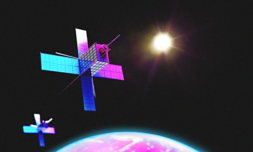
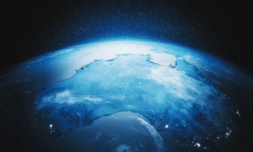
Researchers at MIT are advancing a concept to slow or potentially reverse climate change. It involves placing massive silicon bubbles at the direct point between the sun and our planet.
Admittedly, this concept is a little wacky, but when we hear that research in the field of solar geoengineering is advancing to help stop climate change… it’s something we’ve got to look into.
Last week, a group of scientists at MIT announced that they’ve successfully tested using ‘silicon bubbles’ in outer space conditions as a method for blocking the sun’s harmful radiation.
Once expanded in space, the bubbles would reach the size of Brazil and act as a buffer against the sun’s rays before they reach our planet – ultimately hindering the effects of climate change.
They argue that space-based solutions of this kind are a safer alternative to Earth-bound proposals because the latter pose serious risks to local living ecosystems. According to MIT’s website, deflecting just 1.8 percent of the sun’s radiation ‘could fully reverse today’s global warming.’
The idea was first proposed in 2006 by Roger Angel, an astronomer who suggested that a small spacecraft could deploy ‘thin reflective films’ that mimic clouds to shield our planet from the rays of the sun.
But MIT’s researchers have decided that instead, inflatable silicon bubbles would be better when placed at the L1 Lagrangian Point, the spot directly between the Earth and our strongest star.
Why this spot in particular? Well, this is where competing gravity from the sun and Earth cancels out. This gravitational suspension zone would allow the silicon bubbles to float without being pulled in either direction.
MIT’s researchers said that this should not be viewed as a fix-all solution for climate change and should instead be conducted in combination with other adaption and mitigation efforts.
And sure, giant silicon bubbles floating around our galaxy sounds mad, but it’s not the first and certainly won’t be the last time researchers suggest flinging stuff into space to hinder the sun’s power over our planet.
In 2021, Bill Gates provided financial backing to ‘sun-dimming technology’ that would reflect sunlight away from Earth’s atmosphere in order to create a cooling effect.
To achieve this, Harvard University scientists have been looking at spraying non-toxic calcium carbonate dust – a sun-reflecting aerosol – into our atmosphere which could theoretically offset the process of global heating.
It may have the backing of billionaires, but type of experimentation is not without debate. Long-standing controversy surrounding solar geoengineering has caused research in the field to slow over the last decade.
Those against it believe there the risks are too unpredictable, as interfering with the sun’s reach would likely result in extreme changes to current weather patterns.
Even natural volcanic eruptions have triggered severe weather abnormalities. For example, the 1815 eruption of Mount Tambora in Indonesia resulted in a ‘year without summer’ and the 1991 eruption of Mount Pinatubo in the Philippines created a global cooling effect of 0.5 degrees C.
On top of this, opponents to solar geoengineering note that if such project are carried out, incentives to halt global greenhouse gas emissions could risk being diminished. The potential fallout has led to scholars banding together to form an official Solar Geoengineering Non-Use Agreement.
In addition to the aforementioned arguments, it states that global governance systems are ‘unfit to develop and implement the far-reaching agreements needed to maintain fair, inclusive, and effective political control over solar geoengineering deployment,’ and ‘must therefore be banned.’
In line with this, it’s unclear whether the project co-signed by Bill Gates or MIT’s silicone bubbles will be given the go ahead, and they’ll certainly need to undergo numerous trials and ethical clearances before they can be deployed.
Until then, you tell us – does this sound too far-fetched or even dangerous to work?
Deputy Editor & Content Partnership ManagerLondon, UK
I’m Jessica (She/Her). I’m the Deputy Editor & Content Partnership Manager at Thred. Originally from the island of Bermuda, I specialise in writing about ocean health and marine conservation, but you can also find me delving into pop culture, health and wellness, plus sustainability in the beauty and fashion industries. Follow me on Twitter, LinkedIn and drop me some ideas/feedback via email.
A bizarre event saw thousands of supermarket fridges targeted and mountains of food wasted. But as cyber-attacks like these become more common, their destabilising power proves more insidious than silly.
When supermarket staff arrived early on Sunday morning to stock shelves across France, they found food cooking in the freezers. Some chiller cabinets had risen from as low as -27C to well over 50C, and one shop in Normandy reported...
Gamers have started mashing together different video games using AI tools. So far, we’ve seen Mario in Halo, Minecraft in Skyrim, and much more. Mind-bending results aside, the tech required to pull this off has some people worried about online security and digital infrastructure.
Ever wondered what Super Mario 64 would look like in Halo: Combat Evolved? How about Wii Sports in Silent Hill? Fancy a Minecraft session in the...
With Gen AI now capable of creating functional molecular structures, Google has come up with a new system to tackle imminent biosecurity risks that come with such innovations.
Before modern AI, much of computational biology focused on storing, searching, and comparing biological data. Public databases allowed scientists to check whether a newly identified sequence resembled something already known, but that was it.
However, this changed in 2020, when Google DeepMind unveiled...
With America’s space ambitions only continuing to grow, Trump is turning his focus to the industry’s workforce that could keep the US ahead of adversaries like China.
In both his terms in office, aside from immigration and anti-wokeness, President Donald Trump’s focus has increasingly turned towards the space front. In 2019, he established the US Space Force (USSF), emphasising the growing importance of space to national security.
But this interest...
We use cookies to ensure that we give you the best experience on our website. If you continue to use this site we will assume that you are happy with it.






























 0 comments