‘No laptops’ signs are appearing in coffee shops with increasing frequency, much to the dismay of individuals who want a place to work outside the office and home. Are bans on laptops in cafés justified, or are we about to lose yet another valuable third space?
Upon a recent visit to the newly opened coffee shop in my south London neighbourhood, I noticed a sign stuck to one of the walls. It read: ‘Yes, we have Wi-Fi…. but we like to talk to each other too!’
Though the sign was framed as encouraging community interaction, I figured it doubled as a way to discourage work-from-homers from coming in, ordering a single £3 coffee, and spending the entire day hunched over their laptop, hogging a table.
Glancing around as I waited for my takeaway coffee, I noticed the only other person in the café was, indeed, sitting at their laptop with an empty cup beside them. It seems a gentle approach to discouraging laptop use in public spaces isn’t always the most efficient.
Perhaps that’s why blatant ‘no laptop’ signs are becoming more commonplace inside coffee shops.
Even the coffee giant Starbucks, which basically doubled as a shared workspace over the last decade, has cracked down on ‘laptop lurkers,’ requiring customers to make regular purchases if they want to retain their table for longer stays.
Many café-goers have been outspokenly offended by these new rules, claiming that coffee shops are a cherished public space they go to when they want to be around others or when they need a change of scenery during work from home days.
Laptop use in cafés has been a point of conversation since the early 2010s. But with more of us looking for places to work outside of the traditional office space, the debate is only heating up further.
Are laptop bans in cafés justified? Or does banning technology in community cafés get dangerously close to revoking yet another one of our dwindling third spaces?
View on Threads
Cafés as third spaces
It’s true that we now have fewer ‘third spaces’ than ever.
Third spaces are local spots where we can go to hang out or bump into people we know, chat with (or eavesdrop on) strangers, and meet up with friends. Traditionally, they’ve been community centres, libraries, galleries, parks, pubs, and – you guessed it – coffee shops.
Local cafés aren’t really your classic third space (nine times out of ten, you’ll have to pay to be there), but they do provide a public domain where individuals who don’t know each other can co-exist within a space, potentially meeting and striking up a conversation.
However, the continued use of laptops and other technology including tablets and smartphones in these spaces make it unlikely that people are actually engaging meaningfully or at all with the people around them.
You’re hardly going to interrupt someone who is frowning over their twelfth e-mail of the day or shouting over the squeal of an espresso machine to be heard on their afternoon Zoom call.
The ‘cafés as essential third spaces’ argument pretty much falls apart when technology, especially work laptops, are brought into the equation because being engrossed in a screen is anti-social behaviour.
Although science says that some people’s focus and productivity improves while in coffeeshops, there are alternative (and perhaps more courteous) ways to experience this environment.
If you want to get the ambiance of being in a café, there are content creators on youtube who have cultivated this vibe for you. But if you – like me – find this a little weird and somewhat Black Mirror-ish, there is an alternative.
It’s called the library.
‘Why don’t people use libraries as their third space? Especially if they want to read…’ asks one reader of a Guardian article on the topic of laptop lurkers.
‘Ok so the coffee isn’t as good but it’s much cheaper and if you just want to sit for hours no one will bother you. There’s always people around and a good atmosphere, you can charge your device, no glares for taking up space when you finished your drink an hour ago…and if the coffee bothers you that much, buy a takeaway and take that into the library.’
This is an excellent suggestion, and one that many people should take in stride if they have a community library nearby.
That said, not everyone will have this option, considering the worrying closure of libraries due to lack of funding. In the UK alone, 190 libraries have closed in the last five years.
The owners’ choice
Café owners also have good reasons for banning laptops – especially in the case of laptop lurkers.
Laptop lurkers are people who visit local cafes to work, spending all day using the Wi-Fi and charging points, after purchasing just one coffee for £3-4.
They hold an entire table for themselves for long periods which, in smaller establishments, is problematic when new customers can’t find a space to sit. This is not just unfair, but detrimental to the income of a café.
Coffee shop owners have admitted that banning laptops was a financial choice. Monthly sales quotas need to be met in order for businesses to stay afloat, especially when they are independent or new cafés, and this is impossible when so many people wan
On top of the need to keep their business afloat, owners are hanging ‘laptop free’ signs in order to preserve the community vibe of their locations. They want their cafes to be social places where people can come together, have a chat, or at the very least spend time doing some reading.
In conclusion
Perhaps we can ought to strive for a happy medium.
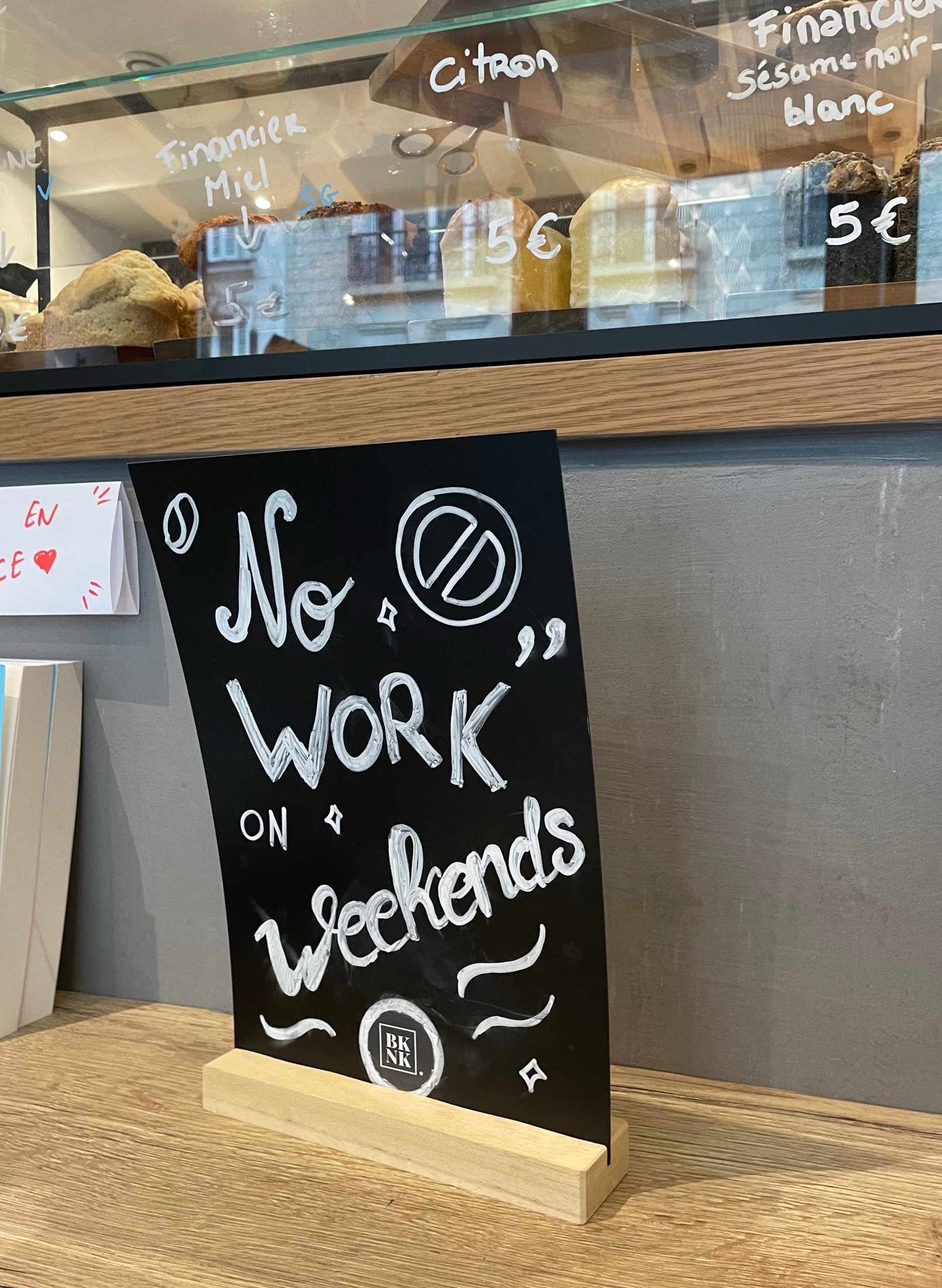
Some cafés, like one incredibly cute spot I visited in Paris, allow the use of computers and iPads on weekdays, but explicitly state that doing work in the café is prohibited during weekends.
Along with its ‘no work on weekends’ sign, it had an additional sign that requested customers to make a purchase of coffee, tea, or cake every 45 minutes, otherwise leave the café to free up your table for someone else.
This is only fair, especially for independent coffee houses, when rental prices aren’t cheap, profit margins are tight, and monthly quotas need to be met.
In fact, for many, being conscious of time and money spent inside a café when working or reading is considered common courtesy.
‘’I go to coffee shops to read. The presence of people around me, even when I am not actually “socializing” with them, is comforting… I always go to the coffee shops at “off peak hours” when there are empty tables, and I order pastry with my coffee, so the staff don’t feel that I am “freeloading.” And I don’t “overstay.” One hour only.’ reads a comment on an article about laptop lurkers.
It seems we could all take a more conscientious approach to our everyday habits. Maybe, then, complete bans on laptops won’t be necessary.
Deputy Editor & Content Partnership ManagerLondon, UK
I’m Jessica (She/Her). I’m the Deputy Editor & Content Partnership Manager at Thred. Originally from the island of Bermuda, I specialise in writing about ocean health and marine conservation, but you can also find me delving into pop culture, health and wellness, plus sustainability in the beauty and fashion industries. Follow me on Twitter, LinkedIn and drop me some ideas/feedback via email.
Widespread protests against the B.J.P have led to lockdowns and arrests, as Modi’s government threatens to upend voter rights.
Nahendra Modi’s Bharatiya Janata Party (B.J.P) have courted an unprecedented backlash for the past several months.
The Indian government is no stranger to public protest, but this most recent wave of demonstration stands apart for its cross-sectionality. In a nation with such a deeply entrenched caste-system, that these protests defy social and...
As in many parts of the world, Africa’s Gen Z faces uncertain starting salaries and rising living costs, making moving out of the family home increasingly difficult.
For young Africans, the question of whether their first salary will be enough to live independently often comes down to how much remains after paying rent.
Living alone offers freedom. It means having privacy, managing your own schedule, and inviting friends over without needing...
Students, teachers, and parents have taken to the street to protest France’s crippling education infrastructure. However, as the movement started to gain nationwide traction, so did violence, driven by clashes with the riot police.
These past few weeks have seen intense waves of violence associated with student-led protests in France. What started as a local walkout by teachers at a high school in Créteil quickly turned into a nationwide...
After surviving two doses of a drug intended to kill her, Christa Pike is at the centre of a high-profile legal battle that’s shone fresh light on the absurdity of humane execution.
Last week, Christa Pike survived an attempt on her life. Now doctors at the Tennessee hospital where she’s being held are working tirelessly to save her. Reports state Pike is ‘angry and confused’ about what happened to her,...
We use cookies to ensure that we give you the best experience on our website. If you continue to use this site we will assume that you are happy with it.































 0 comments