0 comments
Between a Nara Smith rebrand and a New York Times bestselling novel, it seems the glory days of tradwifery are behind us.
Nara Smith is best known for her scratch cooking videos. Or maybe it’s the extravagant couture she wears while cooking. No wait, it’s her famous model husband Lucky Blue Smith (once tumblr’s ultimate it-boy). Ah! Got it. It’s the weird and wonderful names of her children: Whimsy Lou, Slim Easy, Rumble Honey and Fawnie Golden. Cut that. It’s all of the above.
Suffice it to say, Smith has cultivated a niche but instantly recognisable online presence, one that has catapulted her to global fame and made her arguably more recognisable than her aforementioned (very famous) husband. But with great power comes great responsibility. While her success has whipped up a beautifully renovated mansion and sure-to-sell-out cookbook, Smith has been subject to a hefty helping of criticism – much of which has centered on her supposed promotion of the ‘tradwife’ lifestyle.
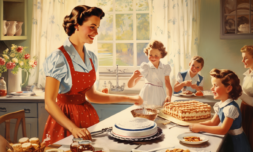
For the uninitiated, a tradwife is a woman who embraces a supposedly traditional model of marriage and family life, generally involving staying at home, looking after children and letting her husband go out and earn the money. On the internet, however, the term has become less about the practicalities and more about the aesthetic. Think homemade bread, gingham dresses, immaculate kitchens and a lot of butter churning.
Smith became one of its most recognisable faces, alongside Ballerina Farm’s Hannah Neeleman. Both women appeared to offer an extraordinarily polished version of domesticity at a moment when the rest of us were struggling to keep a basil plant alive. Their content was aspirational, but it was also political by implication. It served up a vision of womanhood in which the home was not a burden but a lifestyle.
Neeleman and Smith have hardly embraced this label with open arms, but they’ve never outright rejected it either, lucrative as it’s proven for their personal brands. But there’s been a notated shift in the tradwife universe lately, and it comes off the back of a sellout novel. I’d imagine Yesteryear by Caro Claire Burke pricked the ears of every American publisher when it was first pitched. Burke’s pageturner honed in the tradwife image when it was at its viral height. And it paid off. It quickly became one of the bestselling books of the year.
Yesteryear was also a deathknell for its source material. The plot follows an impressionable young woman yearning for the ostensible simplicity of a ‘traditional’ domestic life, only to find herself trapped in the year 1855 and forced to live its reality.
Since Yesteryear lined tote bags and TikTok reviews, the bastions of tradwife life – Smith and Neeleman – have made a marked pivot. Neeleman has emphasised that she is the CEO of Ballerina Farm, not just a basket swinging mother.
Smith recently went on the Call Her Daddy podcast to explain that she is not a tradwife either. She describes herself instead as an ambitious, hardworking businesswoman whose cooking began as a hobby and became a career. She says she and husband Lucky split parenting 50/50, that they have help at home and that she has never prioritised being a homemaker.
But the problem with the tradwife label has never been whether Nara Smith personally believes women belong in the kitchen. It’s that she’s helped make the kitchen look like a very compelling place to be. As Claire Burke points out on her podcast Diabolical Lies, Smith and Neeleman’s recent insistence that they are businesswomen creates something of a discursive dead end. The accusation that they are tradwives is answered with the declaration that being a tradwife is, in fact, their job.
There is nothing inherently wrong with a woman loving to cook, raising four children, wearing a pretty dress or wanting to stay home. There is also nothing inherently radical about doing all of those things while running a business. The more interesting question is what happens when a highly produced version of domestic life is presented without the infrastructure that makes it possible.
Smith and Neelesen both present a very specific portion of their daily lives, and one that positions itself in the whimsically, polished ideal of ‘traditional’ domesticity. I’m sure they each have busy schedules beyond this, but that’s not what they’re choosing to show their audience.
I’d argue that the juggle is considerably more interesting than the fantasy of effortless domesticity. This matters because most women do not have the choices Smith describes. Childcare is expensive, women’s labour remains undervalued, and the idea that women can be both mothers and ambitious professionals is still treated as a logistical puzzle rather than a basic expectation forced upon them by modern life.
In her 1976 book Of Woman Born, Adrienne Rich distinguished between the experience of motherhood and the institution of motherhood: between the personal relationship a woman has with her children and the social structures and expectations imposed upon her because she is a mother. Forty years later, we’re still trying to work out where one ends and the other begins.