0 comments
With America’s space ambitions only continuing to grow, Trump is turning his focus to the industry’s workforce that could keep the US ahead of adversaries like China.
In both his terms in office, aside from immigration and anti-wokeness, President Donald Trump’s focus has increasingly turned towards the space front. In 2019, he established the US Space Force (USSF), emphasising the growing importance of space to national security.
But this interest has gone far beyond the military. As we have seen in the past few years the nation’s space industry is going through a significant boom. There is unprecedented commercial growth, with companies such as SpaceX taking on an increasingly important role in the privatisation and expansion of the sector.
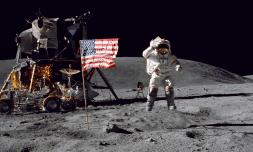
NASA’s priorities are also shifting away from its long-standing focus on the International Space Station, with a greater emphasis now being placed on returning to the Moon and eventually reaching Mars. These ambitions have seen a rise in public-private partnerships, with SpaceX and Blue Origin actively developing infrastructure to support NASA’s plans.
And while China’s rapid advancements are undoubtedly driving much of this renewed competition, there is one major problem: manpower.
With this in mind, just days ago, Trump signed an order proposing the creation of a landmark Space Academy.
While the exact structure of the academy is yet to be determined, its proposed design is what sets it apart. Rather than being exclusively military in nature, the academy is envisioned as a NASA-led federal institution with a hybrid military and civilian focus.
Its overall aim would be to train the next generation of personnel for the USSF, NASA, and the growing commercial space industry. For now, however, the academy remains in its early planning stages, with the launch of a 120-day advisory commission.
Chaired by Jared Isaacman, NASA’s administrator, the panel is expected to present the final framework for the academy by the end of the year. This includes the offered curriculum, degree programs, and graduate service obligations.
However, because it is still a federal academy, the funding and construction of the institution will require official approval from Congress.
Currently, the future of American space exploration requires diverse minds from various fields. This includes a huge range including aerospace engineers, mission operators, scientists, and even military personnel.
So, if universities across the country are already offering degrees in space-related disciplines, why is this academy necessary to increasing manpower?
America cannot afford to come in second to China in the race back to the Moon.
Chairman @RepBrianBabin made it clear: the United States and our partners must lead the next era of space exploration. pic.twitter.com/XJuo4V6DBC
— House Science Committee (@housescience) September 1, 2026
This is where things get interesting because the answer lies less in how the academy teaches, and more in how that education is brought together. Rather than functioning as another conventional university, the academy is proposed to create a direct pathway between education, federal service, and the commercial space sector.
In doing so, this could help bridge the gap between the nation’s existing academic programs, as well as the organisations driving its space ambitions.
Despite this academy sounding like a dream for its space programs, its establishment has also gained criticism. For one, its hybrid military-civilian nature could end up blurring the lines between national security and scientific exploration.
I mean, imagine an institution where missile defence and military space capabilities are developed alongside civilian lunar and planetary research. There may end up being a clear conflict of interest in the pursuit of space.
Additionally, there is also the concern of cost. For context, the USSF itself is requesting around $70 billion for the next fiscal year (more than double the budget of FY2026). If that’s the case, it would be beyond one’s imagination to understand just how much it would take to set up and maintain a space academy.
Thus, critics have instead suggested that the required sum be re-invested into the current system such as strengthening existing university programs, and creating more pathways into NASA, the USSF, and private companies.