LinkedIn influencers are telling us all to grind harder and be better. Meanwhile, companies are masking toxic work culture with free fruit and ping pong tables. Has the rise of the LinkedIn influencer tricked us all into accepting sub-par working conditions?
We’ve all seen that meme poking fun at LinkedIn influencers.
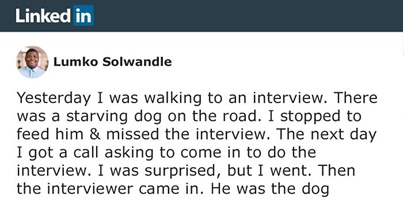
A LinkedIn user satirises the oh-so deep and meaningful content that seems to dominate everyone’s feed, telling the story of missing a job interview to help a starving dog and subsequently being interviewed by said dog.
This viral meme perfectly encapsulates the rise of the LinkedIn influencer.
The premise of LinkedIn is actually a great one. We’re all working more and more online and ‘networking’ has always been a tricky concept.
Your socioeconomic status and background have a big impact on the types of people you’re able to connect with in the outside world. LinkedIn provides all of its users with the opportunity to virtually network with people and aid their professional development.
However, it seems that no social network is safe from the circulation of inspirational content that constantly pushes its audience to become better.
LinkedIn is no exception. The site is filled with daily posts that encourage people to be more productive, more hard-working, and to give 100% all day, every day.
The narrative that dominates LinkedIn posts like these is a pretty conservative one. It promotes the idea that regardless of your gender, race, or socioeconomic status, you can be successful if you just try hard enough. Something we’ve been hearing a lot lately, thanks to Kim. K herself.
This way of thinking, especially in a post-pandemic world, is flawed. The gender pay gap exists. The ethnicity pay gap exists. We’re also dealing with a massive mental health crisis as a result of the pandemic.
While it’s great to have goals and aspirations, there comes a point when this attitude becomes toxic.
https://www.youtube.com/watch?v=sei8eaau_Go
The kind of toxic positivity that is often promoted on LinkedIn can have a big impact on company culture.
We’re all going through a lot right now. The world is still recovering from the pandemic and dealing with its after-effects, including job insecurity, loneliness and the struggle to maintain a work-life balance while working from home.
Companies should be recognising their employees as individuals with a range of human emotions rather than pushing them to always be better and give their all. Giving your all can often mean that you’re left with nothing.
Working culture matters
The rise of start-up culture in recent years has seen companies becoming more fast-paced and often emphasising quantity over quality.
Young people working in rapidly growing companies are forced to constantly adapt and produce at an almost impossible rate. Productivity and smashing targets are celebrated above all else and working with speed is not only encouraged but expected.
Companies with young founders and a young workforce mean that the world of work has changed. It’s no longer the norm to wear a suit to work and the option to work from home has become standard.
While more relaxed and flexible working environments are great, could it be that companies are trying to pull the wool over the eyes of their employees?
In a post entitled ‘5 Red Flags That Suggest You’re Working For A Toxic Start-up’, Refinery29 draws attention to the sinister habit of start-ups referring to employees as ‘family’, stating that “Businesses can harness emotional attachments to the brand and induce guilt from their workers by distorting values like identity, worth, and love, with productivity.”
Furthermore, recruiters are now luring people in with free beer, PlayStations in the office and team building days in escape rooms. Benefits such as these seem to suggest a fun and exciting working culture but the day-to-day reality is often very different.
With companies pressuring their employees to meet unrealistic targets and LinkedIn influencers telling us all to try harder, where does that leave Gen-Z when it comes to seeking out a healthy working environment?
Know your professional worth
Young people in the workplace are often poked fun at for being too demanding and lazy. However, what comes across to older generations as entitled, is actually the young workforce refusing to live to work.
Gen-Z is a socially conscious generation and consistently makes a point of standing up for what they believe in. From climate change to trans rights, fighting for the right cause should also happen in the workplace.
Being part of the younger generation has so many advantages. We’re arguably more tech-savvy, open-minded and forward-thinking than the generations before us. It’s therefore crucial, that we know our professional worth. That means not being swayed by the voice of the LinkedIn influencer or the recruiter promising free pizza in the office on Fridays.
Hi! I’m Molly (She/Her), a writer at Thred. I’m originally from the UK but have been galivanting around Europe for the past seven years. I’m currently based in Vienna, Austria. I love to read and write about feminism, culture, and society. My main interests are books, bread, and hanging out with my Hungarian cat, Zsuzsi. Connect with me on LinkedIn and feel free to drop me an email.
The new judge is dismantling diet culture with big bites and no nonsense. We need more of this on TV, now more than ever.
I’ve always loved Nigella Lawson. I’m a fellow foodie, I’m a writer – which means I’ve devoured her written recipes as fervently as the dishes themselves – and I’m also a woman. Nigella has always represented the essence of womanhood in my eyes. She’s confident and unapologetic...
Gen Z subscribes to everything from music and films to software and storage, paying endlessly for things we never actually own. As ownership is increasingly replaced by access, are subscriptions making life more convenient - or creating a generation that pays forever and owns nothing?
There was once a revolutionary economic model called buying something.
You handed over money, gold, or whatever the currency was. Someone gave you the purchased item....
Recruiters are debating on TikTok whether it’s okay to bring iced coffee into a job interview, highlighting discrepancies in professional standards between different generations and industries.
Would you bring iced coffee into a job interview?
A debate has been underway on social media this week as Gen Zers and older professionals consider whether it’s ‘inappropriate’ or an unnecessary restriction that makes new, potential employees uneasy.
It began when TikToker @caitlinrecruiter uploaded...
From Substack to explainer TikToks, everyone’s craving thought-provoking content. But is our hankering for brain food a reaction to AI or evidence of a deeper desire for fulfillment in the modern age?
What is a ‘thinkfluencer’? Consider them the talking head in your pocket: a bastion of knowledge on often niche topics, sharing facts and figures with the help of a teeny tiny handheld mic. These types of influencers have...
We use cookies to ensure that we give you the best experience on our website. If you continue to use this site we will assume that you are happy with it.






























 0 comments